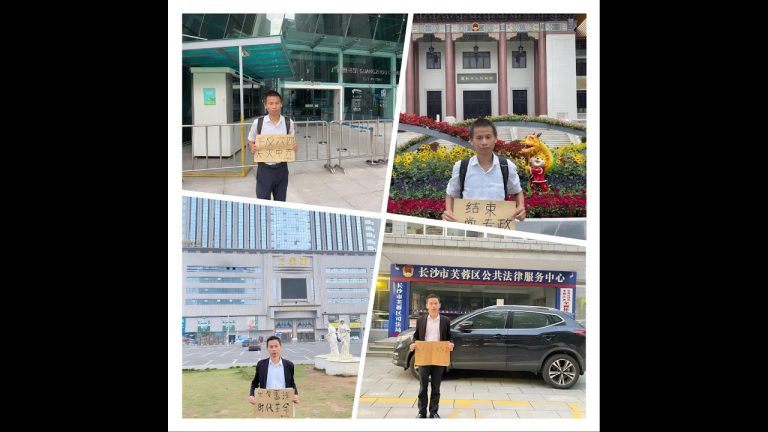
Los Angeles, July 27 – Support Human Rights Lawyer Xie Yang
Event Theme: Supporting Human Rights Lawyer Xie Yang
Event Time: July 27, 2025, 12:00 PM – 3:00 PM
Event Location: Chinese Communist Consulate, Los Angeles
Organizer: Yuan Zegang Coordinator: Hua Zhaosong
After more than a dozen postponements, the case of Xie Yang is finally going to trial. The pretrial meeting is scheduled for July 28. As this is a case of persecution, the one on trial is innocent, and the ones conducting the trial are guilty. Whether it’s a pretrial meeting or a public hearing, each occasion serves a vital purpose: affirming the lawyers, praising the defendants, judging those in power, and placing the judiciary itself on trial.
In the criminal proceedings against the 709 lawyers, every single procedural step constitutes a massive revelation and condemnation of the CCP’s crimes.
Once a criminal case has entered the judicial process, they cannot avoid the stage of holding a public trial.
Igniting the Flame of Freedom Under the Iron Curtain
— An Exclusive Interview with Mao Qingxiang
Written by: Editorial Team of The Opposition Party – Lu Qiankun
Edited by: Feng Reng Chief Editor: Huiwen Lu Translator: Lu Huiwen
Introduction:What does it mean to run a magazine in a country where free publishing is banned?
Mao Qingxiang, a senior from Zhejiang, is perhaps one of the earliest practitioners of China’s contemporary “underground publishing” movement. From his political awakening during the April 5th Movement to three imprisonments in the 1990s, he has spent his life using a faint but unwavering voice to challenge authoritarian power. When he founded The Opposition Party magazine, China had yet to lift its ban on press freedom, and free speech was nonexistent. Yet, he stubbornly mimeographed magazines on the streets, organized writing groups, and even in prison, continued writing poems, conducting research, and defending his dignity—insisting on keeping a buzz cut instead of a shaved head.
In 2025, The Opposition Party was revived. Still in China, Mao Qingxiang was once again summonedby the police for “tea,” but he continued to speak with us in this interview, steadfastly guarding the flame of freedom that has long been lit.
Interview: Independent Will Under Tyranny
Reporter: Some speculate that you were behind this revival of The Opposition Party. What’s your take?
Mao Qingxiang: The local police station asked if I was the one behind it. I said: it has nothing to do with me. What the magazine said is actually a recognition of me—an honor. They’re putting me on a pedestal, but I don’t have such abilities. How could I operate anything from inside the country? You’re all watching me all the time… They’re collecting evidence against me, ready to arrest me anytime.
Reporter:When did your political awakening begin?
Mao Qingxiang: During the April 5th Movement. That was the first time Chinese people took to the streets against dictatorship and authoritarianism. I wrote a poem mourning Zhou Enlai. I didn’t go to Beijing, but in Hangzhou I helped organize protests, wrote big-character posters, gave speeches—the movement was strong.
Reporter: What was the original intention behind founding The Opposition Party magazine? And how did you come up with the name?
Mao Qingxiang: I named it. Three key words: oversight, opposition, checks and balances. At the time, we hoped China could truly transition to a multi-party system, not just have “flower vase parties.” We were not mouthpieces of the CCP. What we wanted was a platform to speak out—to let the people know they’re not alone. After publishing nine issues in China, I was imprisoned. Later, Nie Minzhi, Chen Shuqing, and Wang Rongqing took over and published two more issues—they were also arrested. That’s when it stopped.
Reporter: Was there anything during the magazine’s distribution that moved you deeply?
Mao Qingxiang: After the magazine was distributed, a reader came to me with bedding, books, and luggage, saying he wanted to join the Democracy Party and fight with us. I was very moved. He said: “I’ve seen thelight of freedom.” At that moment, I knew we were doing the right thing.
Reporter: We heard you were imprisoned three times. During your third sentence at Linping No. 2 Prison in Zhejiang, was there anything unforgettable?
Mao Qingxiang: When I first got in, they assigned me to do military machine tool work. I couldn’t finish the tasks, and the team leader threatened to “use methods.” During family visits, I would tell my wife everything. At the time, Voice of America and Radio Free Asia called her every month, and she would tell them I was being forced into labor. The police told her she was “spreading rumors.” She said: “Go investigate. If it’s false, I’ll take responsibility.” Eventually, our landline was dismantled, and I lost contact with the outside world.
Reporter: You didn’t give up studying in prison either?
Mao Qingxiang: Correct. I earned an associate degree in Chinese Language and Literature, and also a Level-3 cooking certificate. Every time I cooked, I got to eat my own food—what a treat. Once I refused to shave my head bald and argued that prison regulations called for humane haircuts. I paid the barber 10 yuan of my food allowance each time so he wouldn’t shave me bald. The squad leader wasn’t happy, but I used the human rights rule to argue my case. I stuck to it and prevailed.
Reporter: Did anyone try to persuade you to admit guilt in exchange for a reduced sentence?
Mao Qingxiang: In my sixth year in prison, the warden said I had over 200 merit points and could get a sentence reduction—if I confessed. I refused. I served the full eight-year sentence.
[Photo caption]
On July 16, 2025, Lü Gengsong (left) was just released from prison. His first visit was to see Zou Wei’s mother (center), accompanied by Mao Qingxiang (right).
Reporter: What is life like for you after release?
Mao Qingxiang: I’m living in Huzhou now. On July 17, I was detained at the police station for 24 hours. The state security police drove me to Hangzhou for interrogation. They won’t issue me a passport—I can’t leave the country. My WeChat and phone calls are all monitored. Holding people accountable retroactively is their usual tactic.
Reporter: Have you met with Lü Gengsong, who was just released?
Mao Qingxiang: Yes, I’ve met with my old comrade. He’s still recovering, since he’s been out of touch with society for so long. But I believe he’ll soon be communicating with everyone again.
Reporter: What do you think of The Opposition Party’s revival today?
Mao Qingxiang: It’s a great thing that you can revive it. I can’t do anything from inside the country now, but I’m happy that you can carry it on. I’ve never regretted founding The Opposition Party. As long as someone is still willing to speak out, the flame of freedom will not die.
Epilogue: The Opposition Spirit—An Unextinguished Flame
Mao Qingxiang once said, “I’m not a hero; I just speak on behalf of the common people.” This sentence encapsulates his decades of persistence. He never left China, yet has always lived under risk and surveillance. Though he cannot speak loudly, he responds to history’s call through his actions.
The revival of The Opposition Party is not only a commemoration but also a continuation of the “opposition spirit” into the future. This spirit means refusing to dance with power, always standing with the people, and using a glimmer of light to illuminate the darkness.
To this day, the ban on press freedom remains. We still cannot freely form political parties. But we can take the torch from our predecessors and continue to pass on the warmth of truth. The Opposition Party will not cease publication—even if every word comes at a price.
Because we believe: true opposition is not just a stance—it is a responsibility.
Appendix: Reflections Behind a Poem from the April 5th Movement
On April 5, 1976, during the nationwide mourning of Zhou Enlai and protests against Mao Zedong known as the April 5th Movement, Mao Qingxiang posted his first poem “Why Fear Evil Spirits Repeating Their Crimes” on the “Democracy Wall” near the Hangzhou Municipal Government:
Why Fear Evil Spirits Repeating Their Crimes
Qingming offerings mourn the fallen, how sorrowful the cry,
The heroic souls of martyrs shall never die.
The Premier’s image still before our eyes,
Storms and tempests again do rise.
The bright foundation laid by one so great,
Deeds of glory time cannot abate.
Today the brave take up the cause anew,
Why fear if evil spirits stir once more too?
This poem was later included on page 60 of Selected Poems of April 5th by China Youth Press. Over time, as more historical archives and memoirs emerged, Zhou Enlai’s dual-faced political role has become clearer. Mao Qingxiang often uses this poem to remind others how easily the search for truth can be obscured in historical fog.
Since its founding, the Chinese Communist Party (CCP) has maintained its rule through brutal suppression of dissent, overseas infiltration, and transnational repression. It has even established secret police stations in multiple countries to intimidate diaspora communities. But justice will not remain silent. The U.S. government has already arrested and convicted several CCP agents—this is a powerful response in defense of democracy and freedom!
The China Democracy Party presents the 33rd edition of the ‘Exhibition on 100 Years of CCP Atrocities.’ This exhibition aims to expose the crimes of the CCP, support democratic activists in China and abroad, and spread the truth. Together, let us overthrow the CCP and rebuild the Republic!
Event Details
🕘 Date & Time: Saturday, July 26, 9:00–11:00 AM
📍 Location: Ding Pangzi Plaza
📚 Content: Exposing CCP atrocities and highlighting U.S. efforts to counter Chinese espionage
📌 Hosted by: China Democracy Party, Hacienda Heights Chapter
📋 Organizers: Wang Naiyi, Deng Xiaoyong
📞 Contact: 619-248-6460
👥 On-site Coordinators: Wang Naiyi, Deng Xiaoyong
The CCP’s repression knows no bounds—but united, we can drive change. Take action for justice. Stand up for democracy and freedom!
— The Deaths of Six Northeastern University Students Were No Accident
By Zhong Ran Date: July 23, 2025
Editor: Luo Zhifei | Translator: Lu Huiwen
On July 23, 2025, six third-year students from Northeastern University, along with a young instructor, fell into a flotation tank filled with slurry and chemical agents at the Unugtu Mountain Copper-Molybdenum Ore Concentration Plant, owned by China National Gold Group in Inner Mongolia. The students—all in their early twenties—were standing on a metal grate above the tank during what was described as an “internship tour.” All six students drowned; the instructor was injured. Beneath an aging, fractured steel panel, they were swallowed by this nation’s systemic disregard for human life.
This was not a “tragic accident.”
It was a premeditated industrial killing, a product of collusion among system, capital, and power—and the final insult to the words “education,” “safety,” and “responsibility.”
I. They Didn’t Drown—They Were Murdered by the System
According to the official report, the steel grate holding seven people collapsed due to “pre-existing cracks in the welds.” The accident platform “lacked load-bearing warnings.” The internship agreement “did not clarify supervision, personnel limits, or emergency procedures.”
One word—“accident”—tries to dismiss a man-made disaster as fate.
But what kind of “accident” was this?
The company had partially replaced the grates in February 2025. Why wasn’t comprehensive nondestructive testing conducted?
Flotation tanks are well-known high-risk zones in ore processing. Why were students brought onto the platform at all? Seven people stood on a three-meter steel panel—without restrictions, without supervision, without safety ropes.
This is not an accident—this is murder. This is the outcome of squeezing educational resources to the lowest cost.
And this wasn’t an individual error. It was systemic collusion:
The Ministry of Education remained silent.
The company boasted of “zero accidents.”
The university dodged responsibility.
The local government passed the buck.
An entire arsenal of official jargon is working overtime to silence the echo of these young deaths.
II. Northeastern University: From “Elite School” to Talent Pipeline for Industry
Northeastern University is a “Double First-Class” institution under the Ministry of Education—once a proud supplier of top engineering talent in China. Today, it acts as a human resources outsourcing contractor for state-owned industrial giants.
“Golden Class,” “joint training,” “on-site instruction”—these are all fancy terms for state-run universities feeding fresh blood to state-owned beasts.
These young people were not students, but unprotected test subjects thrown into the mines—cheap labor under the guise of “education.”
Most of the six students came from rural or county-level backgrounds. One of them, Liu, had just been admitted to a graduate program. His mother was proud of him; his entire village saw him as their pride.
He didn’t go to the mine to sacrifice his life—he went to change his destiny through knowledge.
They came from humble families to attend university, only to fall from a steel plate into a slurry pit.
This is the cruelest end of China’s so-called “elite education.”
III. Before the Incident: “Zero Accidents” — Afterward: “Workplace Injury Compensation”?
Just five months before the incident, China National Gold Inner Mongolia boasted about achieving its “zero-accident target.”
Two days after the deaths, a yellow tape sealed off the accident site. The same state-owned industrial giant that boasted about “safety reforms” had placed the lives of seven people on a faulty steel panel.
The flotation tanks are filled with foam, slurry, and chemical reagents. Listed in the Catalogue of Hazardous Chemicals, these are deadly operational zones where even minor errors can cause burns, poisoning, or suffocation.
And yet, China National Gold Group allowed untrained students to “observe and learn” on these platforms—without any cap on participant numbers.
Is this education—or execution?
After the incident, the company quickly halted production, offered “compensation negotiations,” and insisted on settling “under the Work-Related Injury Insurance Regulations.”
We ask:
Were these students your employees?
Were they on your payroll?
Or were they quasi-sacrificial victims under your exploitative system?
This is the darkest, most common routine in China’s accident management:
One hand hands over a blood-stained check, while the other hand feeds the media statements like “under investigation” and “being handled legally.”
In the end, a sanitized press release is published declaring “the issue resolved”—while the bereaved families must spend the rest of their lives in silence and humiliation.
Compensation is not justice.
Compensation is not truth.
Compensation is not remorse.
It is merely a way for China’s bureaucratic system to evade responsibility—a black-market tool to bury public accountability with money.
IV. University, Enterprise, and Government: A Trinity of Complicity
Don’t blame the steel plate.
It wasn’t just a piece of metal that collapsed—it was the entire system.
Northeastern University sent its students into the mines but failed to enforce even the most basic safety clauses in the internship agreement.
The company conducted only partial maintenance on a hazardous platform.
Regulators only began checking for compliance after the deaths occurred.
And the Ministry of Education, State Council, and Mine Safety Administration have not issued a single statement of mourning—no voice, no apology.
What kind of country is this—where even education and life itself become mere metrics for administrative performance and profit?
Parents send their children to college to learn—not to die in a mine.
Teachers take students on internships to educate them—not to lead them to collective death.
They are the sacrificial victims of exam-based survival, the sediment sinking in this nation’s systemic flotation tank, the offerings to GDP figures and “industry-university partnerships.”
The ones who truly deserve to drown in the slurry are those sitting in offices, signing agreements with no concern for the lives buried beneath their pens.
V. We Demand Accountability—Beyond a Broken Weld
We demand answers:
• Why has “student internship” turned into unprotected labor?
• Who approved these agreements, who organized these visits, and who is covering up the truth?
• Why have Chinese universities become HR outsourcing bases for corporations?
• Does this regime hold even a shred of respect for the lives of its young people?
The six students’ bodies haven’t even been buried, and yet the system has already moved on.
But we cannot move on.
We must remember their names.
We must demand answers from this country:
Can you still protect your best and brightest?
We don’t want a piece of paper called “compensation.”
We want accountability.
We want systemic change.
Otherwise, the next person to fall into that flotation tank could be another Liu—