
作者:Reng Feng(冯仍)
编辑:赵杰 校对:周敏 翻译:戈冰
近日读到中国民主党北京党部成员被重判的消息,我心情沉重,也深感愤怒。据《欧洲之声》报道,2025年10月8日,中国民主党北京党部在北京成立;到2026年1月,多名成员被捕;3月30日闭门开庭,3月31日被以“颠覆国家政权罪”重判,其中副主席王石被判七年半,其余成员分别被判处七年至三年不等及缓刑。

《欧洲之声》报道截图-网址:sinoeurovoices.com
这起案件最刺痛人的地方,不只是判决之重,而是它再次暴露了中国现实政治中的一个根本荒谬:宪法写有“结社自由”,现实却把和平建党当作重罪。
《中华人民共和国宪法》第三十五条明文规定:“中华人民共和国公民有言论、出版、集会、结社、游行、示威的自由。”这说明,“结社自由”并不是海外民主人士强加给中国的概念,而是中共自己写入宪法的政治承诺。全国人大官网公布的现行宪法文本中,这一条至今仍在。(npc.gov.cn)
问题在于,这样的条文在中国长期停留于纸面。
如果公民真正按照公开、理性、和平、非暴力的方式组织起来,宣读党章、选举负责人、表达政治理念,本来正应属于“结社自由”的范围;可在中共治下,这样的行为非但得不到保护,反而会被定为“颠覆国家政权”。这就说明,中共宪法中的“自由”,很多时候只是门面,真正起作用的,仍然是一党专政下的政治禁令。
中共当然不会直接承认自己否定宪法。它更常用的办法,是在宪法之外建立一套审查、登记和监管体系,将公民自由层层架空。现行《社会团体登记管理条例》表面上说是为了保障公民结社自由,实际上却要求社会团体必须经过主管单位审查并依法登记,同时不得触碰所谓“基本原则”和“国家安全”边界。(xzfg.moj.gov.cn)
在现实政治中,这种制度安排早已不只是管理程序,而是政治过滤机制:凡是不挑战体制的组织可以存在,凡是真正独立、具有民主诉求的组织,几乎不可能获得合法空间。
因此,北京党部案所揭示的,绝不只是个别人的命运,而是整个制度的真相:中共最害怕的,不是暴力,而是中国人认真地把宪法上的自由,当成真实权利来使用。
据公开消息,中国民主党北京党部所强调的原则是“公开、理性、和平、非暴力”,所表达的目标是在遵守宪法、平等竞争的基础上,推动中国走向自由民主与社会公正。(sinoeurovoices.com)
这样的主张,在现代文明社会中,本应属于正常的公民政治活动;可在中共眼里,却成了必须消灭的威胁。这再次说明,中共所不能容忍的,不是暴力革命,而是和平结社;不是阴谋活动,而是公开表达;不是非法颠覆,而是人民不再甘于沉默。
Freedom House 在《2026年世界自由度报告》中,继续将中国列为“Not Free”,总分仅9分(满分100分)。
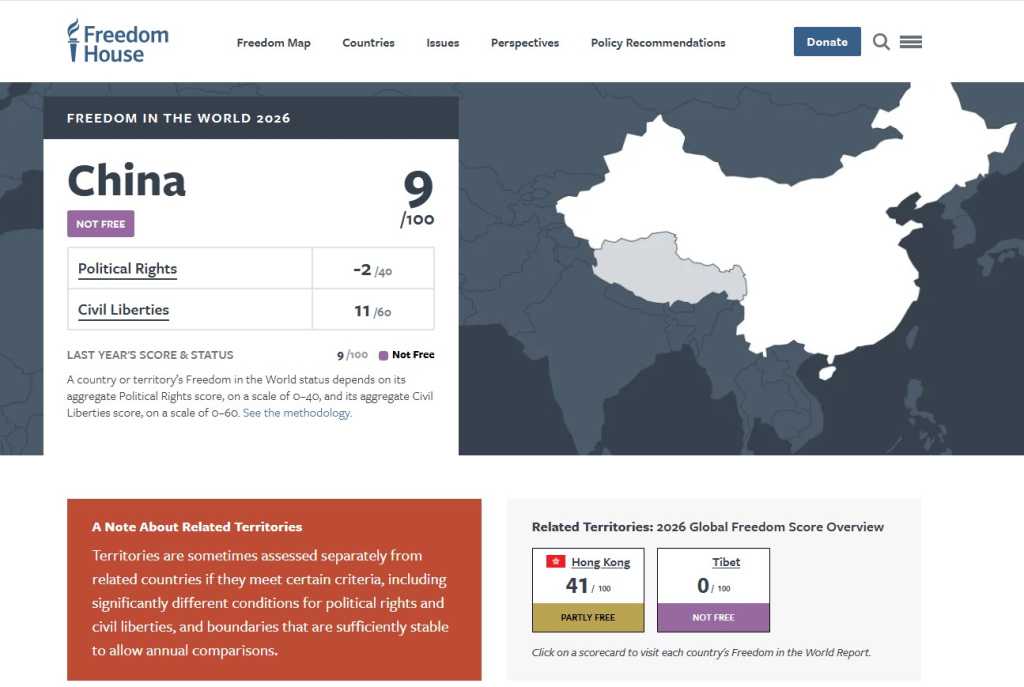
Freedom House 在《2026年世界自由度报告》-网址:freedomhouse.org
这个评价一点也不令人意外。一个连宪法所写“结社自由”都不能兑现、反而把和平建党定成重罪的国家,何谈真正的法治,何谈现代政治文明?
更值得警惕的是,这并非孤例。2026年2月,杭州法院又以 “寻衅滋事罪” 判处浙江民主党人邹巍有期徒刑三年六个月,独立作家昝爱宗有期徒刑三年。自由亚洲电台报道,案件开庭时家属旁听同样受到限制。
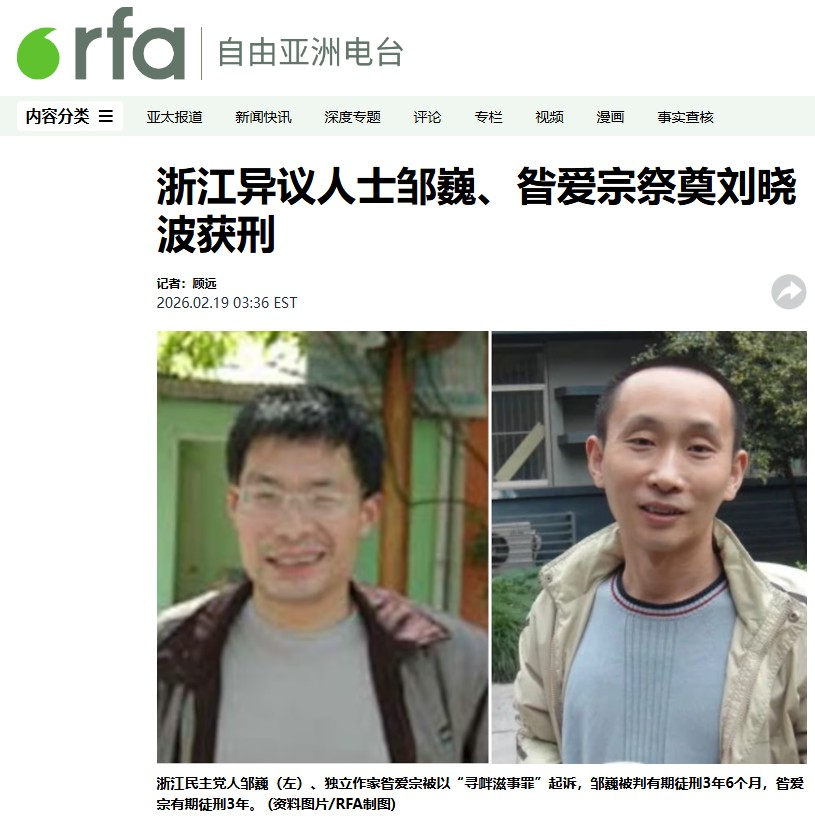
自由亚洲电台的报道-网址:rfa.org
北京案与杭州案,罪名不同,逻辑却完全一致:只要你试图在党的控制之外保留一点独立人格、独立思想和独立组织空间,维稳机器就会迅速启动。
北京是中国的首都,是中共权力最集中的地方。也正因为如此,中国民主党北京党部在北京成立,才具有格外强烈的象征意义。它所传递的信息非常明确:中国人不是只能永远活在一党专政之下,中国人也有权追求民主、多党竞争和政治自由。
我自己也是从中国走出来的人。我越来越深地意识到,在中国,很多人不是不知道压迫,而是不敢碰;不是没有公民意识,而是在一党专政下,真正像公民那样生活,往往就要付出沉重代价。也正因如此,每当我看到国内仍有人明知危险却坚持和平、理性、公开、非暴力地表达民主理念,我心里都充满敬意。因为他们的站出来,本身就是一种见证:见证中国并不是没有追求自由的人,见证中国民主运动并没有熄灭,也见证中共所谓“法治”常常不过是政治镇压的外衣。
从1998年中国民主党在大陆公开成立,到今天依然有人在北京重新举旗,这说明自由的火种并没有被扑灭。哪怕中共用抓捕、审判和判刑去压制,也无法消灭中国人对自由的渴望。
今天被重判的这些民主党人,不应被遗忘。
他们的名字,不应只停留在一纸判决书里。
海外的我们,也不应只是转发消息后继续沉默。
因为沉默,只会让暴政更加肆无忌惮;发声,至少能告诉世界,也告诉中国人民:问题从来不在人民追求自由,而在一个政权把宪法写成门面,把结社自由写成摆设,把和平建党都视为敌人。
宪法写着结社自由,现实却把和平建党判成重罪。
这不是法治的威严,而是制度的自我揭穿;
这不是国家的自信,而是专制的深层恐惧;
这不是现代文明,而是对现代政治文明最基本原则的公然践踏。
愿更多人记住这些人的名字。
愿更多中国人看清这个制度的真相。
也愿中国有一天,不再因为一次结社、一场宣誓、一句真话,就有人失去自由。
The Constitution guarantees freedom of association, so why has the peaceful establishment of a political party become a serious crime?
Author: Reng Feng
Editor: Zhao Jie Proofreader: Zhou Min Translator: Ge Bing
Recently, upon reading the news that members of the Beijing branch of the China Democratic Party had been handed down heavy sentences, I felt a heavy heart and deep anger. According to a report by *Sino-European Voices*, the Beijing branch of the China Democratic Party was established in Beijing on October 8, 2025; by January 2026, several members had been arrested; a closed-door trial was held on March 30, and on March 31, they were handed down heavy sentences for “subversion of state power.” Among them, Vice Chairman Wang Shi was sentenced to seven and a half years, while the remaining members received sentences ranging from three to seven years, some with suspended sentences.
Screenshot from the Voice of Europe report – URL: sinoeurovoices.com
What is most painful about this case is not merely the severity of the sentences, but that it once again exposes a fundamental absurdity in China’s political reality: while the Constitution guarantees “freedom of association,” in practice, the peaceful establishment of a political party is treated as a serious crime.
Article 35 of the Constitution of the People’s Republic of China explicitly states: “Citizens of the People’s Republic of China enjoy freedom of speech, of the press, of assembly, of association, of procession, and of demonstration.” This demonstrates that “freedom of association” is not a concept imposed on China by overseas democrats, but a political commitment the CCP itself enshrined in the Constitution. This provision remains in the current text of the Constitution published on the National People’s Congress website to this day. (npc.gov.cn)
The problem is that such provisions have long remained mere words on paper in China.
If citizens were to genuinely organize in an open, rational, peaceful, and non-violent manner—reading the party charter, electing leaders, and expressing political views—such activities would naturally fall within the scope of “freedom of association.” Yet under CCP rule, such behavior is not only denied protection but is instead labeled as “subversion of state power.” This demonstrates that the “freedoms” enshrined in the CCP’s Constitution are often merely window dressing; what truly prevails are the political prohibitions imposed under one-party dictatorship.
Of course, the CCP would never directly admit to disregarding the Constitution. Its more common approach is to establish a system of censorship, registration, and oversight outside the Constitution, thereby eroding citizens’ freedoms layer by layer. The current “Regulations on the Registration and Administration of Social Organizations” ostensibly aim to safeguard citizens’ freedom of association, but in reality, they require social organizations to undergo review by competent authorities and register in accordance with the law, while strictly avoiding any infringement upon so-called “fundamental principles” and “national security” boundaries. (xzfg.moj.gov.cn)
In the reality of politics, this institutional arrangement has long ceased to be merely a management procedure; it has become a political filtering mechanism: any organization that does not challenge the system is allowed to exist, while any truly independent organization with democratic aspirations finds it virtually impossible to secure a legal space.
Therefore, what the Beijing Party Branch case reveals is by no means limited to the fate of a few individuals; it exposes the truth of the entire system: what the CCP fears most is not violence, but the Chinese people earnestly exercising the freedoms enshrined in the Constitution as genuine rights.
According to public reports, the principles emphasized by the Beijing branch of the China Democratic Party are “openness, rationality, peace, and non-violence.” Its stated goal is to promote freedom, democracy, and social justice in China on the basis of constitutional compliance and equal competition. (sinoeurovoices.com)
In a modern civilized society, such advocacy should be considered normal civic political activity; yet in the eyes of the CCP, it has become a threat that must be eliminated. This demonstrates once again that what the CCP cannot tolerate is not violent revolution, but peaceful association; not conspiratorial activities, but open expression; not illegal subversion, but a people no longer willing to remain silent.
In its 2026 Freedom in the World Report, Freedom House continues to classify China as “Not Free,” with a total score of just 9 out of 100.
Freedom House’s *2026 Freedom in the World Report* – Website: freedomhouse.org
This assessment comes as no surprise. How can a country that fails to uphold the “freedom of association” enshrined in its own constitution—and instead treats the peaceful formation of political parties as a serious crime—claim to have true rule of law or modern political civilization?
What is even more alarming is that this is not an isolated case. In February 2026, a Hangzhou court sentenced Zou Wei, a member of the Zhejiang Democratic Party, to three years and six months in prison, and independent writer Zan Aizong to three years in prison, both on charges of “picking quarrels and provoking trouble.” Radio Free Asia reported that family members were similarly restricted from attending the trial.
Radio Free Asia report – URL: rfa.org
The Beijing case and the Hangzhou case involve different charges, yet their logic is entirely consistent: as soon as you attempt to retain even a modicum of independent identity, independent thought, or independent organizational space outside the Party’s control, the “stability maintenance” apparatus springs into action.
Beijing is China’s capital and the place where the CCP’s power is most concentrated. Precisely for this reason, the establishment of the Beijing branch of the China Democratic Party in Beijing carries exceptionally strong symbolic significance. The message it conveys is crystal clear: the Chinese people are not destined to live forever under one-party dictatorship; they, too, have the right to pursue democracy, multiparty competition, and political freedom.
I, too, am someone who has left China. I have come to realize more and more deeply that in China, many people are not unaware of oppression, but dare not confront it; they are not lacking in civic consciousness, but under one-party dictatorship, living as true citizens often comes at a heavy price. Precisely for this reason, whenever I see people in China who, despite knowing the dangers, persist in expressing democratic ideals peacefully, rationally, openly, and nonviolently, I am filled with deep respect. Their very act of standing up serves as a testament: a testament that there are indeed people in China who seek freedom; a testament that the Chinese democracy movement has not been extinguished; and a testament that the CCP’s so-called “rule of law” is often nothing more than a cloak for political repression.
From the public establishment of the China Democracy Party on the mainland in 1998 to the fact that people are still raising its banner in Beijing today, this shows that the flame of freedom has not been extinguished. Even if the CCP uses arrests, trials, and sentencing to suppress it, it cannot eradicate the Chinese people’s yearning for freedom.
These members of the China Democracy Party who have been handed down heavy sentences today must not be forgotten.
Their names should not be confined to a mere piece of paper—a court verdict.
We overseas should not merely share news reports and then remain silent.
For silence only embolden tyranny; speaking out, at the very least, tells the world—and the Chinese people—that the problem has never been the people’s pursuit of freedom, but rather a regime that treats the constitution as a facade, freedom of association as a mere formality, and the peaceful establishment of a political party as an act of treason.
The constitution guarantees freedom of association, yet reality condemns the peaceful establishment of a political party as a grave crime.
This is not the dignity of the rule of law, but the system’s self-exposure;
This is not national confidence, but the deep-seated fear of an authoritarian regime;
This is not modern civilization, but a blatant trampling of the most fundamental principles of modern political civilization.
May more people remember the names of these individuals.
May more Chinese people see through the true nature of this system.
And may the day come when, in China, no one loses their freedom simply for forming an association, taking an oath, or speaking the truth.