家 博客 页面 101

论中国民主的未来之《五民宪法》详解  第8篇

0

宪法第六条:保障国家领土的完整


作者:何清风

编辑:程铭    责任编辑:罗志飞 翻译:何兴强 校对:冯仍


引言:

   宪法作为国家的基本法,其意义在于背后所承载的思想体系与治理逻辑。本宪法第六条所规定的,是国家领土的性质、范围以及归属方式,这一条款涵盖了国家存续与主权完整的根本保障。倘若没有清晰的领土观念,国家便无法更好的维护公民赖以生存的空间,若缺乏合理的领土制度设计,终将导致主权领土的丧失,以及成为政客交易的筹码。因此,本条是奠定国家领土基础的重要法理依据。
论中国民主的未来之《五民宪法》详解  第8篇

一、领土的神圣性与不可侵犯性

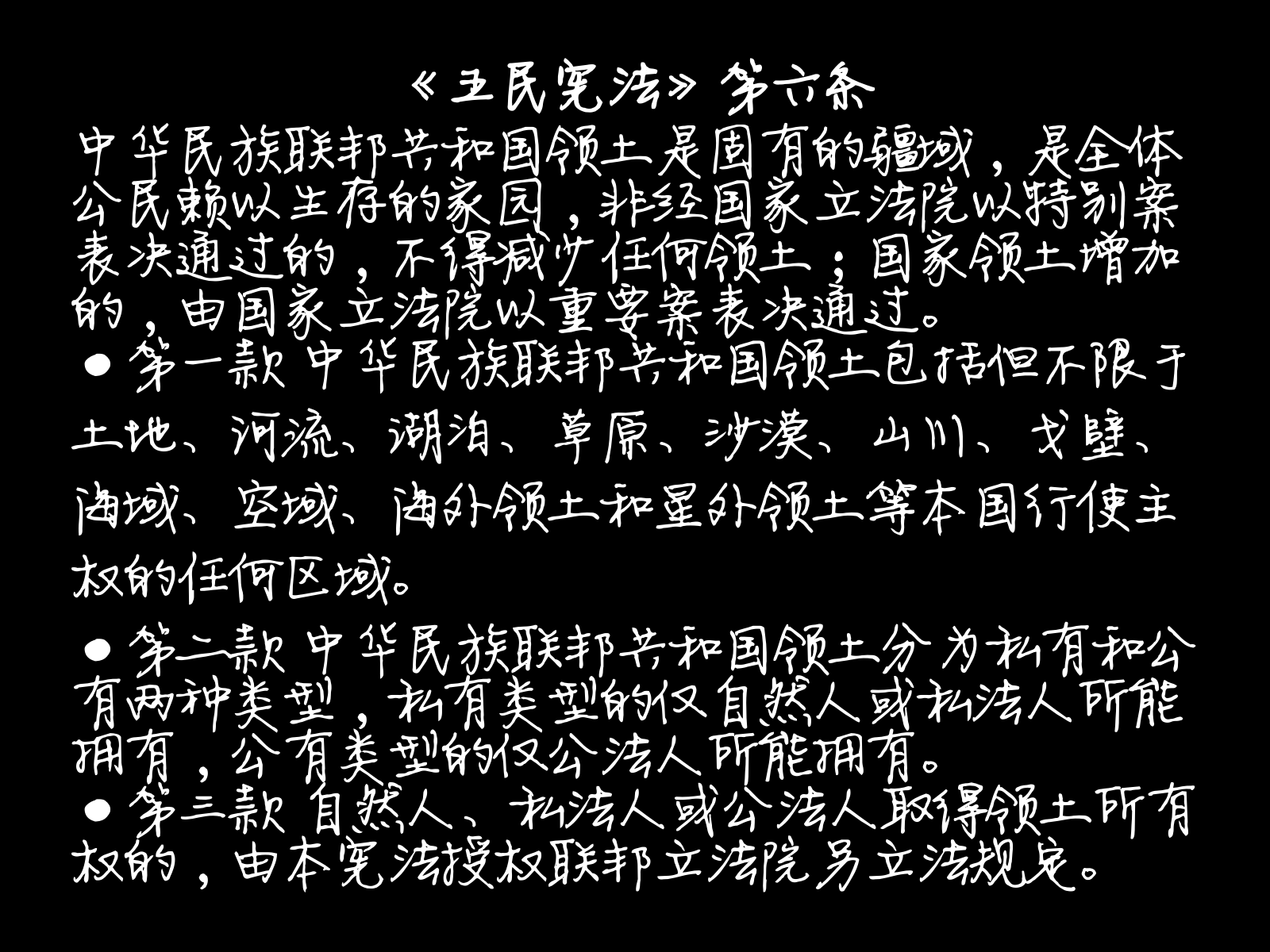
   本条开篇即言:“中华民族联邦共和国领土是固有的疆域,是全体公民赖以生存的家园,非经国家立法院以特别案表决通过的,不得减少任何领土。”这一条款明确两层含义:

   其一,领土是“固有疆域”,并非可随意分割或放弃的交易物,国家的疆域从历史与现实中延续而来,承载着无数代人的耕耘、文化与生存记忆。将其定义为“固有”,意味着领土不是某一届政府的私产,而是全体公民的共同家园。

   其二,任何对领土的减少必须经过“特别案表决”。特别案不同于一般性法案,其门槛更高,代表程序更严谨,不仅要在立法院获得通过,且表决程序包括公民投票表决。这体现了宪法作为全体公民相互之间的契约,对领土完整负有共同的责任与相同的权利,避免因政府官员的外交妥协与私利而轻易割让。
二、领土增加的程序与意义

   条文又规定:“国家领土增加的,由国家立法院以重要案表决通过。”这里形成了与“减少”相对应的逻辑。减少需要“特别案”,增加则需要“重要案”。无论是在制度层面还是现实当中,领土并非静止不变的,而是可以因历史发展、民族意志、国际合作甚至宇宙开拓而不断扩展,故对增加领土作出规定,以适应未来国家发展的需求。

   为何增加时只需“重要案”而非“特别案”?原因在于扩展疆域通常符合国家利益,能够带来资源与安全的提升,不存在损害民族根本利益的危险。但与此同时,仍需立法院审慎决议,以避免盲目扩张带来的治理风险或国际冲突。制度的设计既强调疆域稳固,又保留了未来发展的余地。

三、第一款的解析:领土的全域性

   第一款列举了国家领土的范围:“包括但不限于土地、河流、湖泊、草原、沙漠、山川、戈壁、海域、空域、海外领土和星外领土等本国行使主权的任何区域。”此条款的设计主要有以下三个要点:

全面性:从传统的陆地、河流到现代的空域、海域,几乎囊括一切地理空间,避免出现模糊地带,也为后续立法提供了法条参考。

前瞻性:特别的提出“海外领土和星外领土”,这是对未来空间探索与外太空主权问题的预先回应,宪法并未局限于现有地理空间,而是将眼光投射到星际文明层面,这也是人类在可预见的未来终将实现的。

主权核心:关键在于“本国行使主权的任何区域”。换言之,领土的本质并不单在物理地理的范围,而在于主权的有效实施。无主权之地,纵有疆域之形,亦非国土;有主权之地,即便远在星外,也属于国家的合法疆域。

四、第二款的解析:领土的所有权类型

   第二款规定:“中华民族联邦共和国领土分为私有和公有两种类型,私有类型的仅自然人或私法人所能拥有,公有类型的仅公法人所能拥有。”

   此处是五民宪法的独创性所在。传统宪法大多将“领土”与“国家”直接绑定,极少涉及领土所有权的多样化。而本宪法将领土区分为“私有”和“公有”,这与五民宪法整体强调公民权利与多元主体治理的理念高度一致。

私有土地:指可被自然人或私法人合法取得的土地、地产等。这里不仅是承认私人财产权,更是将其提升为“领土权”。所谓“领土权”即公民拥有国家领土的权利,这与“国家是公民的国家,是公民建立国家”的理念是高度一致的,国家是全体公民共同组建的,国家领土则自然是公民所拥有的。

公有土地:作为一个“地大物博”的国家,其领土是广袤的,对于非公民所有的土地,以及对于一些公权机构所属的土地,设为公有土地,以规范国家领土的管理工作,明确所有权的边界,实现公共利益与个人权利的相对平衡。

五、第三款的解析:立法授权与制度弹性

   第三款规定:“自然人、私法人或公法人取得领土所有权的,由本宪法授权国家立法院另立法规定。”此款承上启下,将具体的领土所有权规则留给立法机关去细化。这种安排有两重意义:

宪法的原则性:宪法只规定基本框架,不陷入细节,避免过早僵化和条款臃肿。

制度的弹性:随着社会发展、经济结构和科技变迁,领土的性质与归属形式可能不断变化。比如太空海洋的开发等,而且,作为一个“地大物博”的联邦制国家,各地区的情况不尽相同,这些都需要在未来通过立法来动态调整。

六、历史与现实的结合

   五民宪法第六条不仅是对领土的规定,更是一种历史经验的总结。中华民族在近代曾因割地赔款而饱受屈辱,领土问题在民族记忆中留下了深刻伤痕。因此,本条强调“不得减少”与严格程序,正是防止悲剧重演的制度保障。

   同时,当今世界正处于新一轮科技革命与地缘竞争之中。海洋权益、极地通道、太空资源等正在成为新的博弈焦点。五民宪法前瞻性地纳入“星外领土”,使国家在未来国际秩序重构中占据了法律与战略的先机。

七、结语

   宪法第六条,写下的不只是疆域的范围,更是国家存在的尊严与未来拓展的方向。国家领土既是先辈们的遗产,也是后世子孙的根基;既是物质的疆土,也是民族精神的边界。唯有守护这一疆域,民族才能真正实现自由、民主、平等与和谐的理想。

    ——“五民主义”奠基人、《五民宪法》撰写人何清风,一身正气、两袖清风。

On the Future of Chinese Democracy: A Detailed Explanation of the “Five-People Constitution” – Part 8

Article 6 of the Constitution: Safeguarding the Integrity of National Territory

Author: He Qingfeng

Editor: Cheng Ming Executive Editor: Luo Zhifei

Translator:He XingQiang

Abstract: The Five-People Constitution defines national territory as “inherent domain,” not a commodity that can be arbitrarily divided or surrendered. The nation’s territory is an inheritance of history and reality, carrying the cultivation, culture, and survival memory of countless generations. Moreover, the Constitution distinguishes territory into “private” and “public” ownership, which aligns closely with its broader emphasis on citizens’ rights and pluralistic governance.

Introduction

As the fundamental law of the state, the Constitution embodies the underlying system of thought and governance logic. Article 6 prescribes the nature, scope, and ownership of the nation’s territory. This clause provides the fundamental guarantee for the state’s survival and sovereignty. Without a clear territorial concept, the state cannot effectively safeguard the citizens’ living space; without a rational territorial system, sovereignty would eventually be lost, and territory might become a bargaining chip for politicians. Thus, this article is an essential legal foundation for national territory.
I. The Sanctity and Inviolability of Territory

The article opens: “The territory of the Federal Republic of the Chinese Nation is inherent domain, the homeland upon which all citizens depend for survival. Unless passed by a special resolution of the National Legislature, no reduction of territory shall be permitted.”

This statement has two key implications:

Territory is “inherent domain,” not a tradable commodity that can be arbitrarily divided or surrendered. The nation’s boundaries are rooted in history and reality, carrying the toil, culture, and survival memory of generations. By defining territory as “inherent,” it means that land is not the private property of any administration but the shared homeland of all citizens.

Any reduction of territory requires a “special resolution.” Unlike ordinary bills, a special resolution has higher thresholds and stricter procedures, including approval by the National Legislature and a referendum. This reflects the Constitution as a social contract among all citizens, making the integrity of territory a shared responsibility and right, thereby preventing concessions or cessions caused by government officials’ diplomatic compromises or private interests.
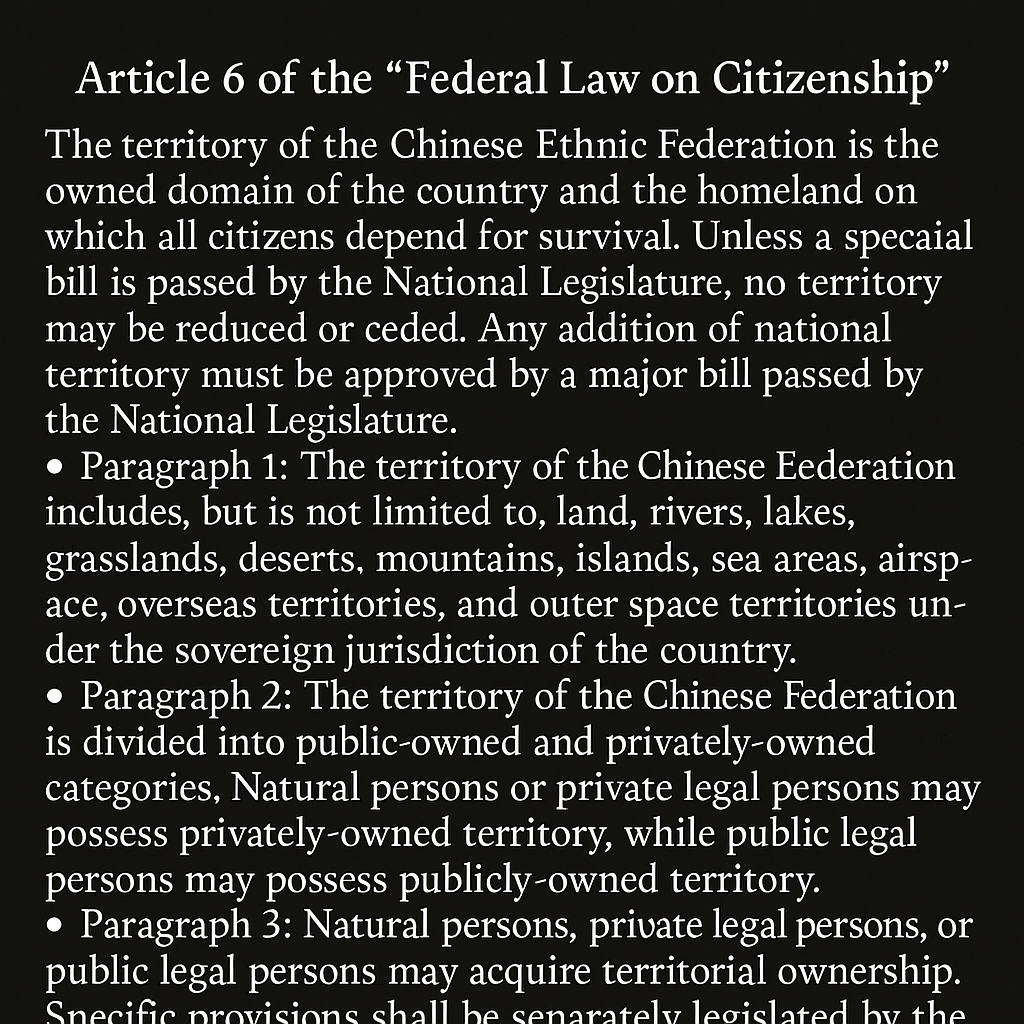
II. The Procedure and Significance of Territorial Expansion

The article further states: “Any addition of national territory must be approved by a major resolution of the National Legislature.”

Here lies a parallel logic: reduction requires a “special resolution,” while expansion requires a “major resolution.”

Territory is not static but may expand through historical development, national will, international cooperation, or even cosmic exploration. Therefore, the Constitution allows for expansion to meet future needs.

Why is expansion subject to a “major resolution” rather than a “special resolution”? Because expansion usually benefits the nation, enhancing resources and security without undermining fundamental national interests. Nevertheless, legislative approval is required to prevent reckless expansion that could cause governance challenges or international conflict. The system emphasizes stability while preserving flexibility for future development.

III. Analysis of Paragraph 1: The Comprehensive Scope of Territory

Paragraph 1 enumerates national territory: “Including but not limited to land, rivers, lakes, grasslands, deserts, mountains, plateaus, sea areas, airspace, overseas territories, and extraterrestrial territories under the sovereign jurisdiction of the country.”

This provision reflects three aspects:

Comprehensiveness: From traditional domains such as land and rivers to modern domains like airspace and seas, virtually all geographic spaces are included, preventing ambiguities and offering reference for future legislation.

Foresight: The mention of “overseas territories and extraterrestrial territories” anticipates future issues of space exploration and sovereignty beyond Earth, projecting vision toward interstellar civilization.

Core of Sovereignty: The key lies in “any region under the sovereign jurisdiction of the country.” Territory is not defined by geography alone but by the exercise of sovereignty. Land without sovereignty, though physically possessed, is not true territory; land with sovereignty, even beyond Earth, is legitimate national domain.

IV. Analysis of Paragraph 2: Types of Territorial Ownership

Paragraph 2 provides: “The territory of the Federal Republic of the Chinese Nation is divided into private and public ownership. Private ownership may be held only by natural persons or private legal persons, while public ownership may be held only by public legal persons.”

This is a distinctive innovation of the Five-People Constitution. Traditional constitutions bind “territory” directly to “the state,” seldom diversifying territorial ownership. By dividing territory into “private” and “public,” the Constitution aligns with its overall emphasis on citizens’ rights and pluralistic governance.

Private Territory: Refers to land or property lawfully acquired by natural persons or private legal entities. This not only acknowledges private property rights but elevates them to the status of “territorial rights.” Such rights embody the principle that “the state belongs to its citizens, and citizens establish the state.” Thus, national territory is naturally also citizens’ territory.

Public Territory: Given the vastness of the nation, lands not privately owned or belonging to public institutions are designated as public territory. This clarifies ownership boundaries, regulates management, and balances public interests with individual rights.

V. Analysis of Paragraph 3: Legislative Authorization and Flexibility

Paragraph 3 states: “The acquisition of territorial ownership by natural persons, private legal persons, or public legal persons shall be determined by separate legislation enacted by the National Legislature under this Constitution.”

This serves two functions:

Principled Role of the Constitution: It outlines the basic framework without delving into details, preventing rigidity or excessive complexity.

Institutional Flexibility: As society evolves, with changes in economy and technology, the nature and forms of territory may shift (e.g., the development of outer space or oceans). As a vast federal state with diverse regions, flexible legislation is necessary to adapt dynamically.

VI. The Link Between History and Reality

Article 6 of the Five-People Constitution is not only a legal prescription but also a lesson from history. In modern times, China suffered humiliation from territorial concessions and indemnities. The scars of lost territory remain deep in the national memory. Thus, the article’s emphasis on “no reduction” and strict procedures ensures institutional protection against repeating past tragedies.

At the same time, the world is entering a new era of technological revolution and geopolitical competition. Maritime rights, polar passages, and space resources are becoming new focal points of struggle. By explicitly recognizing “extraterrestrial territories,” the Constitution positions the state strategically and legally in the reconfiguration of the future global order.

VII. Conclusion

Article 6 of the Constitution defines more than geographical boundaries; it embodies the dignity of national existence and the trajectory of future expansion. National territory is both the legacy of ancestors and the foundation for future generations; it is both material land and the spiritual boundary of the nation. Only by safeguarding this territory can the people truly realize the ideals of freedom, democracy, equality, and harmony.

— He Qingfeng, Founder of the “Five-People Principle” and Author of the “Five-People Constitution,” a man of integrity and upright character.

洛杉矶 雕塑公园9月6日谴责中共反共巡游

0
洛杉矶 雕塑公园9月6日谴责中共反共巡游

第754次茉莉花行动

活动主题:

·为美西美东反共巡游勇士送行

·抗议并揭露习近平93大阅兵,声援所有中国政治犯.良心犯

让我们为即将启程的反共勇士鼓掌,他们的车轮会把真相带到美国每一片土地,他们的行动是自由之路上最勇敢的足迹。

中共在北京大张旗鼓地操弄所谓“9·3阅兵”,这是谎言的秀场,是独裁的遮羞布!阅兵掩盖不了腐败,枪炮掩盖不了真相!在中国,还有无数政治犯、良心犯在牢狱中受苦,他们才是真正的民族脊梁!让我们一起声援中国所有政治犯,良心犯!

——言论自由是权利,不是罪行!

发起人: 张致君

活动负责: 倪世成 程虹 活动策划: 李聪玲

艺术创意: 倪世成 活动主持: 孙小龙 程虹

活动义工: 李延龙 杨雪 彭小梅 朱晓娜

摄影/摄像:卓皓然 活动总协调:杨皓

媒体宣传: 苏一峰 新闻稿: 杨辰

活动时间:

2025年9月6日 下午1点

活动地点:雕塑公园

活动主办方:

中国民主党全委会/洛杉矶雕塑公园

硬糖联盟/洛杉矶民主平台

吃饱饭是最大的政治风险

0

作者:华言(中国大陆)

编辑:李聪玲 责任编辑:胡丽莉

“吃饱饭,是最大的政治风险”,这不是一句玩笑,而是极权制度下隐藏的逻辑真相。它揭示了一个残酷的现实:当人民填饱了肚子,极权统治的根基便开始动摇。

极权制度依赖对社会资源的全面掌控和对个体思想的严密控制。饥饿或匮乏状态下的民众更容易被生存压力所驱使,服从权威以换取基本生存保障。这种“匮乏政治”使得极权政权能够通过分配稀缺资源来巩固权力,强化依赖关系。极权统治者深谙此道:饥饿是最好的枷锁,匮乏是最佳的统治工具。试想,在一个连面包都稀缺的社会,人民会为了什么而活?为了那一口救命的粮食,为了那一点微薄的希望。而这希望,正是统治者手中的筹码。他们用配给制、用特权、用恐惧,换取人民的顺从。极权需要的,是一个永远匮乏的社会,因为匮乏让人民低头,让反抗无从萌芽。

然而,一旦“吃饱饭”,即基本生存需求得到满足,根据马斯洛需求层次理论,民众会转向更高层次的需求,如安全、归属感、尊重,甚至自我实现。这些需求往往伴随着对自由、公平和个人权利的渴望。吃饱饭的人民,开始抬头,开始思考,开始质疑。他们不再满足于被喂食的温饱,而是渴望自由的空气、公正的天空。而这些诉求与极权制度的核心——压制异见、统一思想——相冲突,这就是极权最大的政治风险。因为一个觉醒的人民,是任何铁腕都无法锁住的。

面对这一风险,极权统治者从不坐以待毙。他们设计了一套应对之策:制造人为的匮乏,通过控制资源分配,维持民众的生存压力,限制其追求更高层次需求的空间;同时强化思想控制,宣传机器昼夜运转,强化对思想的垄断,审查无处不在,试图让人民相信极权是唯一的救赎;此外,他们还会转移矛盾,炮制外部敌人,利用外部威胁煽动民族主义情绪,转移民众对内部问题的关注,让人民将怒火投向虚构的威胁,而非真正的压迫者。

“吃饱饭是最大的政治风险”揭示了极权制度的一个悖论:经济发展是政权合法性的重要来源,但也可能动摇其控制基础。极权体制的逻辑在于通过控制资源和思想,压制民众的需求层次上升。一旦温饱解决,民众的觉醒和反抗潜力增加,迫使极权政权在开放与高压之间寻求平衡。然而,这种平衡往往是脆弱的,长期来看,压制人性需求的制度难以持续稳定。

真正的力量,不在于掌控资源与恐惧,而在于回应人民合理需求的能力。只有当温饱成为常态,思想得以呼吸,民众开始独立思考,国家才能走向良性。而看似强大的极权统治,如果仍靠人民吃不饱维系,终将不可持续,注定衰亡。

Eating well is the biggest political risk.

Abstract: Totalitarian rule is shackled by scarcity, and hunger is subject to obedience; but when the people are fed, they pursue freedom, fairness and rights, which poses the greatest risk to the regime.

Author: Huayan (Mainland China)

Editor: Li Congling Responsible Editor: Hu Lili Translator:Ming Cheng

“Eating enough is the biggest political risk”, this is not a joke, but the hidden logical truth under the totalitarian system. It reveals a cruel reality: when the people are full, the foundation of totalitarian rule begins to shake.

The totalitarian system relies on the overall control of social resources and the strict control of individual thoughts. People in a state of hunger or poverty are more likely to be driven by the pressure of survival and obey authority in exchange for basic survival guarantees. This “lack of politics” enables totalitarian regimes to consolidate power and strengthen dependence by allocating scarce resources. The politic rulers are well aware of this: hunger is the best shackle, and poverty is the best tool for domination. Imagine, in a society where even bread is scarce, what will people live for? For that life-saving grain, for that meager hope. And this hope is the chip in the hands of the ruler. They use rationing, privilege and fear in exchange for people’s obedience. What the totalitarian power needs is a society that is always scarce, because the lack makes the people bow down and the resistance can’t sprout.

However, once the basic needs of survival are met, according to Maslow’s theory of hierarchy of needs, people will turn to higher needs, such as safety, sense of belonging, respect, and even self-realization. These needs are often accompanied by the desire for freedom, fairness and personal rights. The people who were full began to look up, think and question. They are no longer satisfied with the food and clothing of being fed but yearn for free air and fair sky. And these demands conflict with the core of the totalitarian system – suppressing dissis and unifying ideas, which is the biggest political risk of the totopolitism. Because an awakened people can’t be locked by any iron fist.

In the face of this risk, totalitarian rulers never sit by and wait for death. They designed a set of countermeasures: create man-made scarcity, maintain the people’s survival pressure by controlling the allocation of resources, and limit their space to pursue higher-level needs; at the same time, strengthen thought control, propaganda machines run day and night, strengthen the monopoly of thought, and censorship is ubiquitous, trying to make people believe that totalitarianism is the only Redemption; in addition, they will also divert contradictions, concoct external enemies, use external threats to incite nationalism, divert people’s attention from internal problems, and make people turn their anger into fictional threats rather than real oppressors.

“Eating well is the biggest political risk” reveals a paradox of the totalitarian system: economic development is an important source of legitimacy for the regime, but it may also shake its control. The logic of the totalitarian system is to suppress the rising level of people’s demand by controlling resources and ideas. Once food and clothing are settled, the awakening of the people and the potential for resistance will increase, forcing the totalitarian regime to seek a balance between opening up and high pressure. However, this balance is often fragile. In the long run, the system that suppresses human needs is difficult to be sustainable and stable.

The real power lies not in controlling resources and fear, but in the ability to respond to the reasonable needs of the people. Only when food and clothing become the norm, thoughts can breathe, and people begin to think independently, can the country become benign. The seemingly powerful totalitarian rule, if it is still maintained by the people’s lack of food, will eventually be unsustainable and doomed to decline.

洛杉矶 9月7日 第三十八期“中共百年暴行展”

0
洛杉矶 9月7日 第三十八期“中共百年暴行展”

揭露真相 从我做起

  中共自建政以来,通过残酷镇压异见人士、海外渗透和跨国打压手段维护统治,甚至在多国设立秘密警察站,威胁侨民。但正义不会沉默,美国政府已抓获并定罪多名中共特务,为民主自由反击!

中国民主党举办第三十八期“中共百年暴行展”。本次展览内容:揭露中共暴行,支持海内外民主人士,一起了解真相!推翻中共,再造共和!!!

活动详情

时间:9月7日(星期日) 14:00—17:00

地点:丁胖子广场

内容:揭露中共暴行、美国政府反击中共特务!

本周举办单位:中国民主党江西工委

现场负责人:曾禹寒

中共镇压无孔不入,但我们团结的力量能推动改变。让我们用行动支持正义,为民主自由站台!

改革的上限与开放的下限

0

作者:陀先润

编辑:周志刚 责任编辑 胡丽莉

我们这一代三十八九岁的人,大多是在“增长神话”和KPI语言里长大的,习惯了用经济学的曲线解释一切转弯。可要读懂过去四十多年,你得先把顺序摆正:先开放,后改革;开放向外,改革向内。开放是外交筹码,用来换技术、换市场、换时间;改革是统治修复,用来把秩序收回来、把资源再分配的阀门握紧。经济只是扳手,不是方向盘。权力才是那只不会放手的手。

很多人相信“经济危机逼出来改革”。这话好听,也最能安慰市场派的自尊:只要增长下滑,政策就会转向。但回头看,恰恰相反。六七十年代对外“开放”的起点,不是慈悲,也不是市场共识,而是安全焦虑。中苏翻脸、边境压顶,才有了对美和解与引资的窗口。开放不是为了老百姓口袋鼓一点,而是为了把国家机器的短板补起来,把卡脖子的装备补齐,把时间赢到自己一边。“改革”也并非要动根基。真正被触碰的,始终是非命脉地带:能放给市场的就放一点,放出来再随时回收;不能放的——军工、能源、金融枢纽、信息阀门——一寸不让。八十年代那套“双轨制”把计划与市场绑在一起跑,结果不是自动到站,而是一路颠簸,1988年价格闯关差点把经济掀翻。你可以说那是“改革成本”,但它更像一次内部压力测试:放到哪一步会触发系统性不稳,触发就回头。经济在这里不是目标,而是表。表针抖得太厉害,就拧回去。九十年代的“外向型理性”同样如此。每年和美国谈最惠国待遇,谈的是时间与空间——用人情、用姿态、用有限释放换一个年度通行证。直到加入世贸组织,才把筹码一次性推了上去。很多人把入世解读成“倒逼国内改革”,可真实的执行逻辑是:先拿到十五年的高速发展窗口,至于承诺,能拖则拖,能打补丁就打补丁。开放从来是单向的:要你的技术、要你的订单、要你的资本,但我的壁垒、我的口岸、我的红线,仍然归我。

2008 年之后的剧本更直白。四万亿不是去托举现金流断裂的民营外贸,而是去喂养“看得见”的铁公鸡与大国企。民营像孵化器,不停下蛋;国企像保温箱,把能量集中到可控处。理由很简单:当经济与稳权发生冲突,先稳权。一个路灯公司的电源都不能完全市场化,因为“断电”的按钮象征着政治风险。金融与数据更不用说,连“谁能发声、怎么发声”都要纳管。边界不是写在法条里,而是写在“风险叙事”里——凡是可被解读为组织风险的,都不属于市场。这就是为什么,每当民间资本试图自我组织、试图建制度、试图把“企业家共同体”变成公共议题时,红灯就会亮。不是你做得不够好,而是你做得太像制度要件。大学、基金会、行业自治、跨区域的职业资格——凡是能产生独立秩序的东西,都会被归类为“可疑的权力替代”。这不是经济学问题,是政治学问题:秩序来源必须唯一。把这条主线放回历史坐标,你就不再指望“危机推动善意拐点”。危机只会推动两种动作:一是对外更激进的讨价还价,争取喘息;二是对内更坚决的结构回收,确保关键阀门不在别人手里。市场与法治只有在不威胁阀门时才会得到扩容,一旦触线,就缩回去。所谓“中国式现代化”,核心机制就是“可增长的边界”:边界在,增长就存在;边界被触动,增长就让路。这并不意味着增长不重要。恰恰相反,增长是合法性叙事的底座,是“绩效政治”的KPI。投资、地价、出口、产业迭代,这些指标变成了“统治会计”的科目表。你能在表上交出成绩,就能在政治上换来安全。但当“绩效”和“安全”发生冲突,选择题没有悬念。于是我们看到“先放后收”的循环:放,是为了把经济这匹马拉起来;收,是为了确保缰绳在手。对我们这代人而言,真正需要更新的认知是:不要用经济逻辑套政治抉择。你可以用现金流模型估企业,用需求曲线看行业,但不要用它来预测“何时转向”。转向从来不是由GDP 的同比数决定的,而是由“风险感知”的温度计决定的。今天的外部压力会带来一些短期的姿态调整、一些技术型的“开放修辞”,但这不代表边界被重写。边界的书写者只认一条:政权安全。

那么,我们是不是在走一条熟悉的老路?如果“老路”指的是“以安全为纲、以经济为器、以开放求时、以改革修政”的路径,那么答案八九不离十。不同的是,外部世界更复杂,国内结构更庞大;相同的是,方向盘握在同一只手上。看懂这点,才知道该把哪些期待放低、哪些行动提速:做生意要看边界,做公共议题要看风险叙事;与其把希望交给“转向”,不如把准备交给“常态”。这不是犬儒,是成年人的清醒。我们这一代人,至少要把清醒当作基本素养。

The upper limit of reform and the lower limit of opening up

Author: Tuo Xianrun

Editor: Zhou Zhigang Responsible Editor Hu Lili

Abstract: The path of China’s “reform and opening up” for more than 40 years is “opening up first, reform later”. The economy has always served power; the crisis is not driving institutional breakthroughs, but external bargaining and internal tightening. The core logic is growth is important, but the security of the regime is a priority.

Most of our generation of thirty-eight-nine-year-olds grew up in the “growth myth” and KPI language and are used to explaining all the turns with the curve of economics. But to understand the past 40 years, you must first correct the order: first open up, then reform; open outward, reform inward. Opening up is a diplomatic chip, which is used to change technology, market and time; reform is the repair of rule, which is used to bring back order and redistribute resources. Economy is just a wrench, not a steering wheel. Power is the hand that won’t let go.

Many people believe that “the economic crisis has forced reform”. This is nice to hear, and it can also comfort the self-esteem of the market faction: as long as the growth declines, the policy will turn around. But looking back, it’s just the opposite. The starting point of “opening up” to the outside world in the 1960s and 1970s was not compassion or market consensus, but security anxiety. Only by turning the face of China and the Soviet Union and pressing the border to the top, there is a window for reconciliation with the United States and attracting investment. Opening up is not to make up the pockets of the common people, but to make up for the shortcomings of the national machinery, make up for the equipment of the stuck neck, and win time on your side. “Reform” does not need to be rooted. What is really touched is always the non-lifeblood zone: if you can release it to the market, put a little, release it and recycle it at any time; what can’t be released – military industry, energy, financial hub, information valve – don’t give up an inch. The “dual-track system” in the 1980s tied the plan to the market. The result was not automatic arrival but bumps all the way. In 1988, the price breakthrough almost overturned the economy. You can say that it is the “cost of reform”, but it is more like an internal stress test: whichever step it is put, it will trigger systemic instability, and if it is triggered, it will turn back. The economy here is not a goal, but a table. The needle of the watch shook too much, so I screwed it back. The same is true for the “extroverted rationality” in the 1990s. Every year, we talk about most-favored-nation treatment with the United States, which is about time and space – using kindness, posture, and limited release in exchange for an annual pass. It was not until he joined the WTO that the chips were pushed up at once. Many people interpret the accession to the WK as “reverse domestic reform”, but the real implementation logic is getting the 15-year window of high-speed development first, as for the promise, drag it if you can, and patch it if you can patch it. Opening up has always been one-way: I want your technology, I want your order, I want your capital, but my barriers, my port, my red line, still belong to me.

The script after 2008 is more straightforward. Four trillion yuan is not to support private foreign trade with broken cash flow, but to feed the “visible” iron rooster and large enterprises. Private enterprises are like incubators, which do not stop laying eggs; state-owned enterprises are like incubators, concentrating energy in a controllable place. The reason is very simple: when there is a conflict between the economy and stability, the power should be stabilized first. The power supply of a streetlamp company cannot be fully marketize, because the “power off” button symbolizes political risk. Not to mention finance and data, even “who can speak out and how to speak out” needs to be managed. The boundary is not written in the law, but in the “risk narrative” – anything that can be interpreted as organizational risk does not belong to the market. That’s why whenever private capital tries to self-organize, tries to build a system, and tries to turn the “entrepreneur community” into a public issue, the red light will come on. It’s not that you don’t do it well enough, but that you do it too much like the institutional requirements. Universities, foundations, industry autonomy, and cross-regional professional qualifications – anything that can produce an independent order will be classified as “suspicious power substitution”. This is not a problem of economics, but a problem of political science: the source of order must be unique. Put this main line back to the historical coordinates, and you will no longer expect “the crisis drives the inflection point of goodwill”. The crisis will only promote two actions: one is to bargain more radically externally to fight for respite; the other is to make more resolute structural recovery internally to ensure that key valves are not in the hands of others. The market and the rule of law will only be expanded when it does not threaten the valve. Once it touches the line, it will be retracted. The core mechanism of the so-called “Chinese-style modernization” is the “border of growth”: when the boundary is there, growth exists; when the boundary is touched, growth gives way. This does not mean that growth is not important. On the contrary, growth is the basis of the narrative of legitimacy and the KPI of “performance politics”. Investment, land prices, exports, industrial iteration, these indicators have become the account list of “dominant accounting”. If you can hand in your grades on the table, you can get security in politics. But when “performance” and “safety” conflict, there is no suspense in multiple-choice questions. So, we see the cycle of “release first and then collect”: release is to bring up the economy; collect is to ensure that the reins are in hand.

For our generation, the real understanding that needs to be updated is don’t use economic logic to make political choices. You can use the cash flow model to estimate the enterprise and the demand curve to look at the industry, but do not use it to predict “when to turn”. The shift is never determined by the ratio of GDP, but by the thermometer of “risk perception”. Today’s external pressure will bring some short-term posture adjustments and some technical “open rhetoric”, but this does not mean that the boundaries have been rewritten. The writer of the boundary only recognizes one: The security of the regime.

So, are we walking a familiar old road? If the “old road” refers to the path of “security as the platform, economy as the tool, openness to seek the time, and reform and government”, then the answer is eight or nine. The difference is that the outside world is more complex, and the domestic structure is larger; the same thing is that the steering wheel is held in the same hand. Only by understanding this point can we know which expectations should be lowered and which actions should be accelerated: doing business should look at boundaries, and doing public issues should look at risk narrative; instead of giving hope to “turning”, it’s better toLeave the preparation to “normal”. This is not cynicism, but the sobriety of adults. Our generation should at least regard sobriety as a basic literacy.

9月6日 旧金山 毛泽东反思行动日活动公告

0
9月6日 旧金山 毛泽东反思行动日活动公告

各位朋友:

9月9日是毛泽东的忌日。

我们将在毛泽东逝世日前的星期六(9月6日)下午4:00,于旧金山领事馆举行 “毛泽东反思行动日”,活动预计时长约1小时。

本次活动旨在揭露毛泽东在1949–1976年间发动的政治运动、造成的惨烈死亡,以及其极权统治的恶劣本质。

欢迎大家参加,共同反思历史,认清极权的本质。

召集人:方政 赵长青 郑云

组织人:袁强 王灵 吴京 潘志坚 韩震 张善城

言论自由无罪,呼吁中共释放胡洋

0

作者:权录军

编辑:张致君 责任编辑:罗志飞 翻译:程铭

我们都知道很多中国的民主人士都因言获罪,受到中共的残酷打压和迫害

我总结了三点:

第一,中共倒行逆施迫害民主人士,打压言论自由,使得真相无法传播,是对民主自由的危害,是人类社会的倒退。

第二,中共这种行为会对世界上其他国家和政权形成极坏的示范效应,同样是对民主和自由的危害。

第三,中共自私且无底线,中共不能剥夺每个人与生俱来的各种权利,这是上帝赋予每个人的权利,中共的存在是反人类反社会的,所以终止邪恶理所应当。

言论自由无罪,呼吁中共释放胡洋

参加声援活动的民主人士史庆梅说:胡洋没有罪,因为言论自由是宪法赋予中国人的权利。中共这样打压一个年轻人、公然违背自己定的宪法,会遭到文明世界人们的耻笑,另外我呼吁那些公安狱警人员,你们要善待政治犯,枪口抬高一寸,因为他们没有做错,历史会证明这一切,如果继续是非不分替中共作恶,我相信有一天历史会清算你们。

Freedom of speech is not guilty, calling on the Communist Party of China to release Hu Yang

Author: Quan Lujun

Editor: Zhang Zhijun Responsible Editor: Luo Zhifei Translator: Cheng Ming

We all know that many Chinese democrats have been convicted for their words and have been brutally suppressed and persecuted by the Communist Party of China.

I have summarized three points:

First, the Communist Party of China persecutes democrats and suppresses freedom of speech, so that the truth cannot be spread, which is harmful to democratic freedom and a regression of human society.

Second, the behavior of the Communist Party of China will have a very bad demonstration effect on other countries and regimes in the world, which is also harmful to democracy and freedom.

Third, the Communist Party of China is selfish and has no bottom line. The Communist Party of China cannot deprive everyone of their innate rights. This is the right given to everyone by God. The existence of the Communist Party of China is anti-human and anti-social, so it is right to stop evil.

言论自由无罪,呼吁中共释放胡洋

Shi Qingmei, a democrat who participated in solidarity activities, said: Hu Yang is not guilty, because freedom of speech is the right granted to Chinese people by the Constitution. If the Communist Party of China suppresses a young man in this way and blatantly violates its own constitution, it will be laughed at by the people of the civilized world. In addition, I appeal to those public security prison guards, you should be kind to political prisoners and raise the muzzle an inch higher, because they have not done a mistake. History will prove all this. If we continue to do evil for the Communist Party of China, I I believe that one day history will liquidate you.

9月7日 纽约联合反共活动通知

0
9月7日 纽约联合反共活动通知

【第247次民主中国阵线(纽约)&中国民主人权联盟(纽约联合反共活动通知】

【时间】

9月7日(周日)上午11点20分(最好准时到,可能会有媒体、电视台采访)(10:10法拉盛图书馆包车出发)

【地点】

布碌崙八大道66街(10:10法拉盛图书馆包车出发)

坐标(40.6320278, -74.0131389)

【注意】

(1)包车前往,车接车送(出发集合地:法拉盛图书馆),车票免费,活动完集体定免费的白宫套餐(5美元麦当劳套餐)

(2)活动完大家可决定是否去coney(康泥岛)玩,车接车送,欢迎带家庭、孩子。

游乐设施、海洋馆门票需自费;阳光沙滩免费。

最终把大家送回 法拉盛图书馆门口。

我们的理念:以最小的成本筹划、最舒服的姿势参与、最大程度反共。

反共生活两不误。

【活动入群链接】(照片/视频/报道)

https://t.me/+GFSUJYv7mohmYmQ1

【活动话题】

1、支持法轮功,祝贺4.5亿同胞退出中共党、团、队。

2、谴责习近平“九三阅兵”对“活摘器官”的支持。

3、抵制中共跨国镇压,感谢法轮功的“破墙软件”自由门等;同时声援“拆墙运动”发起人乔鑫鑫,谴责中共跨国镇压、跨国抓捕。

4、由于这次我们在布鲁克林参与游行,为牛腾宇家属募捐活动暂停一次。下周日法拉盛图书馆活动继续。

咨询电话:(929) 389-8606、(347) 880-6906