New York August 31sh Flushing Joint Anti-Communist Activities Notice
[Notice of the 246th Joint Anti-Communist Activities of the Federation for a democratic China (New York) & Chinese Democracy and Human Rights Alliance (New York)]
[Time]
August 31 (Sunday) 11 a.m.
[Location]
At the entrance of the library on Main Street in Flushing
(41-17 Main St, Flushing, NY 11355)
[Link to join the activity group]
Https://t.me/+GFSUJYv7mohmYmQ1
[Activity Topic]
Condemn the Vice Chairman of the Chinese People’s Political Consultative Conference of the Communist Party of China and the former Hong Kong Special Leader for threatening Falun Gong practitioners; Congratulations to 450 million compatriots on withdrawing from the Communist Party of China, League and Team.
Protesting against the Communist Party of China’s military parade plan on September 3, that is, the 80th anniversary of China’s victory in the War of Resistance Against Japanese Aggression and World War II, the “SS Military Parade” was held in Tiananmen Square in Beijing, touting its hypocritical “mainstay” role. At the same time, many international dignitaries were invited to form an anti-American axis.
After eight years of resistance, the Chinese nation made great sacrifices. The Kuomintang army, as the backbone of the front battlefield, together with countless compatriots, with the great support of the United States (including the important factors that nuclear weapons deterred Japan’s surrender), won the final victory with blood and life. However, the Communist Party of China deliberately erased the contributions of the Kuomintang, the Chinese people and the American people by tampering with historical facts, took the victory of the whole nation for itself, and packaged its political legitimacy with false narratives, which is heart-wreaking!
Please bring 1 dollar in cash each to the participating members of the activity. We will continue to take the lead in raising donations for Niu Tengyu’s family. We can’t be indifferent to the Communist Party of China.
At present, the first two public fundraisings have totaled 61 USD = 427 RMB.
Between Faith and Silence: The Awakening of the Sin and Good Faith of Organ Harvesting
—-Participating in the 752nd Jasmine Action to resist the Communist Party of China’s illegal organ transplantation Hollywood parade
Abstract: In the Hollywood parade, the author witnessed believers expose the evil of the Communist Party of China’s live organ harvesting with silent actions. The article compares the reality with Buddhist righteousness, pointing out that silence is indulgence. Only compassion and courage can protect the bottom line of human nature and faith.
Author: Chen Ting
Editor: Feng Still Responsible Editor: Hu Lili
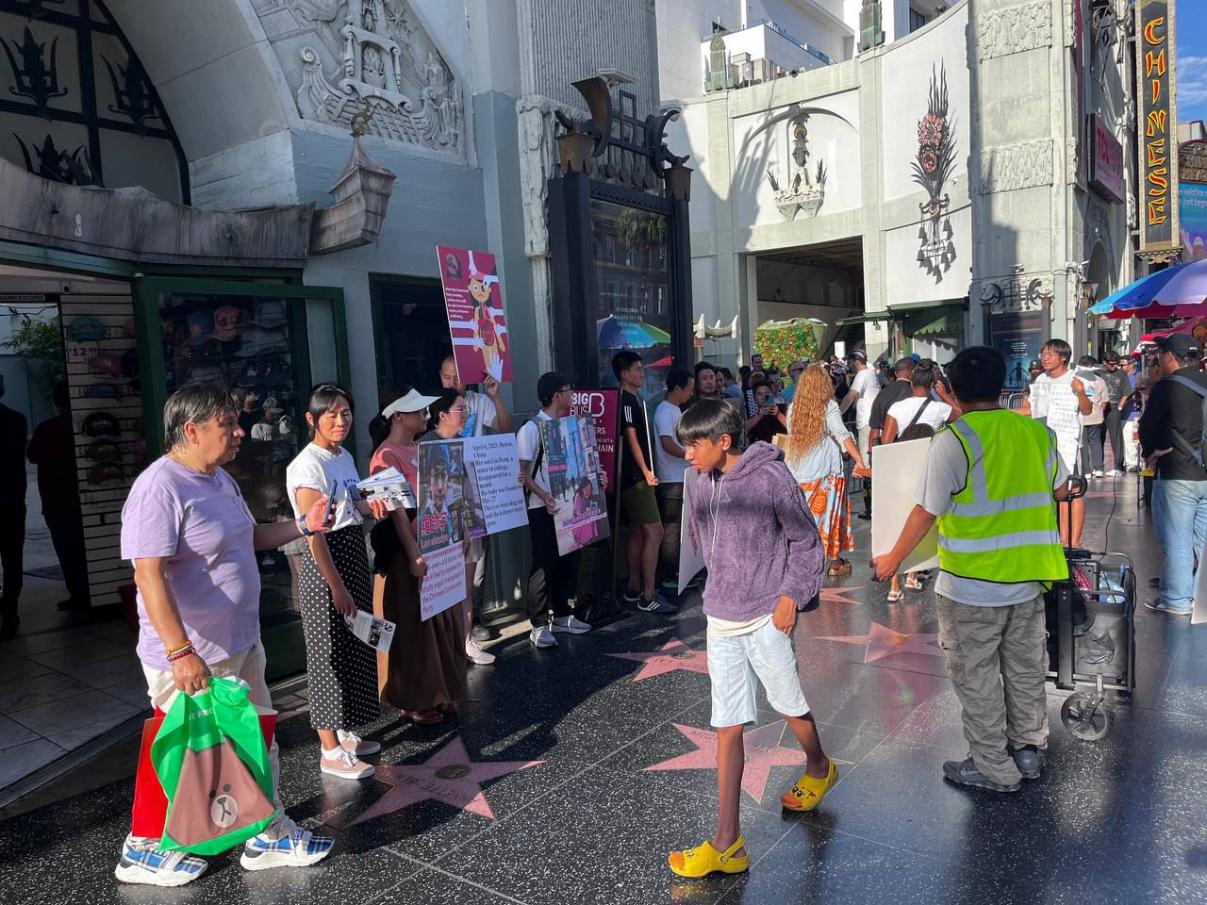
In the sunshine of Hollywood in Los Angeles, a group of believers from different backgrounds stood quietly on the corner of the Avenue of Stars. On the exhibition board in their hands, there are pictures that are difficult to see directly: children being locked up in iron cages, shocking scars on young people’s naked bodies, and mothers’ howling across the ocean. These images are not artistic creations, but come from real sins – the systematic persecution of live organ harvesting of religious groups.
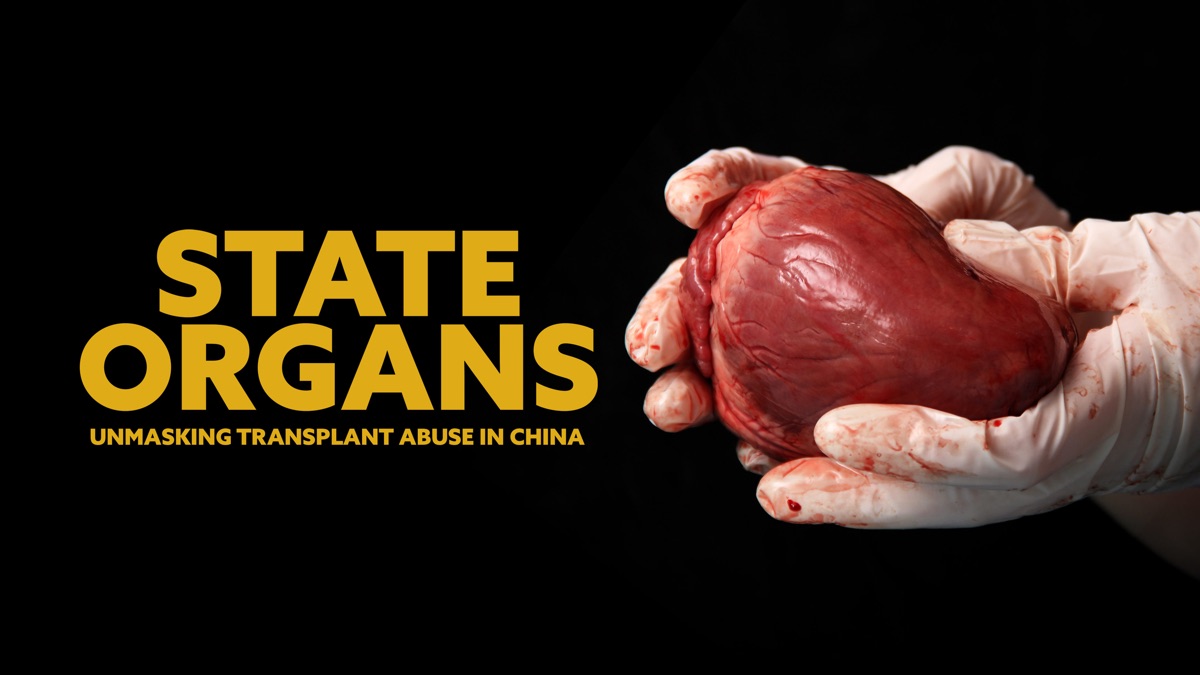
I also stood in the crowd, holding a display board with the word “STATE ORGANS” in my hand. This is a documentary that records live organ harvesting, and it is also evidence of the double killing of the body and soul by the totalitarians. On the crowded Hollywood Boulevard, we do not stand to attract attention, but just to break the silence and let the voices of the persecuted penetrate the hustle and bustle of commerce and entertainment.
In Buddhist doctrine, “Bo Xun” is the demon king who confuses sentient beings and hinders the way to becoming a Buddha. Its characteristic is not that he is ferocious in appearance, but that he is good at disguise and distorting the truth. It often wears the cloak of justice, development and stability, and practices the reality of suppression and slaughter. Today, the behavior of some regimes is just like Bo Xun: covering up evil deeds with powerful state narratives, suppressing religious freedom in the name of patriotism, and destroying individual dignity in the name of order. Truth, compassion and awakening have all become things to be judged. As Kambusodagi said, “The most difficult enemy in the world to deal with is the fool who wears the cloak of benefit.”
Organ harvesting is no longer a mere political problem, but a sinful act that transcends the bottom line of human morality. It is carried out in the name of the hospital but abandons the ethics of medicine; it is disguised by judicial procedures but ignores the dignity of life. If a regime can systematically remove organs from dissents and practitioners for profit, then this is not only the embodiment of evil government, but also the act of falling into hell. Buddhism teaches sentient beings to respect cause and effect and be compassionate to sentient beings, but such behavior is subverting cause and effect and selling fear.
We can’t avoid this problem, nor should we indulge in the excuse of “political complexity” to avoid discussion. Those living individuals are not statistics, but the same kind as us who can cry, hurt and survive. Their organs are coldly included in the matching database, their beliefs become the grounds for conviction, and their bodies become tradable resources under the state apparatus.
And can we, as believers, knowers, and people who can still express themselves freely, remain silent? Can you turn a blind eye to the truth in front of you? As Sodaji Kambu said in the “On the Bodhisattva’s Theory”: “The real warrior is the one who does not turn with the eight winds.” In the face of Bo Xun, do not respond with anger, do not compete with hatred, but live in compassion with the power of right knowledge and right view, continue to speak out, not for self-interest, just to break the fog.
The petition was neither noisy nor intense. People just stood quietly for an hour or two, handing out leaflets to passers-by and telling reporters the truth. We know that this practice may not change the world immediately, but it may sow a seed of awareness for those who pass by. As it is said in Buddhism: “A lamp can break the darkness of a thousand years, and a wisdom can destroy ten thousand fools.” Even if only one person consults, thinks and empathizes with it, it is not in vain.
On that day, an American tourist stopped for a long time in front of the exhibition board. He whispered, “I’ve never heard of this.” There were shock and uneasiness in his eyes. I handed over the leaflet: “The truth may be uncomfortable, but it can set you free.” This is a collision of the soul and a transmission of light. We don’t ask for victory or applause. We just want to protect the little fire of humanity that has not been extinguished.
Buddhism talks about fate, and faith talks about awakening. We are willing to stand on the Avenue of Stars not to protest against a country, but to respond to the call of a soul. It is not to condemn a system, but to defend the inviolability of life. This is not only the field of political position, but also the bottom line of the basic values of human beings.
Sodajikmbu mentioned in his many lectures: “Evil deeds cannot defeat the truth in the end, and violence cannot extinguish compassion.” When we speak out in a non-violent way, we are not weak but choose a deeper strength. Even in the face of indifference and misunderstanding, we still have to stick to the core of our faith.
In this generation, religious freedom is no longer just an abstract right, but a bright light in everyone’s heart when resisting the great darkness. May we all be the guardians of this lamp.
May the injured sentient beings be comforted, may the perpetrators wake up as soon as possible, may more people see the truth, and may faith become the power to cross the darkness, not the silent burial goods.etween Faith and Silence: The Awakening of the Sin and Good Faith of Organ Harvesting
Luo Gan (1935–2019), a native of Zigong, Sichuan Province, was a former member of the Chinese Communist Party’s Politburo Standing Committee and Secretary of the Central Political and Legal Affairs Commission. During the Jiang Zemin and Hu Jintao eras, he was the top official overseeing China’s political-legal system, holding long-term control over the police, state security, procuratorates, courts, justice system, and the People’s Armed Police.
Luo began his career in the petroleum sector and entered the political-legal system in the 1990s. In 1998, he was elevated to the Politburo Standing Committee and appointed Secretary of the Central Political and Legal Affairs Commission, taking full charge of political-legal affairs until his retirement in 2007. Over this near-decade, China’s “stability maintenance” (weiwen) apparatus took full shape, with expenditures rising annually. “Stability above all else” became the central slogan of the political-legal system.
The most prominent measure under Luo’s tenure was the suppression of religious and spiritual groups. In 1999, the CCP launched a nationwide campaign against the Falun Gong movement. Luo was widely regarded as the chief architect and enforcer of this policy. He promoted the establishment of the extralegal “610 Office,” which coordinated cross-departmental operations to arrest, detain, and subject practitioners to ideological “transformation,” resulting in a massive nationwide campaign. During this period, torture, re-education through labor, and surveillance were systematically employed, marking a shift of the political-legal apparatus toward extremity.
At the same time, Luo maintained a hardline stance toward petitioners and rights-defense groups. Under his direction, large-scale “interceptions” of petitioners became routine, with local governments setting up detention sites to prevent citizens from traveling to Beijing to lodge complaints. Rights lawyers, dissidents, and citizens involved in social movements were frequently investigated, detained, and suppressed. Within the system, the saying “One word from Luo Gan can ruin a person’s life” circulated, reflecting his absolute authority in the political-legal establishment.
He stressed “maintaining stability with an iron hand,” yet disregarded judicial independence and citizens’ rights. Under his leadership, political-legal organs became not only institutions for preserving public order but also the core instruments for maintaining political security and suppressing social dissent.
Luo’s policies drew wide international attention. Human rights organizations and United Nations bodies repeatedly named him, holding that the stability maintenance and crackdowns he directed constituted grave violations of human rights. He has thus been regarded as one of the defining figures of China’s contemporary stability-maintenance regime.
Luo retired in 2007 and died of illness in 2019. In its obituary, the CCP praised him as “an outstanding Party member,” but outside observers focused more on the political-legal line he left behind. The high-pressure and stability-first approach he advanced profoundly shaped China’s political-legal system and continues to define its governance logic today.
Luo Gan was not only a key figure in the CCP power structure but also a quintessential representative of contemporary authoritarian strong-arm politics. The coercive policies he implemented within the political-legal system brought state control over society to an unprecedented level and laid the foundation for China’s subsequent “stability-maintenance” trajectory.
Immigrants Embrace American Values Through Action— Volunteer Service by the Chinese Democracy Education Foundation in Irvine
Author: Zhao Xuefeng Editor: Luo Zhifei Executive Editor: Hu Lili Translation: Lyu Feng
Abstract:On August 30, 2025, under the blazing sun, the Chinese Democracy Education Foundation organized a volunteer activity at the FARM+FOOD LAB in Irvine’s Great Park. Volunteers, accompanied by their families, worked in groups under the guidance of FARM staff, carrying out tasks such as harvesting, watering, weeding, and tidying pathways. Through these concrete actions, they fulfilled their commitment to “give back to American society with love,” demonstrating the proactive role immigrants play in integrating into U.S. communities.
The event was guided by the core values of “compassion, inclusiveness, freedom, and human rights.” By participating in the upkeep of urban agriculture and community gardens, volunteers were encouraged to deepen their understanding of local public service ecosystems and to build stable connections with the broader community.
Democracy advocate Sun Shengyao remarked:“The act of bending down to touch the earth is not only physical labor but also a form of civic education. In working together, learning together, and helping one another, barriers between people are dissolved, and individuals from diverse cultural backgrounds discover ways to empathize and cooperate on the same piece of land. When we participate in community building through volunteer service and help maintain a shared public space, love naturally flows and extends through both labor and smiles. We are willing to contribute steadily and consistently, to convey goodwill to society, and to set an example of responsibility and civic spirit for our children.”
Zhao Xuefeng, Project Director of the Chinese Democracy Education Foundation in the Los Angeles area, stated:“Love can be shared. When we respond to the needs of the community through our labor, love extends through every smile and greeting. Through steady and sustained volunteer service, we seek to embody immigrants’ recognition of American values in concrete action—growing from ‘newcomers’ into ‘good neighbors’ and ‘co-builders.’ In doing so, we transform the ideals of compassion, inclusiveness, freedom, and human rights into a form of public goodwill that everyone can tangibly experience.”
The Chinese Democracy Education Foundation will continue to adopt an open posture, connecting schools, nonprofit organizations, and civic volunteers to jointly advance civic education and community engagement, thereby contributing to the building of a more inclusive and resilient local society.
Abstract: This article examines the inevitability of the phenomenon “bad money drives out good” within the Leninist totalitarian system. Drawing on the analogy of Gresham’s Law, it argues that under conditions of highly centralized power, single-ideology control, and loyalty-first selection mechanisms, the compliant and opportunistic often prevail because of their low risk and institutional protection, whereas independent thinkers, innovators, and those upholding moral principles are marginalized due to their higher costs.
The idea that “bad money drives out good” originates from Gresham’s Law, which originally referred to monetary circulation: inferior currency, due to its lower cost and greater ease of circulation, tends to drive superior currency out of use. In the realm of socio-political life, this principle can be extended to mean that low-value, low-cost actors (“bad money”) gain advantage through institutional incentives, thereby displacing high-value, high-cost actors (“good money”). Here, “good money” refers to individuals with independent thought, innovative capacity, or moral integrity, while “bad money” refers to those who are submissive, opportunistic, or mediocre.
The Leninist totalitarian system is characterized by a highly centralized power structure, the coercive imposition of a single ideology, and systematic repression of dissent. Its institutional logic inevitably results in “bad money driving out good.”
Mechanism 1: Single ideology suppresses plural thought, marginalizing the independent and innovative. A totalitarian system elevates one ideology as its core, treating any deviation as a threat. To maintain the absolute authority of ideology, the regime uses censorship, punishment, and repression against dissent. As a result, independent thinkers and innovators—the “good money”—bear extremely high costs (persecution, exile), while the submissive—the “bad money”—reap low-cost benefits by aligning with the official line. Thus, institutional incentives favor low-value conformity while excluding high-value critical thought.
Mechanism 2: Loyalty, not ability, as the selection criterion—mediocrity occupies the core of power. The concentration of power in totalitarian systems necessitates building a minimal winning coalition, which leads to loyalty being prioritized over objective ability or contribution in cadre selection. Loyalists enjoy low risks and high rewards (political promotion, resource allocation), while capable individuals who voice dissent face high costs (marginalization or purge). This mechanism ensures that “bad money” (loyal but mediocre actors) replace “good money” (capable yet independent actors).
Mechanism 3: A culture of fear suppresses genuine expression and moral behavior, fostering opportunism and hypocrisy. Through surveillance, denunciation, and punitive measures, the regime creates pervasive fear. To protect themselves, individuals adopt low-cost behaviors—silence or conformity—rather than the high-cost path of truthfulness or moral steadfastness. Informants and opportunists thrive under such an environment, while integrity and courage are punished. This culture further consolidates the survival advantage of “bad money.”
Mechanism 4: Resources flow to loyalists rather than contributors, obstructing efficiency and innovation. Resource distribution in totalitarian regimes is centrally controlled, flowing preferentially to loyal individuals or institutions. Through patronage, allies are bound together, regardless of efficiency or actual contribution. Consequently, efficient and innovative actors are starved of support, while inefficient yet loyal actors endure. This distortion leads to resource waste, societal stagnation, and further strengthens the displacement of “good money” by “bad.”
Consequences: The dominance of “bad money” has profound socio-political implications.
1. Loss of social vitality: Suppression of innovation and critical thinking results in economic stagnation and technological backwardness.
2. Collapse of moral order: Fear and denunciation corrode social trust, fostering hypocrisy and opportunism.
3. Systemic crisis: The long-term dominance of “bad money” produces decision-making errors and resource misallocation, ultimately undermining regime stability.
The Leninist totalitarian system, through its mechanisms of single ideology, loyalty-first selection, fear culture, and distorted resource allocation, systematically incentivizes “bad money” behavior and marginalizes “good money” actors. The rigor of this logic, combined with its historical universality, demonstrates that “bad money drives out good” is the inevitable outcome of such a system.
Remember the martyrs and expose the lies of the Communist Party of China
——Commemorate the 80th anniversary of the victory of the Anti-Fascist War
Author: Guan Yongjie Photography: Xue Mingzhu
Editor: Hu Lili Responsible Editor: Luo Zhifei Translator: Ming Cheng
On August 15, 2025, the China Foundation for Democratic Education and the San Francisco Party Department of the Democratic Party of China jointly held a rally to commemorate the 80th anniversary of the victory of the anti-fascist war in front of the statue of Chiang Kai-shek in the San Francisco Bay Area Chinese Cultural Park. The activity aims to expose the historical lies of the Communist Party of China’s War of Resistance, remember the martyrs, and warn the world to beware of the return of fascism.
At the beginning of the rally, the participants bowed to the statue of Jiang Kai-shek.
Dr. Feng Congde, president of the China Democratic Education Foundation, gave a speech and pointed out that the Communist Party of China has long distorted the history of the War of Resistance and claimed that the Kuomintang’s “negative War of Resistance” is the narrative of the Communist Party of China’s united front. In fact, the National Government exchanged space for time under the extreme power gap and waited for change until the United States later joined the war. The Constitution of the Republic of China (Nanjing Constitution), formulated under the promotion of President Jiang, is the most stable constitutional plan after the fall of the Communist Party of China. It helps to quickly stabilize the country, prevent the resurgence of the remnants of the Communist Party of China, and avoid local division and war. After the situation stabilizes, a referendum can also be held under the constitutional framework to choose independence or highly self-government.
Fang Zheng, chairman of the San Francisco Party Department of the Democratic Party of China, stressed that the Chinese nation made great sacrifices in the War of Resistance. The national army and the people stopped the fascism of the world at the cost of tragic sacrifices, while the Communist Party of China had no front battlefield, and even colluded with the Japanese army, but tampered with history afterwards. The surrender of Japan on August 15, 1945, was the day when the Chinese nation really stood up, and the establishment of the Chinese Communist Party of China in 1949 meant the beginning of the Chinese people’s kneeling again.
Other participants also spoke actively. Luo Yanli said: Eighty years ago, human beings sacrificed for freedom, but the ghost of totalitarianism has not far away. Today’s commemoration of the War of Resistance is to continue the spirit of resisting tyranny and pass on the spirit of pursuing freedom to future generations. Hu Pizheng, a Chinese Democrat, said: The Communist Party of China is a contemporary neo-fascist. It uses false narratives and nationalism to brainwash the Chinese people, treat the people as cannon fodder, and threaten the world’s freedom and human rights. People and countries who love peace and freedom all over the world should be vigilant. In view of the fact that the Communist Party of China will hold a military parade of the victory of the Anti-Japanese War on September 3, Liu Jingtao, a Chinese Democrat, believes that the so-called “anti-Japanese Victory Parade” of the Communist Party of China is to take the opportunity to continue to make up lies for the legitimacy of its rule. We should expose the lies, remember the sacrifices of the martyrs, and inherit the true historical memory. Yuan Qiang said: The victory of the Anti-Japanese War belongs to the Chinese nation, not any political party. The Communist Party of China has emeared legitimacy to the one-party dictatorship and consolidated its rule through military parades and nationalism. Guan Yongjie’s view is that the Communist Party of China has always ruled the country with lies, and the Communist Party of China, which did not fight the war head-on, held a military parade in the international community. However, under the current situation of economic downturn and intensifying social contradictions in China, it is still for the people who have been brainwashed for a long time to divert attention and unite people with the help of nationalism and grand narratives. Effective.
On the occasion of the 80th anniversary of the victory of the anti-fascist war, we are gathered here to remember the martyrs who truly sacrificed for national independence and freedom. We should stick to the true historical memory, expose lies and tampering, and reject any confusing political manipulation. Only in this way can the sacrifice of the martyrs be truly respected, and the future of the nation can be built on truth and justice.