Faith Is Not a Gift, but a Right — Tibetan Buddhism and Freedom of Religion
Author: Chen Ting Editor: Cheng Wei Executive Editor: Luo Zhifei Translation: Lu Huiwen
If a person has even lost the freedom to pray, how much of his life can still truly belong to himself? This is not only a heart-wrenching question, but also a reality we cannot avoid confronting. In today’s world, where globalization and human rights awareness are steadily expanding, there are still many who, because of their choice of faith, are suspected, restricted, and even deprived of the right to express themselves. For Tibetan Buddhist believers, this is not some distant philosophical discussion, but a lived, daily experience.
Throughout human civilization, religion and faith have been not only a source of spiritual sustenance, but also an important fountainhead of culture and wisdom. Faith traditions in different regions are like trickling streams, merging into the vast ocean of our shared culture. When we speak of freedom of religion, we are not talking about the special demands of one group, but about an inherent and inalienable right of every person. Article 18 of the Universal Declaration of Human Rights clearly states: Everyone has the right to freedom of thought, conscience, and religion. This freedom includes not only the right to believe or not to believe, but also the right to practice one’s faith, to conduct religious activities, and to pass down religious culture. It is a natural human right, not a “gift” from any government, institution, or individual, and should never become a reason for discrimination or persecution.
Tibetan Buddhism is a brilliant and unique cultural jewel. It is not only a faith, but also carries profound philosophical thought, distinctive artistic forms, an ancient written language, and a unique way of life. Step into a monastery in Tibet, and the brightly colored thangkas, the deep, resonant chanting in the assembly hall, the slowly turning prayer wheels—all speak of a people’s spiritual heritage spanning centuries. Morning prayers, scripture recitation, pilgrimages, and religious assemblies are not just religious rituals, but the rhythm of believers’ lives and a symbol of their cultural identity. When these rights are restricted or stripped away, it is in fact an interference with personal freedom of thought—because faith exists not only in temples, but is deeply rooted in the human heart.
Tibetan Buddhism is closely intertwined with Tibetan culture, shaping not only religious life, but also language, music, dance, architecture, literature, and medicine. Monastery murals, thangka painting, Tibetan classics, traditional festivals—all of these are nourished by faith. Culture can be preserved through art and education, but if it loses the core of faith, it will gradually become an empty shell—reduced to performance and symbols, a decoration for tourism, no longer a vessel for the soul of a people.
In many places around the world, Tibetan Buddhism not only exists freely, but also contributes positively to social development. In Nepal, Bhutan, and Mongolia, Tibetan Buddhism is an important part of national culture; in Europe and America, more and more people are finding peace and wisdom through its meditation practices. These facts prove that in an environment free from human repression, Tibetan Buddhism can thrive and even transcend cultural boundaries, offering spiritual nourishment to many more people. In stark contrast, in China, the religious activities of believers are strictly restricted—religious assemblies require approval, pilgrimages require permits, and even openly expressing faith may bring risk.
In such an environment, faith can only survive in silence—and the price of silence is the gradual disappearance of culture.
Some may think that religion is only the concern of the faithful, unrelated to themselves. But in reality, freedom of religion is a cornerstone of social stability and civilization. When a society respects diverse beliefs, its inclusiveness, creativity, and cohesion all increase. The exchange of different ideas and cultures does not weaken a nation; rather, it allows society to find balance and vitality in diversity. On the other hand, if freedom of faith is not guaranteed, the victims will not be limited to a particular group, but will include the fairness and trust of the entire society. History has proven time and again that the suppression of faith often goes hand in hand with the shrinking of thought and the fragmentation of society—and once such a trend spreads, anyone could become the next person to lose their freedom. Do you want to be next?
The value of faith lies not only in offering comfort to the soul, but also in carrying the history, culture, and sense of identity of a people. When a people’s faith is bound, it means their thought is shackled and their culture suppressed. Freedom of religion has never been the concern of only a few; it is a right shared by all humanity. It safeguards cultural diversity and is an important marker of a civilized society. Today, we speak out for the religious freedom of Tibetan Buddhism; tomorrow, this same force may protect other groups under oppression.
In an era of deepening globalization and diversity, defending freedom of religion is not only an act of respect for history, but also a commitment to the future. Whether as members of the public or as part of a faith community, we all have the ability and the responsibility to sow seeds of respect and tolerance from where we stand. For in a truly free society, different voices are not only permitted to exist, but are allowed to grow together through dialogue.
Comparing the Jiangyou Incident and the Film Nanjing Photo Studio — Learn to Recognize the People’s True Enemy!
I am Lü Feng, a member of the China Democracy Party, and today I stand in front of the Chinese Embassy to speak out for the young girl in Jiangyou who endured hours of brutal bullying.
The public attention to this tragedy has already been rapidly suppressed under the CCP’s censorship and repression.
Meanwhile, the film Nanjing Photo Studio is being shown nationwide—once again proving the CCP’s habitual tactics:
They loudly proclaim “Never forget history,” yet spare no effort to cover up the reality of the present.
They claim on screen to be “recording the truth,” yet block all information at the scene.
They use art to package a narrative of hatred, yet use violence to crush the people who protest.
Author: Lü Feng
Editor: Zhao Jie Executive Editor: Lu Huiwen Translation: Lu Huiwen
Event Volunteers: Wang Fuqing / Liu Leyuan / Yu Hailong / Wang Biao / Lao Shaohai
Photography: Ji Luo / Chen Jinbo / Lu Minjian / Wang Yong
Hosted by:
China Democracy Party National Committee Western U.S. Branch / China Democracy Party National Committee Southern U.S. Branch
Liberty Bell Democracy Foundation / China Democracy & Human Rights Alliance
⸻
About Gao Zhisheng:
Born April 20, 1964, in Jia County, Yulin City, Shaanxi Province, Gao Zhisheng came from a poor background but was self-taught and became a highly respected lawyer. In the late 1990s, he began providing legal aid to vulnerable groups, religious believers, petitioners, and victims of torture. He was named one of “China’s Top Ten Outstanding Lawyers” three times. However, because he dared to stand up to power and expose the CCP’s human rights abuses, he was subjected to repeated illegal detentions, secret trials, and house arrest since 2006, along with threats, beatings, kicks, sleep deprivation, electric shocks, and even torture with bamboo sticks to his genitals — all causing extreme humiliation and destruction of his dignity.
After his release from prison in 2014, he remained under strict surveillance and was cut off from the outside world. On August 13, 2017, Gao was taken from his home again and has been missing ever since. Authorities have refused to disclose his whereabouts or allow family visits. For eight years, his wife Geng He and their children have endured the agony of exile overseas, clinging to the hope that he is still alive.
Gao Zhisheng’s case is undeniable proof of the CCP’s abuse of state power and deprivation of citizens’ freedoms! His courage and convictions symbolize the Chinese people’s will to fight for justice and dignity; his disappearance exposes the CCP’s judicial darkness and human rights catastrophe.
On August 17, we will not remain silent! We will go to the Chinese Consulate General in Los Angeles to demand that the CCP immediately disclose Gao Zhisheng’s whereabouts, ensure his safety, release all political prisoners, and end one-party dictatorship!
Abstract: The Jiangyou incident exposed the Chinese Communist Party’s system to manipulate public opinion, create gender antagonism and transfer contradictions, and cover up core issues such as campus bullying, rights protection pressure, and institutional indifference, which is alarming.
Author: Zhang Zhijun
Editor: Li Congling Responsible Editor: Luo Zhifei Translator: Ming Cheng
I want to write an article after the Sichuan Jiangyou Special Police suppressed the people on August 5, 2025. Bullying on campus has been repeatedly banned, and several cases have been heard in the past two years alone, and children have been abused to death. A 13-year-old boy in Handan, Hebei Province, was abused to death and his body was buried. The case of a student falling from a vocational school in Pucheng, Shaanxi Province, and the case of a girl jumping from a junior high school in Xuchang, Henan Province, etc. finally fell out of attention. In particular, the Pucheng incident is the same as the scene where the Chinese people rose up to fight in the Jiangyou case but were suppressed by the Chinese Communist Party of China police.
After each group incident, as the Chinese people want to hold the system accountable, we should avoid the tragedy from happening again. However, the public opinion guidance created by the Communist Party of China can always lead the rhythm to “avoid the heavy and light”, and the thousands of troops on the Internet make the sober people look at the situation of the Chinese more pathetic.
This time, it is not the original sin of the system that has repeatedly occurred in bullying and maintaining stability. In this incident, there is a malicious voice, which is especially prominent under the rule of the Communist Party of China, in order to create “male and female antagonism” and crazily suppress “women” to shift the focus of contradictions.
And just a group of Chinese men who had just cut their braids during the 1911 Revolution are now shouting that “short hair” has become a masculine characteristic. This is the unexpected direction in my public group incident.
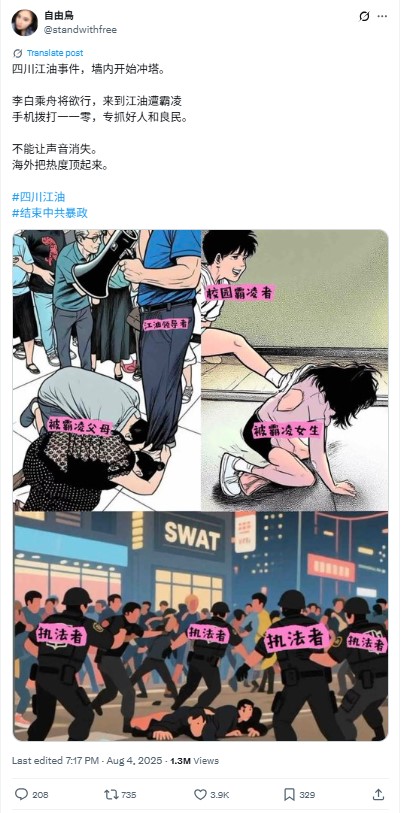
The cause of the matter is simple, an AI diagram of a bullying incident. In order to avoid the audit mechanism of the Communist Party of China as much as possible, so that public events are not blocked and spread, it is easiest to pass the review by using comics to restore or modify on-site events and mark them. And the war-progging picture was just downloaded from Chinese social media and sent back to Twitter. In order to protect the spreader, I deliberately cut off the original source and even lost the “citizens” of the original icon annotation. Who would have expected that a group of people shouting that they must rape and kill women rushed to the comment area, deliberately enlarging the short-haired problem of “campus bully” in the upper right corner of the cartoon, and criticized that a cartoon picture to spread the “suppression incident” was deliberately creating antagonism between men and women. ( If you are interested in checking the details, you can click the Twitter link: https://x.com/standwithfree/status/1952554527078626480). The picture comes from the author’s Twitter screenshot)
Judging from the production of comics, it can be understood that the labeler uses “people” to express the “upper” uniformly, and the “lower” is just a simple identification of identity, whether it is ordinary “parents” or “girls” and “citizens” cut off by the author. The critic’s focus is that the bully in the comics is short hair. Why are they painted as boys? I can’t help but ask when short hair became the “sexual characteristics” of boys? Chinese men’s braids have only been cut off since the 1911 Revolution, and they have had short hair for a hundred years. Some of them are still forced to cut by the government with scissors. Today’s Chinese men can’t have long hair, and women can’t have short hair.
Under the original sin of the evil government of the Communist Party of China, “lower rank” is not worthy of “people”, which is also the connotation conveyed by comics. Who cares whether the upper class is a man or a woman? The government’s inaction on campus violence and the suppression of people’s protests have been blurred and even forgotten.
Whether there are enough live videos and photos of bullying or suppression, maintaining correct memory depends on videos and photos, not a few comics to avoid review. Even if it’s a mixture of men and women, is it really important?
Isn’t bullying itself more important than men and women if it is not properly handled?
Isn’t it more important for ordinary people to kneel at the feet of Chinese Communist Party officials to pray for justice than men and women?
Isn’t it important enough that Chinese citizens are violently suppressed by the Communist Party of China government to fight for justice and peace?
From these important things, I see “hatred” and “malice”, which are the gradually expanding contradictions brought about by public opinion under the rule of the Communist Party of China. Hatred and evil towards women can’t help but make me feel cold.
From the beginning of the founding of the People’s Republic of China, the Communist Party of China has constantly created internal struggles to divert the contradictions between the Party and the people. What’s more, after the government, such as the conflicts of the cultural class created during the Cultural Revolution, the conflicts between landlords and peasants, etc., are countless. Now I seem to see a new round of “internal hatred”, gender hatred.
On August 10, 2025, a small news that a boy failed to harassed girls and stabbed more than a dozen times in a row, which confirmed the portrayal image of the author’s comments who only paid attention to the “adversion between men and women”.
Now in China, when facing public tragedy, some male groups do not choose to criticize power or pay attention to institutional oppression, but persist in gender struggles. Behind this, it is not only the distortion of gender consciousness, but also a political coldness and a collective psychological defense mechanism after being disciplined.
In a democratic society, when the people face police violence, institutional indifference and judicial injustice, they will naturally pay attention to issues such as institutional reform and power checks and balances. However, in China, especially on social media platforms, some Chinese male netizens rarely seem to question key issues such as “why the police suppress the masses” and “whether schools bear the responsibility for supervision”. Instead, they are more concerned about “whether feminists hyped this matter” and “whether women beat women should be laughed at”.
This kind of “misfocus” has its root cause. It is the Communist Party of China in the decades that has been in power. Through a complete set of discourse systems, words such as “civil rights”, “human rights”, “democracy” and “rights protection” have been stigmatized, and negative labels such as “overseas forces” and “color revolution” have been implanted, and successfully established a conditioned reflex mechanism of “anti-power is danger” in public psychology. In particular, men, who have been indoctrinated as the “backbone of the country” and “the pillar of the family”, are encouraged to maintain the status quo, obey the authority, and avoid questioning the state apparatus inside and outside the system.
In other words, the way power disciplines men is not oppression, but assimilation. In contrast, women often face more direct oppression in employment, education and marriage, and are more likely to realize the oppression of the system on individuals. Therefore, women are often present in many rights protection issues. And those men who are unwilling to reflect on the system regard this kind of female participation as “provocation” – so feminism, even just women, becomes “the most vulnerable scapegoat” in their eyes.
In recent years, the Communist Party of China has continuously strengthened nationalist propaganda and regarded the “traditional gender order” as part of national rejuvenation. Promote “women should not be too strong” and “boys should be masculine”, deny women and advocate the traditional patriarchal family structure. The spread of this trend is closely related to the emergence of gender antagonism.
In the current propaganda ideology, men are indoctrinated with the collective role of “dominating society” and are given the high hope of “saving the Chinese nation”. And when they encounter anxiety such as internal volume, unemployment, marriage panic, etc. in real life, they cannot point to the system that really oppresses them – because it is defined as an “untouchable” red line. Therefore, they transferred their anger to women who “look more free than them” and built a “chain of exploitation in fantasy”:
“We treat cows and horses, but women still need rights?”
This idea is absurd but communicative. It establishes a hostile imagination between the oppressed, so as to cleverly blame the power system, let the people fight each other, and divert the contradictions.
Many studies have pointed out that China’s “misogyny culture” has risen significantly in recent years. From “bitch”, “princess disease” and “pastoral feminism” to “short hair = male” and “no makeup = neutral”, gender stereotypes have become the core content of social network language violence. This kind of misogynism does not come from a single hatred, but a composite of social structure and cultural emotions.
Anxiety is externalized under the imbalance in the marriage and love market. In the face of the real dilemma of “can’t afford to marry a wife” and “can’t find a partner”, men blame it on “women’s pickiness” and “women’s power”. When the upward channel of the social class is blocked, and the sense of deprivation under the solidification of the class leads to the hallucination of sexual privilege, some people need a target that “lives better than me” as an outlet – women who seem to be independent on the Internet become the most suitable object. And in the traditional concept, “men should earn money to support their families”. In reality, this role requires that men at the bottom often feel failure and shame, so they are more likely to use the network to attack “them” to cover up self-denial, which is actually the collapse of self-worth.
Back to the Jiangyou incident, I must soberly point out that a young girl was bullied and asked for help to no avail, which was a tragedy of common negligence between the campus and society; parents had to kneel at the feet of the powerful to protect their rights; and the people spontaneously protested peacefully, but were brutally suppressed by the police, which was a serious conflict of power and human rights.
These three questions should have become the focus of common questions in society.
But now, public opinion wastes time on “whether the rhythm of women’s rights” and “whether short hair is male”, which shows the success of the speech manipulation of the totalitarian system. As long as the masses stand against each other and bite each other apart, no one will ask again: “How did the school dereliction of duty?” Why does the public security suppress the masses?” Who is responsible for the fate of a girl?” How can Chinese people hold the Communist Party of China accountable?”
What really should be reflected on is how a system has created so many victims of distrust, disunity and irrationality. Among these victims, some men choose to avoid facing social structural problems with “anti-feminism”, which is not accidental, but the inevitable result of institutional design.
I can’t deny the importance of gender issues, but I must also emphasize that the basis of all rights is the rights of “people” – regardless of gender, region or class.
In a country where the power structure continues to create “secondary contradictions”, any individual who truly cares about justice and freedom should learn to resist the means of being manipulated by public opinion and refocus on the original sin of the system.
Today, the death of a woman and the abuse of a group of women are not a “war between the sexes”, but a common oppression of “ordinary people” by the indifference of the system. It is simplified to “gait between men and women”, which is only helping power shield the real crime.
In every social event where human life is at risk, in every Chinese struggle for the rights they should have, when the people are against the power of the Communist Party of China, if a person cares most about “men and women”, then he has already been trained by power to lose the ability to sympathize, judge and act.
And this is the most vigilant point.
And this kind of current situation is the favorite status quo of the Communist Party of China.
Gather solidarity, Jiangyou girls, disclose the truth and deal with it fairly
Abstract: On August 10, a public rally organized by the Western Party Department of the Democratic Party of China was held in front of the Consulate of the Communist Party of China in Los Angeles to speak out for the girl who was bullied on campus in Jiangyou, Sichuan.
Author: He Qingfeng
Editor: Li Congling Responsible Editor: Luo Zhifei
Translator: Ming Cheng
On August 10, a public rally organized by the U.S. Western Party Department of the Democratic Party of China was held in front of the Consulate of the Communist Party of China in Los Angeles. Participants gathered together to speak out for the girl who was bullied on campus for 4 hours in Jiangyou, Sichuan. The on-site cry was deafening – not only for the victim and her family, but also for all the children who may become the next victim. During the activity, the participants strongly criticized the handling attitude of the relevant departments and called on the society to face the problem of youth campus bullying and the shortcomings of the centralized system behind it. This activity was hosted by Lv Feng, a member of the Democratic Party.
Recently, a video widely spread on the Internet attracted public attention. The video showed that an underage girl was slapped, kicked, forced to undress, and other insulting behaviors by several perpetrators in an abandoned building. The whole process lasted for up to 4 hours. The abuser not only recorded the video, but also spread it on the Internet, and shouted in the process: “Call the police, are we afraid? It will come out in twenty minutes.
According to people familiar with the matter, the victim’s mother is deaf and dumb, and her father is disabled, and her family conditions are difficult. After the incident, the victim’s parents called the police for help, but the police intervened late. In the end, the perpetrator was only lightly punished, which caused public dissatisfaction.
In today’s rally, the participants raised slogans and shouted slogans, demanding that the details of the case be disclosed, the legal responsibility of the abusters should be investigated, and the loopholes in the Juvenile Protection Law should be improved. Parents, teachers, students and social welfare figures participated at the scene. They believed that bullying was not a case, but a repeated tragedy under the centralized system of the Communist Party.
“What we are angry about is not only the bullying incident itself, but also the indifference and perfunctory of the Communist Party of China government after the incident.” There was also a father at the scene who shared his feelings. He said, “I didn’t dare to watch the video carefully at all”, because it was a double destruction of body and dignity. During the rally, many people mentioned a sharp contrast – during the hot screening of the movie Nanjing Photo Studio, the official shouted “We can’t forget history”, but in reality, it covered up the current truth.
The rally ended nearly two hours later, but the shouts did not stop. The organizers said that they would continue to follow up the progress of the case and take action again if necessary. One participant said at the end of the event: “Justice may be late, but it will not come by itself. It needs us to fight for it.” This rally is not only a response to bullying, but also a question of centralized tyranny and justice in law enforcement. People expect that a society that truly values the weak and respects the truth will come as soon as possible.
I am Zhong Ran, a member of the China Democracy Party. Today, together with my wife, Hu Lili, who is also a member of the China Democracy Party, I participated in the San Francisco stop of the Global Launch Ceremony of the “National Resistance Movement Declaration” at the Golden Gate Bridge.
Standing shoulder to shoulder with freedom-loving and democracy-seeking people around the world, we carry steadfast faith and fearless courage, vowing to end the CCP’s dictatorship and usher in a new era of freedom and democracy!
Author: Zhong Ran, Hu Lili Editor: Luo Zhifei Executive Editor: Lu Huiwen Translation: Lu Huiwen
Global “National Resistance Movement” Relay – San Francisco Stop: Democracy Advocates at the Golden Gate Bridge Vow to End Tyranny
Summary: On August 9, 2025, the “National Resistance Movement” took place in San Francisco.
Author: Hu Lili
Editor: Li Congling Executive Editor: Lu Huiwen Translation: Lu Huiwen
From August 8 to 9, 2025, the “National Resistance Movement” was held in relay fashion across more than a dozen cities, including New York, Washington, Los Angeles, San Francisco, London, Berlin, Sydney, Toronto, and Tokyo. Today, democracy advocates from the Bay Area and across the United States gathered near “Fort Point,” a World War II–era military post by the Golden Gate Bridge, sending a message to the world: end tyranny and pursue freedom and democracy.
Fort Point was built in the late 1850s to early 1860s and originally served as a key coastal defense fortification on the U.S. West Coast. During World War II, it was an important military outpost guarding against Japanese invasion. Today, it is a U.S. National Historic Landmark, symbolizing the resolve to defend one’s homeland and freedom. Holding this resistance rally here was not only a tribute to the historical spirit of safeguarding liberty but also a declaration of opposition to tyranny and defense of humanity’s universal values.
Today, shrouded in mist, the Golden Gate Bridge appeared and disappeared in the fog. Sea winds tousled the hair of the democracy advocates but could not shake their steadfast resolve. Fang Zheng, Chairman of the Chinese Democracy Education Foundation; Zhao Changqing, a leader of the 1989 student movement; and Chen Chuangchuang, Executive Director of the China Democracy Party National Committee, along with other prominent democracy figures, delivered speeches one after another, encouraging attendees to hold firm in their convictions and unite in action. Speakers stressed that the CCP’s authoritarian regime is the greatest obstacle to the Chinese people’s freedom and dignity, and that overseas democratic forces must rally more voices to drive global attention and action.
“It is time to act—with extraordinary determination and courage—to end tyranny and usher in a new era of freedom and democracy!” declared Fang Zheng in his passionate address, capturing the core demand of the National Resistance Movement.
At the end of the ceremony, all participants released balloons printed with the phrases “Go Rolling, CCP” and “Democracy, Freedom, Civilization,” symbolizing the Chinese people’s message to the CCP and Xi Jinping: “Go rolling!”
This San Francisco rally not only resonated with gatherings in other cities worldwide but also laid the groundwork for larger-scale international joint actions in the future. Organizers stated that the relay will continue to expand to more cities until the dawn of freedom shines upon China.
Some photos in this article were provided by Yongjie Guan.