Abstract:This article examines the foundational role of the Bible in shaping modern political systems and human rights concepts. It argues that two central biblical political principles—God’s supreme sovereignty and the belief that humans are created in the image of God—form the philosophical basis for limited government and the inviolability of human rights. Through comparative analysis of the U.S. Constitution, the separation of powers, popular sovereignty, and religious freedom, the article reveals the profound impact of biblical political theology on modern constitutional systems. It further demonstrates that the universality and moral legitimacy of modern human rights originate from biblical anthropology. Drawing on historical counterexamples such as the French Revolution and communism, the author concludes that once political systems abandon the transcendent foundation of Scripture, they inevitably slide into totalitarianism and nihilism. The article contends that biblical political principles not only shaped Western civilization but also offer essential insights for China’s future political transformation.
The Bible is not merely a religious text—it is the foundational document of Western political civilization. Modern constitutional democracy, human rights, and the core principles of the international order are all shaped—at the deepest historical and intellectual levels—by the biblical worldview. This article will examine the Bible’s foundational role in the formation of modern political institutions through the lenses of constitutional structure, the origins of human rights, mechanisms limiting governmental power, and the political crises faced by nations that abandon biblical foundations. It will also explore the implications of biblical political thought for the future of China.
I. Core Biblical Political Principles: God Above Kings, Humans Made in God’s Image
The Bible articulates two political principles with far-reaching consequences:
1. God is the supreme sovereign; governmental authority is delegated, not inherent.
Romans 13:1 — “There is no authority except that which God has established.”Kings are merely stewards. They do not possess absolute power. This destroys the legitimacy of ancient autocracies and divine-right monarchy.
2. Humans are created in the image of God and therefore possess inherent dignity.
Genesis 1:27 — “So God created mankind in His own image.”Human rights are thus God-given, not granted by governments, and cannot be legitimately taken away.
These two principles provide the philosophical foundation of all modern politics: government is limited, human rights are inviolable, and law stands above rulers.
II. The Bible’s Structural Influence on the U.S. Constitution
Although the United States was founded as a secular republic, its political architecture is deeply rooted in biblical political theology. Key parallels include:
James Madison famously wrote: “If men were angels, no government would be necessary. If angels were to govern men, no controls on government would be necessary.” This insight mirrors the biblical doctrine of human fallenness.
III. The Biblical Foundation of Modern Human Rights
1. The source of rights: theological, not political
Modern human rights theory asks: Why do humans have rights? Why can’t government take them away?
The Bible answers:
Human rights arise from humans being bearers of the imago Dei (God’s image).
Human dignity does not depend on social status or governmental recognition.
2. The inviolability of human rights
The Ten Commandments prohibit murder, theft, and enslavement, establishing protections for life and property.
Leviticus emphasizes equal application of the law regardless of wealth or status.
3. The universality of human rights
John 3:16 — “For God so loved the world.”This universal love forms the moral foundation of the Universal Declaration of Human Rights.
IV. Biblical Mechanisms of Political Restraint: The Deep Roots of Anti-Totalitarianism
The American Revolution was justified theologically: Britain had violated the God-given freedoms of the colonists, making revolution an act of obedience to divine justice—not rebellion.
V. What Happens When Politics Abandons the Bible?
Case 1: The French Revolution — dechristianization leading to terror
Grounding rights in “the will of the people” rather than divine law caused that “will” to devolve into mob rule, culminating in Robespierre’s Reign of Terror and Napoleon’s dictatorship.
Case 2: Communism — an atheistic system that denies human dignity
Marxism-Leninism rejects God and the idea that humans bear God’s image, reducing humans to tools of production. The result: gulags, the Cultural Revolution, Khmer Rouge massacres—catastrophic violations of human rights.
Conclusion:Deny God → deny human dignity → political systems sink inevitably into totalitarianism.
VI. What Biblical Political Principles Mean for China
Justice above power: Legitimacy depends on righteousness, not control.
Humans are ends, not means: This demands human-rights protection and genuine rule of law.
Government must be limited: The Bible provides moral boundaries for governance.
National renewal: China’s political future requires a return to universal moral foundations, not simply copying the West.
Proverbs 14:34 — “Righteousness exalts a nation, but sin condemns any people.”
Conclusion
The Bible is not an outdated religious document; it is the foundation of modern political civilization.Constitutionalism, human rights, and democracy are not inventions of human reason alone—they grew from the soil of the biblical worldview.
A modern nation that seeks to preserve human dignity and freedom must acknowledge a moral authority higher than the state.Without such a foundation, modern civilization collapses into nihilism and authoritarianism.
Biblical political thought is not a relic of the past—it is the source and future of civilization.
Abstract:This article exposes how the Chinese Communist Party uses the charge of “secession” to suppress democratic voices in Taiwan. It criticizes the CCP’s cross-border intimidation, speech suppression, and manipulation of legal tools. The author calls for unity in resisting authoritarian interference, defending freedom of expression, and safeguarding Taiwan’s democratic values and dignity.
The Chongqing Public Security Bureau has recently launched a so-called “criminal investigation” against Taiwanese legislator Puma Shen, accusing him of “secession.”Shen is a scholar-legislator dedicated to Taiwan’s defense and civic education. Everything he has said and done is fully lawful. Yet the CCP dares to apply its domestic laws to a democratically elected representative of Taiwan. This is not law enforcement—this is cross-border political intimidation aimed at silencing Taiwan and creating fear.
Media have called this tactic “distant-water fishing”—reaching across borders to suppress people outside the CCP’s jurisdiction. By filing a case against Shen, Beijing is trying to interfere in Taiwan’s internal politics and warn everyone: whoever speaks the truth will be punished. If this becomes a pattern, Shen’s case will not be the last. More people will be targeted.
Every person of Chinese heritage must be clear: The CCP has no right to rewrite history, and no authority to decide Taiwan’s future. Taiwan has its own government, constitution, elections, and freedom of speech. These rights are not negotiable and cannot be taken away by any external dictatorship. Taiwan has proved that a Mandarin-speaking society can thrive in freedom and under the rule of law. Taiwan’s future must be decided by its own people—never by an authoritarian regime across the strait.
But the CCP has never stopped pushing. Through cross-border intimidation, legal manipulation, and media pressure, Beijing keeps trying to limit Taiwan’s democracy. This is not only an attack on Taiwan’s internal order—it challenges universal principles of freedom and rule of law worldwide. Freedom is not something to compromise.
Silence is surrender. Retreat is defeat. Taiwan must strengthen its protections, preserve its space for free expression, and speak out together. Only determined action can show the world: Taiwan will not be threatened. Democracy will not be crushed. Freedom will not be surrendered. Stand together. Stand against the CCP. Stand for Taiwan’s dignity and freedom.
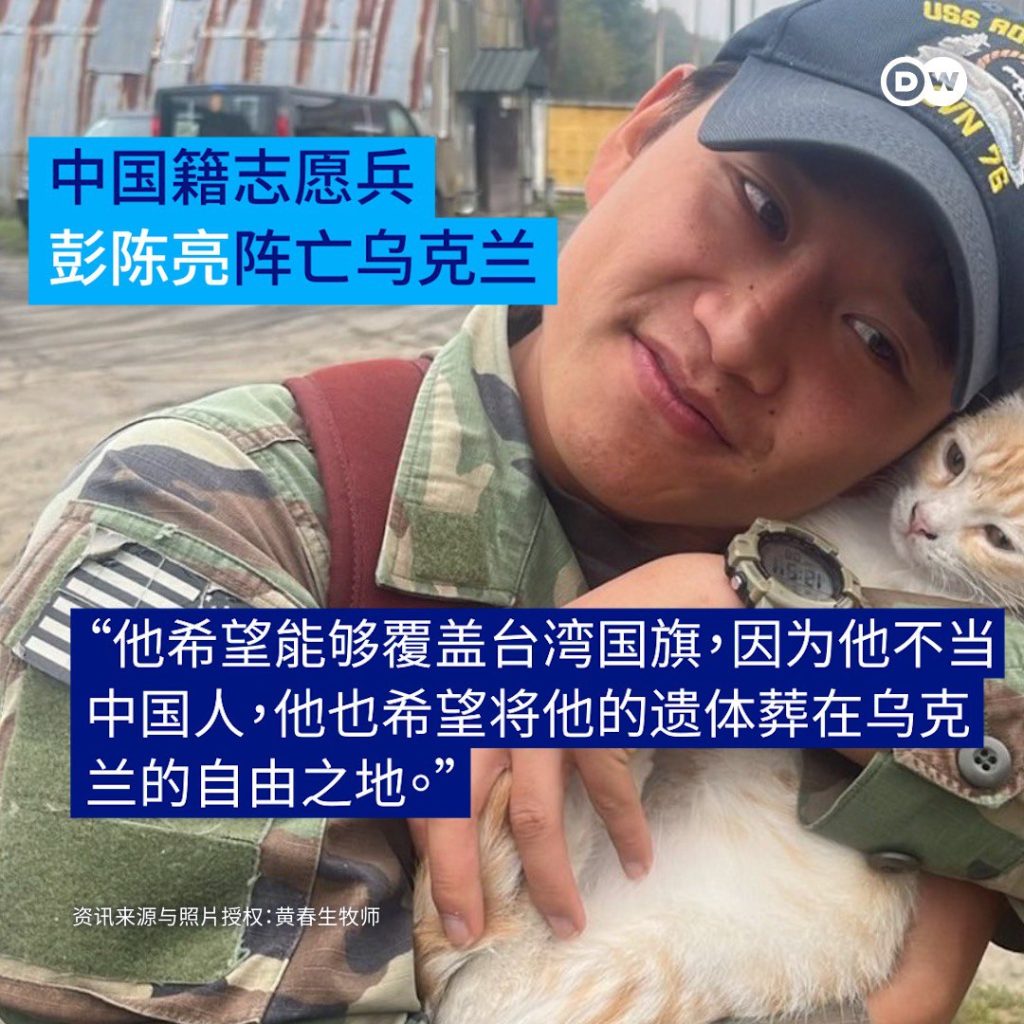
Eternal Free Man — In Memory of Peng Chenliang One Year After His Sacrifice(Farias, 1994–2024)
Author: He Yu Editor: Li Jing Executive Editor: Hou Gaiying Proofreader: Cheng Xiaoxiao Translator:Xiaomei Peng
Introduction
Nearly a year has passed. When I rewatched the memorial video Freeman made for the soldiers who fell in the Russo-Ukrainian war, I was once again shaken by his final words—fearless and resolute even in the face of death.On the night of November 4, I received a video link forwarded by Elder Zhu along with his instruction:(https://youtu.be/bq0lrW25l30?si=wTZzrvR0wijT6QDg)“Today is the first anniversary of Peng Chen liang’s sacrifice in Ukraine. Please write it down and publish it in Issue 17.”Only then did I suddenly realize—he has been gone for a full year. Entrusted with this task, I felt both honored and anxious. After much reflection, I decided to restore Freeman’s oral accounts as faithfully as possible, to build for Peng Chenliang a memorial that can be read again. They were comrades, but also closest friends. Every detail of their shared life is the best tribute to a hero. Below is the presentation of Freeman’s spoken memories.
I. His Final Words and Last Wishes
“I am a soldier of the International Legion. If one day something happens to me, please place my photo and my flag—the Blue Sky, White Sun, and a Wholly Red Earth—next to Tseng Sheng-Kuang (the first Taiwanese volunteer killed in action).I will not return to Mainland China.Let my body be covered with this flag—not the five-starred red flag, but the Blue Sky, White Sun, or the Ukrainian flag. We fight for freedom. We fight for democracy. If war ever breaks out in Taiwan, every one of us will go to defend her. We will give everything to safeguard democracy and fight the CCP to the very end.”
II. His Story with Us
I first met Farias in April 2024. That early morning, due to delays on the bus to Lviv, he waited at the station until curfew, then had to return home. By the time I finally got off, I found my way to his building, and he came out to the corridor to greet me. That night we hugged and talked until two or three in the morning. I knew he was talkative; he also had endless things to share with me.
After that, we were in contact nearly every day. In training assignments, I joined a mechanized unit of the Ukrainian army; he went to the International Legion, primarily light infantry.On September 29, we had our last shared leave. After returning to our units, we still called often—sometimes for one or two hours—about friends, about girls we liked, about frustrations in the army. Nothing was off limits. We made four episodes of our channel together. We were cyber-harassed together, banned together. We wrote postcards to supporters together.We laughed (or complained) at programs like “1989,” “Teacher Li,” or Tsao Hsing-Cheng’s show. Even our wills—we entrusted them to each other.
III. The Road to Awakening: From ‘Little Pink’ to ‘Free Man’
Raised under the full indoctrination of mainland China’s education, Farias was once a “Little Pink,” even criticizing President Tsai Ing-wen’s statement that “the two sides of the Strait are not subordinate to each other.” But after entering society and experiencing hardship and lack of freedom firsthand, he gradually awakened, turning toward liberal democracy, and sought to atone for his earlier views through action. He stood up again and again:
After the 2021 Zhengzhou flood disaster, he condemned the authorities’ concealment of death numbers.
On multiple ROC National Days, he proudly displayed the Blue Sky, White Sun flag to friends.
He took photos under “One Country, Two Systems Unify Taiwan” propaganda in Fujian and said: “To hell with your One Country, Two Systems.”
During the White Paper Movement, he silently held up a blank sheet in his social media.
When Russia launched its full-scale invasion of Ukraine, he denounced Putin as a war criminal.
For these actions, he was repeatedly muted on social media, summoned by police for “tea,” and even detained in a precinct. But he never stopped fighting. He often reminded me: “Even if one of us gets killed, the other must Keep Fighting—until the CCP dictatorship no longer threatens us.”
On identity, he rejected ethnic nationalism. He disliked calling himself “Chinese.” He preferred: “I’m an American in spirit.” “I’m a West-Taiwanese.” “I am someone who fights for freedom and democracy, whose conscience hasn’t died.” In formal documents he filled “China,” but in private he mocked ultranationalist slogans: “Already living overseas yet insisting on being a ‘dignified Chinese’—that’s like fleeing Earth but still obsessed with being a ‘dignified Earthling’! Ridiculous!”
Pro-Russia disinformation once claimed he was a mercenary. In reality, he often spent more on gear than he earned. As he said: “If we were real mercenaries, we’d love to get actual mercenary pay. What we get barely covers a scope or a thermal sight.”
IV. Hardship and Misfortune: Cheated, Detained, Yet Never Turning Back
On the road to joining the Ukrainian army, he encountered obstacle after obstacle—visa troubles, bureaucratic hurdles, and even scammers. One man, using the alias “Li Yong” (real name likely Cao Zijng), swindled at least $3,000 from him, fabricating excuse after excuse while offering no actual help. Even after being detained for seven months on the charge of “picking quarrels and provoking trouble,” he still walked step by step toward the battlefield—toward the front. He never turned back.
V. An American in Spirit, A Heart Belonging to Lviv
In 2015, he received American-style military training on Saipan, a U.S. territory. From then on, he loved the United States and the U.S. military, often wearing clothing featuring the Stars and Stripes. If asked, he would say: “I’m an American in spirit. I fight for the values the U.S. flag represents. “Many American teammates and instructors appreciated him deeply for this.
In Ukraine, he often wore a U.S. flag patch to honor his beliefs. But because Russian spies hunted volunteers and because some Russian-speaking locals held anti-American sentiments, I advised him to keep a lower profile. He refused: “We are Freedom Fighters. If we hide ourselves because of the enemy, how is that any different from living under China’s oppression?”
When the spoke of “homesickness,” he meant Lviv. Not because of the beautiful, classical architecture, though he loved it. But because of the person he loved—his girlfriend, a Lviv woman whose family also liked him very much. We once walked through the streets of Lviv together and filmed an episode. At the city’s only military cemetery, he told me: “If I fall, I want to be buried here.”
VI. Voluntary Mission and the Transfer That Never Happened
His final mission was entirely voluntary. By that time, he had already passed interviews and was waiting to transfer to an infantry unit. He could have chosen to stay behind. But he said: “The Russians are attacking like mad. If I don’t go, someone else will have to. “Even being in a “safe” location was no guarantee—frontlines can collapse overnight. Russian pressure had caused temporary Ukrainian errors, poor communication, and low morale. This also influenced his decision. But at the root, it was his profound sense of responsibility.
He could have stayed in the UAV unit as a drone operator—he had an engineering degree, had been a fitness coach, and was a drone instructor. But his heart was set on becoming an infantry soldier, fighting alongside the three Taiwanese volunteers he deeply admired. He passed the interview. But the paperwork wasn’t completed in time.
We once tried persuading him to join a “war-tech upgrading” support project—based on his skills, he could have contributed enormously to improving operational effectiveness.But he insisted: “I need more frontline experience first. Only then will my advice carry weight. “I understood. But now, many Ukrainian friends keep asking me: “Should we have tried harder?Pulled him back one more step?”
VII. The News and the Promise
Early November 2024, Donbas front. On November 4 at 2:30 p.m., his trench mate informed me that he had been killed. Multiple confirmations followed. Even now it feels like yesterday. Before his death, he told me: “If I die, make sure my information is handled properly. My story must be told truthfully—not twisted by Russian or CCP propaganda.”
He also entrusted me with his final wish:
Cover him with the Blue Sky, White Sun flag
Or the Ukrainian flag
Do not send his body back to Mainland China
Lay him to rest in Ukraine—the free land he loved and died defending
He even asked two Taiwanese friends to help him buy the flags and ended up owing me a small amount—just a few dozen dollars. I was happy he “owed” me. I never wanted him to pay it back.
My phone was soaked with tears for days. A British female soldier, Tanya, asked me: “Why Farias? He was such a good guy.” I had no answer. We made a pact: No matter what happens, we will Keep Fighting till the End. He’s gone now. But I will keep my promise. I will fight on—until victory.
VIII. Testimony and Clarification
Russian sources once deliberately claimed he was “Taiwanese,” attempting to smear and mislead. The truth is this: He was born in Yunnan, China. He held a PRC passport.He is the only known Chinese citizen who served in the Ukrainian forces and died in action. During his second interview, the commander and officers questioned him for thirty minutes straight—they had never seen a Chinese volunteer before. He was not an “ultranationalist.”He was not a “mercenary.” He was a Free Man.
He died shortly after turning thirty. He was my comrade, my friend, my beloved brother-in-arms—a free soul. He lived like a hero, and he died like one. If “hero” means a person who performs acts of extraordinary courage on behalf of others— then he deserved that title beyond all doubt. The founding purpose of our “Democratic Guard” was to defend the freedom and democracy we cherish—especially on the frontlines of Ukraine and Taiwan. Now, without you, I often feel my strength is not enough. But as you wished, I will Keep Fighting, until the very end.
IX. Prayer
A Prayer for Farias
Dear Lord,
We lift up this brother, this comrade, this friend before You.He was born in Yunnan, yet his heart belonged to the land of freedom.On the soil of Ukraine, he gave his young life.
May You comfort his family, his beloved, his friends, and his fellow soldiers.In a place of tears and brokenness, grant them peace that comes only from You.
Lord, he longed for truth to be told rightly, without distortion or slander.Guard our conscience and our memory,that his name may not rest only on a grave,but live on wherever freedom grows.
If darkness has not yet lifted,grant us courage and wisdomto fulfill his final wish—to Keep Fightinguntil justice shines like the light,until freedom stands without fear.
Into Your hands we entrust Farias:May he rest in the radiance of Your glory.May his footsteps illuminate the road ahead of us.
Author: Zhang Yu Editor: Xing Wenjuan Executive Editor: Li Congling Proofreader: Cheng Xiaoxiao Translator: Liu Fang
Abstract: This article criticizes China’s recent suppression of free speech, the erosion of legal principles, and the systematic deprivation of citizens’ rights. It reveals how charges such as “subversion of state power” have become tools to silence dissent, and questions whether any space for freedom of thought still remains.
“The simplest way to destroy a people is to corrupt their language.” —George Orwell
Language is the breath of human thought. How do we measure whether a society is healthy? Not by the height of its buildings, nor by the length of its high-speed railways, nor by the speed of its factory machines. The one and only standard is whether its people can speak freely.
Yet in today’s China, many words are quietly being “disappeared.” “Divorce” has become an ominous topic, “suicide” an unspeakable term. Words such as “rights defense,” “protest,” and “truth”—once part of ordinary civic vocabulary—have been sentenced to a silent death by algorithms and systems.
The literary inquisition was a tool of feudal autocracy—political persecution wielded by emperors against scholars. Its history is as long as imperial rule itself, and reached brutal extremes during the reigns of Yongzheng and Qianlong. A scholar who wrote the words “Heaven and Earth Society” could be charged with treason. A poem containing “bright moon” might be interpreted as longing for the previous dynasty—punishable by beheading. Even the phrase “white clouds and grey dogs” could be taken as slander against the emperor, resulting in exile or execution.
History textbooks tell us that era is long gone. But today, when we open our computers or phones and see “This content cannot be displayed” or “This content is deemed sensitive,” when word after word disappears from public discourse—is this not another form of literary inquisition? Is modern China lacking examples of people punished for speech?
The difference is this: In ancient times, people knew they were being silenced. Today, many don’t even realize they once had the right to speak. That is the most terrifying part—when silence becomes habit, injustice begins to appear normal.
When a state censors even individual words, it is not merely afraid of speech—it is afraid of its people thinking. If the people learn to speak the truth, lies can no longer stand.
(Photo provided by Zhang Yu, taken at a November 1 rally on the Hollywood Walk of Fame in Los Angeles.)
In 2019, while the CCP celebrated the 70th anniversary of its founding with a massive military parade, it arrested numerous so-called “unpatriotic individuals.” Some were detained simply for posting comments the authorities disliked. One case was particularly absurd: a man in Sichuan wrote, “What’s so great about a military parade?” Another netizen in Shandong said, “It wasn’t the motherland who raised you—it was your mom.” Both were detained.
Huang Genbao, a 45-year-old senior engineer at a state-owned company in Xuzhou, was sentenced to 16 months in prison in June 2019. His “crime” was insulting state leaders and “damaging the nation’s image” on Twitter. During imprisonment, he shared a cell with more than 20 people and had to follow rigid routines, even for using the toilet. Both he and his wife lost their jobs, and he now delivers food to support his family.
In April 2020, three young Beijing residents—born in the 1990s—went missing after archiving online articles deleted during the COVID-19 outbreak. Chen Mei and Cai Wei were formally arrested for “picking quarrels and provoking trouble.”
Perhaps the most heartbreaking cases are those punished for speaking about the COVID-19 pandemic. At the top of the list is Dr. Li Wenliang. On January 1, 2020, he and seven others were reprimanded for warning friends and colleagues about the coronavirus. He died of COVID-19 on February 6, 2020, and is now widely remembered as a whistleblower. But beyond Dr. Li, 587 other individuals were penalized for COVID-related speech.
There are also well-known figures widely reported by the media: real estate tycoon Ren Zhiqiang, who called Xi Jinping a “clown stripped naked” and was sentenced to 18 years; former Tsinghua professor Xu Zhangrun, dismissed for his critical essays; publisher Geng Xiaonan, charged with “illegal business operations” for supporting prisoners of conscience; Cai Xia, a former Party school professor expelled for calling the CCP a “political zombie”; and journalist Zhang Zhan, imprisoned for reporting on the Wuhan outbreak.
(Photo: Los Angeles Freedom Sculpture Park, symbolizing that whistleblowers in China bear extreme costs—death, prison, or disappearance.)
Today, the CCP uses the ideology of “only socialism can save China,” and “whoever opposes the Party or socialism is a counterrevolutionary,” as a judicial weapon to suppress human-rights defenders, democracy advocates, and intellectuals who fight for freedom.
Even now—when “socialist rule of law” has supposedly been written into the Constitution—this persecution of speech and thought grows ever more severe, cloaked in new forms. The CCP has incorporated such repression into law enforcement using the charge of “inciting subversion of state power.”
This charge fundamentally contradicts constitutional principles. It mirrors the old “counterrevolutionary crimes,” functioning solely to use the law as a tool of political persecution—silencing those who dare to criticize authoritarian rule.
“Inciting subversion of state power” is a paradox in the modern rule-of-law framework. Its essence is brute-force suppression—nothing but a chain of authoritarian violence used to crush free speech and free thought. A chain that violates the Constitution and suppresses freedom and democracy will, inevitably, be shattered by the political tide of the Chinese people’s struggle for a free and democratic constitutional order.
The CCP’s effort to suppress language will not succeed forever. Whenever truth is blocked, people find new ways to express it.
When words are deleted, people invent new ones. When topics are banned, people change their tone and ask again.
This is the instinct of human thought, the natural rebellion of consciousness.
History has shown again and again: no matter how tall the wall, it cannot stop the flow of ideas.
When the CCP tries to control language, it reveals its own fear— fear of being questioned, fear of being exposed, fear of being remembered.
History teaches us this: any regime that imposes extreme authoritarian control over its people will ultimately collapse under the weight of public outcry.
Why “Small Incidents” Become “Great Disasters” Under Totalitarian Rule
Abstract: In totalitarian systems, small problems are concealed due to information blockades and bureaucratic inertia, allowing tensions to accumulate until they erupt into major crises. When chaos finally breaks out, the regime suppresses it through its model of “concentrating power to accomplish big tasks,” forming a recurring cycle of concealment—loss of control—repression. This vicious cycle reveals governance failures and exposes a deep crisis of legitimacy.
Author: Zhang Xinggui Editor: Li Congling Executive Editor: Luo Zhifei Proofreader: Cheng Xiaoxiao Translator: Liu Fang
A paradox repeatedly unfolds under totalitarian rule: a “small incident” is always allowed to fester until it grows into a regional or even nationwide “major event.” Once the crisis spirals out of control, the regime inevitably responds by “concentrating power to accomplish big tasks,” smashing everything with overwhelming force. This seemingly contradictory cycle is no accident—it is the inevitable outcome of totalitarian governance logic. It reveals both the arrogance and fragility of power; it reflects not only routine governance failures but also the performative nature of crisis response.
I. Small Incidents Are Covered Up—Information Monopoly and Failure to Correct Errors The core of totalitarianism is the absolute monopoly over information, resources, and power. Within such a structure, any “small problem” may be treated as a threat to the official narrative, and is therefore systematically concealed from the beginning. Information flow is blocked at every level. Grassroots officials understand that reporting negative news brings political risk. Thus concealment, downplaying, and labeling issues as “isolated cases” become routine. A simple livelihood complaint is dismissed as “making trouble” at the township level, classified as a “localized issue” at the county level, and disappears entirely under “overall stability” in provincial reports. Central leaders always see a carefully polished reality. The power structure rejects correction. Totalitarian logic demands “centralized and unified leadership,” leaving grassroots officials unable—and afraid—to act proactively when problems first appear. “The less trouble, the better,” “No action without instructions”—such vertical dependence eliminates any chance for small issues to be addressed in time. Minor illnesses go untreated, eventually becoming major crises.
II. Major Disasters Erupt—Pressure Accumulation and the Absence of Relief Valves When small issues are continually suppressed, social grievances accumulate like underground magma, heating steadily. Totalitarian regimes appear solid on the surface but lack resilience. They have no independent judiciary, no free press, and no pluralistic oversight to serve as “pressure valves.” Thus the tension erupts in more violent ways. On one hand, public trust erodes continuously. People repeatedly experience “no channel for complaints, no result from seeking justice, truth being concealed,” and gradually form a collective memory: small issues are ignored until they explode. Once an accidental event touches a raw nerve—whether it is a traffic accident, a law enforcement conflict, or a viral video—pent-up resentment ignites instantly, evolving into mass incidents. On the other hand, technology accelerates the loss of control. In the internet age, information spreads faster than censorship. A single video or post can break through all barriers within hours. The combined force of technology and public anger often turns a “small incident” into a “great disaster” almost overnight.
III. Concentrating Power to Accomplish Big Tasks—Extraordinary Response and Performative Governance Once a crisis fully erupts, the totalitarian regime deploys its “ultimate solution”: concentrating power to accomplish big tasks. The military, police, propaganda apparatus, and financial resources are rapidly mobilized to crush the unrest with overwhelming force. This model can indeed “restore order” quickly—roadblocks, mass arrests, censorship—executed with stunning speed and scale. But this is not evidence of effective governance; it is merely an extraordinary emergency response. It relies on unchecked power that mobilizes resources across regions and agencies without regard for due process. Decisions are made without oversight, regardless of cost or efficiency. Consequences carry no accountability: earlier failures go unpunished, and deep structural issues remain untouched.
IV. The Root of the Vicious Cycle—The Structural Absence of Feedback Mechanisms Why does totalitarianism fall into the cycle of “small incident → great disaster → concentrated power intervention”? The fundamental cause is the absence of normal governance feedback mechanisms. In democratic societies, small issues are exposed by the media, creating public pressure that drives policy adjustment. Officials are accountable and must respond to the public. In totalitarian systems, small issues are concealed and postponed until emergencies force reactive interventions. Officials answer only to their superiors, never to the people. Thus neglect → breakdown → force becomes the only available path.
Totalitarian regimes appear powerful, yet are fatally vulnerable to small problems. They conceal small issues to preserve their image; they concentrate power to handle big ones to salvage control. But each cycle erodes public trust and accumulates new dangers. Real governance is not about “spectacular rescues” during crises, but about “preventing problems at their root” in everyday governance. True strength is not the ability to “carry out big tasks,” but the ability to keep small issues from becoming catastrophes. A regime that does not dare face small problems will eventually be destroyed by big ones; a system that relies solely on concentrated power will one day discover that no amount of force can mend the cracks created by the loss of public trust.
“CCP ≠ China ≠ Chinese”。这句话看似简单,其实是一场思想的复原。它让我们从语言里夺回真相,也让世界学会分辨一个政权与一个民族的区别。苏联共产党不是苏联,不能代表俄罗斯;纳粹也不是德国,不能代表德意志。同样,中共不是中国,更不能代表中国人。真正的中国不在天安门城楼上,更不在于那面巨大的党旗,它在人民的心里,在那些仍相信自由与公义的人心里。
The CCP Is Not China, and It Does Not Represent the Chinese People
Author: Zhou Xiaoxing Editor: Hu Jing Executive Editor: Li Congling Proofreader: Cheng Xiaoxiao Translator: Liu Fang
Abstract: In real life, many people fail to distinguish the Party from the state, or the nation from its people. They mistakenly equate the CCP with China, and with the Chinese people. As a result, the CCP’s crimes and abuses are unfairly projected onto the country and its citizens. This is wrong. Not all Chinese people praise or identify with the CCP.
In today’s world, the misunderstanding surrounding the word “China” has grown astonishingly deep. Many people take criticism of the CCP as criticism of China itself, and further extend this criticism to the entire Chinese nation—treating the arrogance of an authoritarian regime as the face of the Chinese people. In truth, this confusion is a political tactic the CCP has perfected. To help the world understand China again, the first step is simple: the CCP is not China, and it does not represent the Chinese people.
In recent years, I have often heard the question, “Why are you Chinese like this?” Every time, my heart tightens. I know they are referring to the CCP’s brutality, its authoritarian arrogance, its wolf-warrior rage. Yet in that moment, Chinese people themselves become the scapegoats. I often ask myself: how many more years will it take before the world understands a simple truth—the CCP is not China, and it does not represent the Chinese people?
The CCP loves binding itself to China. From “Without the Communist Party, there would be no New China” to “Criticizing the Party is insulting China,” it deliberately blurs language and swaps concepts, turning the fate of a political regime into the fate of a nation. But the real China is far older than the CCP. Two thousand years before Karl Marx was even born, China already had the Book of Songs, already had Confucius and Mencius, already had the Silk Road. That is the China of civilization—not the China of the Party-state. The CCP is an accident in history, a nightmare for a nation. It is not the entirety of China, nor can it represent China.
Many foreigners confuse the CCP with China—and this is exactly what the CCP wants. It pushes 1.4 billion people in front of itself as a human shield; “1.4 billion people” becomes its political armor. It claims to represent the Chinese people, yet never allows the Chinese people to represent themselves. Those who dare to speak out are disappeared, put on trial, or forced into exile. It uses the name of “China” to suppress Chinese; uses “the state” to crush individuals; replaces “citizens” with the political term “the people”; demands silence in the name of “patriotism.” This deliberate confusion and political hostage-taking is the CCP’s most sophisticated form of violence.
China does not belong to the Communist Party, and the Chinese people are not the Party’s slaves. Look at the imprisoned lawyers, the expelled journalists, the demolished churches, the suffocated internet—you will understand the hardships real Chinese people endure. They are the conscience of the nation; they represent the silenced China. Opposing the CCP is not hostility toward the Chinese people—on the contrary, it is a form of respect. Only by resisting the CCP can this nation have a future and hope.
“CCP ≠ China ≠ Chinese.” This phrase seems simple, yet it restores clarity of thought. It reclaims truth from political language and teaches the world to distinguish between a regime and a people. The Soviet Communist Party was not the Soviet Union and did not represent Russians. The Nazis were not Germany and did not represent the German people. Likewise, the CCP is not China and certainly does not represent the Chinese.
The real China is not on Tiananmen Gate, nor in that massive Party flag. It is in the hearts of the people—in those who still believe in freedom and justice.
I firmly believe that five thousand years of civilization cannot be rewritten by a single political party. One day, the CCP will be cast aside by history just as the Soviet Communist Party was. China will remain. The Chinese people will remain. And only then will the world fully understand this truth: The CCP is not China, and it does not represent the Chinese people. This statement is not only a clarification of fact—it is a restoration of dignity.
Abstract:On October 25, 2025, numerous groups gathered in front of the Chinese Consulate in Los Angeles to condemn the CCP’s persecution of dissidents Xing Wangli and Zhang Pancheng, calling on the international community to pay close attention to China’s human rights situation.
On October 25, 2025, outside the Chinese Consulate General in Los Angeles, the Los Angeles Committee of the China Democracy Party, the China Democracy & Human Rights Alliance, and Opposition Party magazine jointly held a protest condemning the Chinese Communist Party’s long-term persecution of Xing Wangli and Zhang Pancheng, calling on the international community to pay urgent attention to their situation.
Chinese citizen Zhang Pancheng has repeatedly been imprisoned for his commitment to freedom of expression and social justice. Fearless in the face of authoritarian power, he exposed social injustices and spoke out for persecuted citizens and prisoners of conscience. He was repeatedly jailed on the charge of “picking quarrels and provoking trouble.” Even after release, he continued to face harassment and surveillance, and was forcibly labeled as “mentally ill.” His ID card and household registration were confiscated, and his freedom of movement was stripped.
In July 2024, he was again placed under criminal detention. He has since disappeared, with no information about his whereabouts.
Another Chinese citizen, Xing Wangli, has spent twenty years defending rights, only to receive a decade of imprisonment and injuries as severe as skull fractures. Over the past two decades, he has been illegally detained for a total of 10 years and 8 months, and was subjected to repeated administrative detentions, illegal house arrests, and “residential surveillance.”
Since 2002, Xing began his difficult journey of rights defense—from handling his own grievances to helping others for years.In 2016, he was violently beaten in prison, causing comminuted fractures of the skull.In 2019, Chinese police even conducted a cross-border operation to seize his son, Xing Jian.
In June 2024, while Chinese Premier Li Qiang was visiting New Zealand, Xing Jian held a protest sign outside Li Qiang’s hotel denouncing CCP tyranny and calling for his resignation. He was assaulted on site by pro-CCP individuals. New Zealand’s major media outlet Stuff reported on the incident. Shortly afterward, Xing Jian’s residence was splashed with feces, and crystalline substances suspected to be methamphetamine were thrown onto the property.
In August 2025, Xing Wangli was once again framed by the CCP with the charge of “picking quarrels and provoking trouble,” and was unjustly sentenced to three years in prison. On that very day, Xing Jian personally attended the protest in Los Angeles to show support for his father.
The photo shows the initiators and hosts of the event: from left to right — He Yu, Zhang Xiaoli in the center, and Zeng Qunlan on the right.
We call on the Chinese government to disclose the current conditions of Xing Wangli and Zhang Pancheng, to safeguard their basic human rights, and to cease all persecution against dissidents and their family members.


张宇-中国新的文字狱时代-rId7-1916X1440.jpeg?w=768&resize=768,0&ssl=1 "中国新的文字狱时代")
张宇-中国新的文字狱时代-rId7-1916X1440.jpeg "中国新的文字狱时代")
张宇-中国新的文字狱时代-rId9-1698X1128.jpeg)
曾群兰-rId5-640X424.jpeg?w=768&resize=768,0&ssl=1 "以良知抗暴政,以真相照黑暗——第761次茉莉花行动在洛杉矶举行")
曾群兰-rId5-640X424.jpeg "以良知抗暴政,以真相照黑暗——第761次茉莉花行动在洛杉矶举行")
曾群兰-rId6-640X480.jpeg)
曾群兰-rId7-640X480.jpeg)