From Iran’s “Decapitation Strike” to Asymmetric Deterrence in the Taiwan Strait
Author: Miao Qing, Reporter of The Opposition PartyEditor: Zhou Zhigang Proofreader: Xiong Bian Translator: Peng Xiaomei
I. A Convergence of History: The Memory of February 28 and a Shock in the Middle East
On February 28, 2026, history produced a meaningful convergence across different parts of the world.
On that day, Taiwanese society continued commemorating the February 28 Incident of 1947. That bloody suppression not only reshaped Taiwan’s social structure but also became a historical trauma that cannot be ignored in Taiwan’s path toward democratization.
Yet on the very same day, a dramatic event shook the political landscape of the Middle East. A joint U.S.–Israel military operation, code-named Operation Epic Fury, carried out a targeted strike against Iran’s supreme leader, bringing an end to his thirty-seven-year rule.
The symbolic meaning of this operation quickly transcended the Middle East itself. It was not merely a military strike; it became a landmark event reflecting the transformation of warfare in the 21st century.
For Taiwan, this day has acquired a dual historical meaning:it is both a memorial of past authoritarian violence and a moment witnessing how modern “decapitation strikes” can end long-standing authoritarian rule.
II. The Transformation of War Logic: From Total War to “Decapitation Warfare”
From the perspective of military strategy, the operation represents a transformation in the logic of warfare.
During the two world wars of the 20th century and throughout the Cold War, war largely followed the logic of total war. Competition between nations depended heavily on resource reserves, industrial capacity, and troop numbers. Whoever possessed more tanks, more aircraft, and more soldiers was more likely to prevail.
However, Operation Epic Fury demonstrated a completely different form of warfare.
When Iran’s supreme leader could still be precisely eliminated despite operating within an extremely tight security system, it suggested that the deterrence logic of modern warfare is changing. The decisive factor is no longer merely the quantity of weapons but whether one possesses the capability to strike the decision-making core of the enemy with precision.
The key to victory is shifting from attrition on the battlefield to targeting the command center.
This transformation means that the cost of war is no longer an abstract national loss; it increasingly falls directly on specific decision-makers.
III. The Iranian Case: The Reality of Technological Gaps in Modern Warfare
Before the collapse of Ali Khamenei’s rule, Iran had long claimed to possess a vast missile arsenal and advanced air-defense systems.
In official propaganda, these weapons were portrayed as a defensive shield capable of crippling regional adversaries.
However, many of these systems had never been tested in a real high-intensity electronic warfare environment.
When U.S. and Israeli forces launched a cross-generation military campaign, stealth technology, electronic warfare systems, and real-time intelligence networks formed an overwhelming technological advantage. Iran’s once-proud air-defense network quickly revealed fatal weaknesses: insufficient detection capability, slow response times, and chaotic command structures.
The defensive system once portrayed as impenetrable proved almost incapable of functioning on the real battlefield.
This outcome once again demonstrates that in modern warfare, technological gaps often outweigh numerical superiority.
IV. Beijing’s Military Narrative and Its Real Risks
For years, Beijing has attempted to shape a strategic image of overwhelming power through large-scale military parades, displaying missile forces and stealth aircraft.
The purpose of such displays is to create psychological deterrence through sheer scale.
Yet the Iranian case reminds observers that in an era of highly informationized warfare, relying solely on the number of weapons does not guarantee military superiority.
If a military has never been tested in genuine high-intensity conflict, its massive arsenal may amount to little more than a visual spectacle. When confronted with advanced electronic warfare and stealth penetration capabilities, these weapons may even become precise targets themselves.
In other words, in 21st-century warfare, numerical advantage is increasingly being redefined by technological superiority.
V. Taiwan’s Strategic Choice: Asymmetric Deterrence
For Taiwan, this event provides an important strategic lesson.
Taiwan cannot compete with mainland China in terms of military spending, population size, or industrial capacity. If Taiwan were to fall into the traditional logic of attritional warfare, it would always remain at a disadvantage.
Therefore, Taiwan’s security strategy must be built upon asymmetric deterrence.
The essence of this deterrence is not to destroy large numbers of enemy troops but to ensure that decision-makers must confront personal risks when issuing the order to wage war.
When the cost of war shifts from national losses to direct threats to the personal safety of decision-makers, the psychological effect of deterrence becomes greatly amplified.
VI. The Structural Weakness of Authoritarian Systems
One defining characteristic of authoritarian regimes is the high concentration of power.
In traditional warfare, such concentration can increase efficiency in command execution. However, in the era of decapitation strikes, it may become a fatal vulnerability.
When state power is concentrated in the hands of a small number of individuals—or even a single leader—the entire political system relies on an extremely fragile command chain.
Once this chain is severed, the entire state apparatus may quickly fall into chaos.
In contrast, democratic systems usually possess more distributed decision-making structures. Even if individual leaders face risks, the state can continue to function.
Therefore, decapitation deterrence poses a far greater strategic shock to authoritarian regimes than to democratic states.
VII. From Military Deterrence to Psychological Deterrence
If Taiwan can deepen intelligence and technological cooperation with allies such as the United States and Japan, and develop long-range precision strike capabilities, the security landscape of the Taiwan Strait could fundamentally change.
When potential aggressors calculate the cost of war, they would no longer consider only equipment losses but also personal security risks.
Under such conditions, the decision to start a war becomes far more difficult.
The essence of this deterrence is not merely military—it is psychological.
Once the cost of war shifts from abstract national losses to the concrete life-and-death risks of individuals, even the strongest expansionist impulses must reconsider the risks involved.
VIII. The Institutional Contest Between Democracy and Dictatorship
Ultimately, the Taiwan Strait issue is not only a military contest but also a competition between political systems.
The strength of democratic systems lies in the resilience and legitimacy of their power structures.
Authoritarian regimes, on the other hand, often depend on personal authority to maintain control. Once the core of power is threatened, the entire system may rapidly destabilize.
Thus, under modern warfare conditions, authoritarian regimes may in fact be more fragile than democratic states.
If Taiwan’s security strategy can be built upon this institutional difference, Taiwan may possess a stronger strategic foundation for defending democracy and freedom.
Conclusion: The Real Trump Card of Peace
Peace across the Taiwan Strait does not depend solely on the number of weapons or the scale of military spending.
What ultimately determines war or peace is how decision-makers calculate risk.
If one day Beijing’s leaders realize that launching a war will not merely cost soldiers’ lives but could directly threaten the stability of their own rule, then the option of war may be shelved at the very source of decision-making.
Only then will peace possess a truly reliable strategic trump card.
To study the political structure of human society, one must first have a correct understanding of human nature. Political structures are fundamentally centered on human beings as their subjects. Governments are established either to manage people or to serve them, and governments themselves are composed of people. Therefore, only by fully understanding the weaknesses of human nature can appropriate institutional measures be taken to prevent these weaknesses from manifesting in governmental behavior.
(1) Common Characteristics of Human Nature
Human beings are animals. Although the human way of life has become vastly different from that of other animals—humans no longer need to hunt prey or gather fruit for survival—the fundamental nature of humans as animals has not disappeared. Many human instincts remain identical to those of other animals.
These basic instinctive needs include eating and drinking, protection from heat and cold, reproduction, personal safety, rest, and recreation. Nearly all human activities ultimately aim to satisfy these instinctive needs.
In modern society, although machines and specialized production have greatly changed the form of human labor, people often perform tasks that are not directly related to satisfying these instincts. However, the ultimate purpose remains the same: the rewards obtained from such labor can be exchanged for food, drink, clothing, and shelter that fulfill basic needs. Without such exchanges, few people would naturally enjoy operating monotonous machines at fixed hours every day, transporting goods that hold no personal interest, or enduring muscular fatigue.
Secondly, human beings are highly intelligent animals. In a crowded world, when conflicts of interest arise, humans recognize the benefits of cooperation. By forming groups with relatives, friends, or tribes, individuals gain greater security through collective strength. Consequently, individuals may sometimes sacrifice personal interests for the benefit of the group.
Within these groups, in order to maintain order and prevent chaos, people recognize the necessity of shared agreements and the restraint of personal desires. This gives rise to the social characteristics of human beings.
The key distinction between humans and other animals lies in humans’ enormous capacity for memory. The invention of writing and printing further expanded human memory almost without limit. The accumulation and dissemination of knowledge and experience have enabled humanity to transform the entire planet and fundamentally change its way of life. Yet it can be argued that the purpose of most human inventions is essentially the same: to obtain greater returns with less labor.
The tendency to prefer comfort and avoid labor is part of human nature. People generally do not enjoy physical labor.
Humanity has long studied its own nature. For those who are curious, this question remains fascinating. Some believe that “human nature is inherently good,” and that individuals become morally corrupted only later in life. Marxist theory, however, argues that the root cause of human evil lies in private property. According to this view, the desire to possess property creates conflicts between individuals and gives rise to oppression and exploitation.
Under this theory, the abolition of private property and the establishment of public ownership would permanently solve these problems. If all property belonged collectively to society, every individual would become an owner of all property. Each person would then be working for themselves, generating tremendous enthusiasm for labor. Since property would belong to everyone, the incentive to accumulate personal wealth would disappear, eliminating selfishness. In such a society, individuals working for themselves would simultaneously work for others, producing an atmosphere of mutual cooperation—“everyone for one, and one for everyone”—thus creating a perfect and superior social order.
However, historical practice has shown that this well-intentioned theory did not succeed. The reason is simple: human selfishness does not disappear simply because private property is abolished. When individuals expend effort performing tedious labor and endure physical discomfort, yet find that the rewards they receive are not proportional to their effort—while countless others share the fruits of their labor—the rational calculation becomes clear.
If one reduces effort, the shared benefits may not decrease significantly. After an initial period of enthusiasm, the dominant characteristic of people in such systems becomes inertia rather than productivity. Few individuals remain willing to work tirelessly to create wealth that will be shared by countless others. Social progress stagnates, and a “society of equal prosperity” often becomes a “society of equal poverty.”
Human beings are fundamentally self-centered animals; selfishness is an inherent aspect of human nature. This is particularly evident in infants. Careful observation shows that infants are extremely self-centered. They attempt to possess anything they perceive as useful, driven purely by their own needs and desires. The only difference between adults and infants is that adults learn to restrain their desires and recognize the benefits of cooperation and patience. Yet when opportunities arise, these infantile characteristics often reappear.
Human selfishness is not easily erased. Individuals naturally consider issues first from their own perspective. This tendency does not disappear simply because property ownership systems change, nor does it vanish when individuals change social status.
Anthropological studies also show that humans are group-oriented animals centered around family structures. Although modern societies differ greatly from primitive lifestyles, people still care more about relatives and friends than about strangers. Human relationships resemble the layered structure of an onion—ranging from close relationships to distant ones. Individuals are generally reluctant to sacrifice their own interests for strangers.
Human beings also possess other common weaknesses: arrogance, stubbornness, competitiveness, hypocrisy, laziness, and greed. Human nature is somewhat flexible, much like a rubber band. External forces can temporarily alter its shape, but once those forces disappear, it quickly returns to its original form. Similarly, external constraints may temporarily modify human behavior, but once those constraints are removed, inherent weaknesses tend to reappear.
Human nature is far from perfect and contains many weaknesses. Government officials are no different from ordinary people in this regard. Therefore, when studying political systems, designing governmental structures, and selecting leaders, these characteristics of human nature must never be ignored.
Ruling elites, however, often prefer that the public not perceive them as possessing such weaknesses. They attempt to persuade citizens that they are selfless, humble, knowledgeable, and always correct. The purpose is simple: to encourage people to accept their rule so that their privileges can be maintained effortlessly.
If a well-intentioned social system is built upon incorrect assumptions about human nature—overestimating the impact of property ownership on behavior, overestimating individuals’ sense of responsibility and altruism toward the collective, while ignoring human weaknesses and failing to establish safeguards—such a system will inevitably deviate from its original goals. Ultimately it may become distorted and bring disastrous consequences to society.
In any political society, the government is the most powerful organization. No other civil association can rival its authority. Governments are exclusive institutions—each country can have only one government. Once individuals obtain power and experience its benefits, they rarely relinquish it voluntarily. Consequently, once a political system is established, reforming it becomes extremely difficult and rarely achievable in the short term.
Where there is government, there are government officials. The authority of government must be exercised through these officials. In terms of human nature, they are no different from ordinary individuals. Yet they possess enormous power and can directly influence the lives of citizens in many ways.
In systems of public ownership, officials effectively become the administrators of all social property. They thus acquire immense power over citizens’ livelihoods—even control over life and death. Like all humans, however, they also desire comfort and convenience. When they discover that power can easily be exchanged for material benefits, they may gradually form privileged groups corresponding to their level of authority. Over time this can evolve into a large bureaucratic ruling class.
If power clearly provides significant personal benefits, individuals will pursue official positions with great determination, cultivate political networks, seek lifetime tenure, and even attempt to pass positions to their descendants. If bureaucrats possess absolute authority over citizens without constraints, they may become arrogant and domineering. Driven by laziness or stubbornness, they may become indifferent and inflexible. When faced with resistance, they may resort to repression and violence, demanding absolute obedience and compelling citizens to serve their interests.
Ultimately, the relationship between administrators and the public may deteriorate into one of oppression and exploitation.
A famous psychological experiment illustrates this phenomenon. A group of volunteer students was randomly divided into two groups: prisoners and guards. They were asked to simulate prison life. After only two weeks, researchers were forced to terminate the experiment. Participants had fully internalized their roles. The “guards” began abusing and humiliating the “prisoners,” while the “prisoners” became resentful and desperate.
This experiment reveals an important aspect of human nature: when one group gains unrestricted power over another group that lacks effective resistance, social relationships can quickly deteriorate.
Thus, wherever government exists and officials possess power, the tendency to abuse that power will always exist. Even if an old government is overthrown and replaced by leaders drawn from the people, their interests may gradually diverge from those of ordinary citizens. They may eventually form a new bureaucratic class, repeating historical cycles seen throughout many societies.
Therefore, when individuals possess authority over others without constraints, they tend to use that power to serve their own interests. This tendency must always be remembered in the study of politics.
Although societies around the world differ in many respects, there is no significant difference in intelligence among different races or nations. Differences arise primarily from climate, environment, customs, economic development, and education. Human weaknesses are universal across societies. Therefore, successful political systems and governance experiences from one country can be adopted by others.
Political science, like natural science, is not limited by national borders. Just as scientific innovations can be applied worldwide, effective political institutions that improve people’s lives will eventually gain universal recognition.
However, some local interest groups resist such innovations. Without understanding their merits, they claim that foreign ideas are incompatible with local traditions. In reality, such resistance often serves only to protect the privileges of a small minority at the expense of the broader population.
(2) Individual Differences Among Humans
Although humans share many common characteristics, significant individual differences also exist. People differ not only in physical appearance but also in knowledge, experience, personality, diligence, and intelligence.
If a social theory attempts to enforce absolute equality of income while ignoring these differences, it effectively punishes the hardworking, rewards the lazy, suppresses capable individuals, and encourages mediocrity. Such a society may appear equal, but it is not truly fair. Genuine equality would only exist when everyone becomes equally mediocre and unproductive.
Human abilities vary due to both innate traits and environmental influences.
For society to progress rapidly, effective organization and management are essential. Not everyone possesses the ability to perform these roles successfully. Only a small number of exceptionally capable individuals can perform them effectively.
Some may argue that intelligent individuals can become more dangerous if they misuse power. This is indeed possible. However, if a society allows officials to abuse authority without punishment, both incompetent and brilliant leaders can cause harm. The key is to establish strong institutional constraints that prevent abuse of power.
A healthy society should be managed by its most capable individuals—whether in government, business, research institutions, or social organizations. By allowing the most talented and creative individuals to lead, society ensures continuous progress.
A fundamental question for any political system is how to identify and select the most capable individuals. Talented people do not always seek power, and they may remain unnoticed unless effective mechanisms exist to discover them.
Public elections are one such mechanism. Citizens are capable of recognizing competent individuals and selecting leaders who serve their interests. Public trust can enhance a leader’s sense of responsibility and commitment.
At the same time, compensation should correspond to contributions. Individuals who create greater value for society should receive appropriate rewards. Adequate compensation also reduces incentives for corruption.
Political equality and economic equality are different concepts. They are not inherently linked. Economic inequality does not necessarily prevent political equality. Political equality refers to equal opportunities for individuals to exercise their rights.
The relationship between political and economic systems can be summarized as follows:
A society should not promote absolute economic equality but should encourage and reward individuals who contribute to progress and innovation. Proper incentives can transform individual creativity into collective advancement.
However, excessive inequality should also be avoided. Governments may use taxation and social programs to support disadvantaged groups and ensure fair opportunities, particularly through education and anti-monopoly policies.
In most societies, both the richest and the poorest individuals represent only a small portion of the population. The majority belong to a middle group capable of maintaining a decent standard of living. In a healthy democracy, the majority’s will determines laws and policies.
Ultimately, the direction of political and economic policies depends on the collective choices of citizens. Public opinion is capable of balancing the interests of different social groups.
Editor: Huang Jizhou Proofreader: Feng Reng Translator: Zhou Min
Abstract: In China, religious belief is strictly incorporated into the administrative control system. House gatherings outside of official churches are often regarded as “illegal,” and even reading scriptures or praying may face interference, reflecting the sharp conflict between freedom of belief and power regulation.
In many countries, religious belief is a completely ordinary matter. Some people go to churches to pray, some go to temples to burn incense, and some quietly read scriptures or sing hymns; these are all personal, free choices. But if one places the same things in China, they sometimes become very “complicated.”
In China, if you want to be a Christian, there is actually a “standard route”—that is, to go to a government-approved “Three-Self Church.” There, everything is orderly: churches must be registered, sermons must be filed for the record, activities must be approved, and even religious affairs must accept administrative management. In other words, here, belief is best when it is “organized, planned, and supervised.”
The problem is that not all Christians believe that faith requires this method of management. Consequently, some people choose to read scriptures and pray at home or in small gathering spots; three or five people singing hymns or sharing their faith—these are known as “house churches.” According to common sense, this is just a group of people gathering at home, but in some places, this is defined as “illegal religious activity.”
Thus, a rather ironic scene emerges: a few people reading the Bible in a living room may be treated as objects requiring “rectification”; a prayer meeting may sometimes be met with “on-site guidance” from the police; a common religious book may also be treated as an “item” that needs to be confiscated. Even more interesting is that many house churches do not engage in public propaganda, nor do they hold large-scale events; they simply gather together to pray and read scriptures. Yet, in some places, such gatherings will still be registered, questioned, or even banned. It is as if the act of belief itself appears exceptionally “dangerous” if it has not undergone administrative approval.
This leads to the question: If prayer must be approved, is belief still belief? If reading scriptures requires filing for the record, is the conscience still free? Many members of house churches actually do not have any grand goals; they only hope to express their faith without interference. However, reality often tells them one thing: in certain places, even the quietest prayer can become a matter that “needs to be explained.”
Whether a society is truly open is not only reflected in its economic development or city scale, but in whether people can freely think, express, and believe. Faith should belong to the heart, not to an approval process.
Perhaps one day, people will no longer need to pull the curtains in their living rooms to pray, will no longer worry about their gatherings being interrupted, and will no longer need to explain why they are reading a religious book. At that time, faith will have truly returned to where it was originally meant to exist—within the conscience and freedom of human beings.
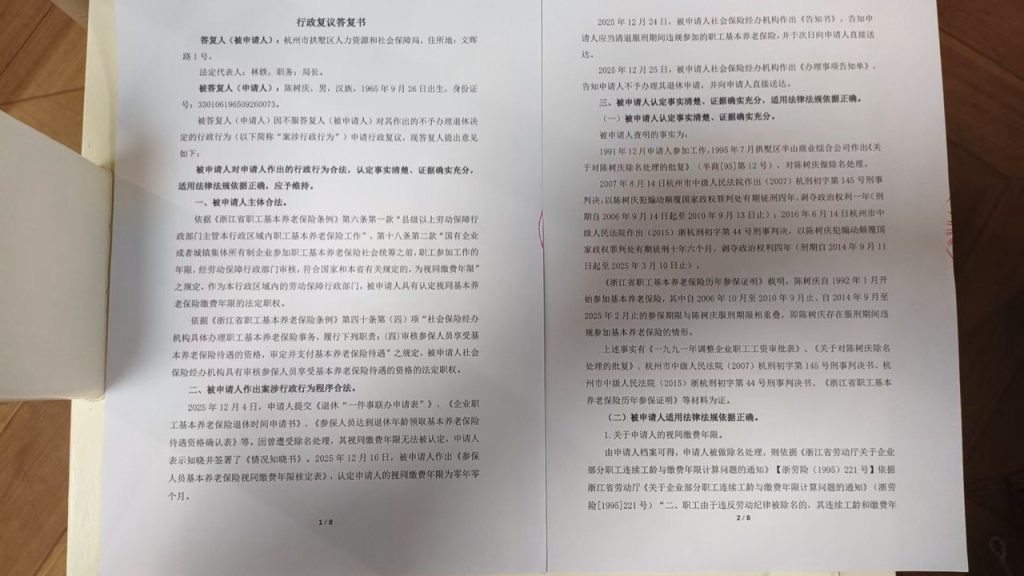
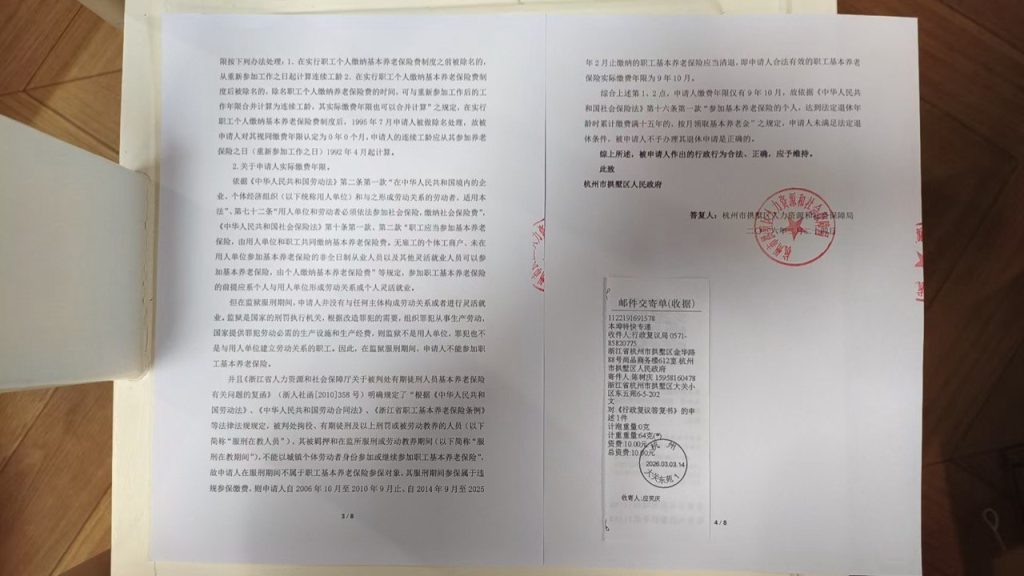
Representation Regarding the “Reply to Administrative Reconsideration”
Abstract: This article is the author’s response to the “Reply to Administrative Reconsideration,” exposing the truth regarding the China social security department’s handling of his pension insurance contribution years and retirement benefits. The social security department lacks sufficient legal basis and violates the principles of fairness, honesty, and human rights.
To: The People’s Government of Gongshu District, Hangzhou (Administrative Reconsideration Bureau):
The Petitioner, Chen Shuqing, is the applicant for administrative reconsideration in Case No. [2006] 67 of the Gongshu District Government (hereinafter referred to as “the Petitioner”).
On the afternoon of March 2, 2026, in accordance with the provisions of Article 47 of the Administrative Reconsideration Law of the People’s Republic of China, the Petitioner went to the Administrative Reconsideration Bureau of Gongshu District, Hangzhou, to consult and copy the “Reply to Administrative Reconsideration” and other relevant materials submitted by the Respondent, the Human Resources and Social Security Bureau of Gongshu District, Hangzhou.
Prior to receiving the aforementioned “Reply” and related materials, the Petitioner had never received such detailed written reasons and bases regarding the Respondent’s performance of duties during previous dealings. At the same time, it was discovered that regarding the claims of unreasonable and illegal administrative acts raised in the “Application for Administrative Reconsideration” of this case, the “Reply” neither acknowledges nor refutes or denies them. The Petitioner now provides necessary factual supplementary explanations and targeted representations regarding the “Reply.”
I. Regarding the Petitioner’s dismissal and the issue of deemed contribution years. The “Reply to Administrative Reconsideration” states: “In July 1995, the Petitioner was processed for dismissal; therefore, the Respondent determined his deemed contribution years to be 0 years and 0 months. The Petitioner’s continuous length of service should be calculated from April 1992, the date he began participating in the old-age insurance.”
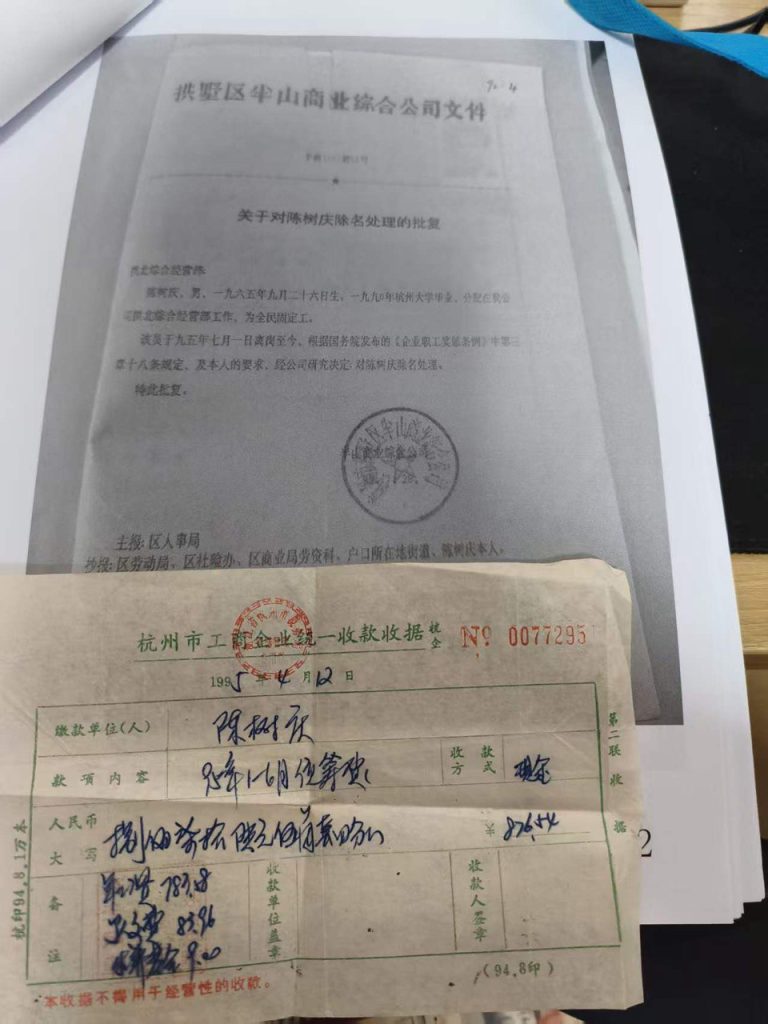
First, the Approval Regarding the Dismissal of Chen Shuqing by the Gongshu District Banshan Commercial Integrated Company dismissed the Petitioner on the grounds of “leaving the post from July 1, 1995, to the present,” and this dismissal decision was made hastily within that very month. If the deducted deemed contribution period were from the so-called “absence” on July 1, 1995, until the decision was made, it would certainly be justifiable. However, is it appropriate to deduct the four-month period from December 1991 to March 1992, during which I worked at the unit without any fault?
The description in the July 1995 Approval Regarding the Dismissal of Chen Shuqing, stating “the person has left the post since July 1, 1995, to date,” is fabricated and inconsistent with the agreement between the company and me. The actual situation was that the unit itself suffered from long-term poor management (old state-owned commercial units were impacted by a large number of professional markets, comprehensive markets, and individual vendors). Wages had already been suspended more than a year prior. Subsequently, I proposed to contract business, but because the conditions necessary for me to generate income for the unit were not provided (the business premises I sought were rented to others), it was agreed to allow the Petitioner, Chen Shuqing, to seek his own livelihood. The personnel relationship continued to be attached to the unit, which would pay social security on my behalf, though all actual costs were provided by Chen Shuqing himself (refer to the Hangzhou Industrial and Commercial Enterprise Unified Collection Receipt No. 0077295 for social security fees paid by Chen Shuqing to the unit, which was only found after rummaging through boxes at home a few days ago and is attached as an annex to this Representation). Under these circumstances, there is naturally no issue of so-called “leaving the post” or “being at the post.” Before being notified of the “dismissal,” I was not informed of the reasons for the impending dismissal or the channels for protecting my rights. At that time, I merely treated it as a unilateral termination of the contract by the unit and did not seriously understand or distinguish the actual meaning and consequences between “dismissal,” discharge, and resignation.
Although this “dismissal” reflects, to some extent, the vulnerability of individual citizens due to a lack of legal awareness—especially rights-protection awareness—under a deficient social rule of law, the Petitioner’s ignorance of his rights as an employee and failure to seek protection after the “dismissal,” combined with the fact that the deducted deemed contribution period was only four months, led to the request in this case to process the pension audit based on 24 years and 4 months of contribution, which did not include these four months. Since the Respondent raised this issue in the “Reply to Administrative Reconsideration,” the Petitioner might as well provide supplementary explanations and evidence sufficient to overturn the facts of the “dismissal.” It would be best if a fair solution could be reached during the reconsideration process. However, if it is ignored or if the Respondent’s determination regarding the “dismissal” and the zeroing out of the four-month deemed contribution continues to be formally accepted, the Petitioner is willing to adopt the stance of “if the other party no longer mentions it, we will no longer pursue it,” as it does not affect the overall situation of this case.
II. The “Reply” remains silent on the issue of the Respondent “failing to keep its word” and damaging the principle of protecting the interests of trust in government actions.
At the time of payment, the Respondent did not inform payers, including the Petitioner, of the so-called issue of “irregular participation in basic old-age insurance during imprisonment.” It feigned ignorance of “irregular fee collection” and, as a government action, accepted all social security contributions without refusal. Now, when required to fulfill statutory social insurance responsibilities, it suddenly changes its tune, claiming “irregularity” because of the “irregular payments” by the payer. Today, the Respondent, as a professional entity (which should have known), is suspected of intentional or clearly negligent “failure to inform of regulations” and “collecting fees in violation of regulations,” yet it does not bear the responsibility for the “violation.” Instead, it forces the layperson and active contract-fulfilling social security beneficiary—the Petitioner, Chen Shuqing—to bear the loss of contract breach under the name of “irregularity.” Furthermore, so-called “irregularity” can by no means be equated with “illegality.” No law in the People’s Republic of China clearly stipulates that “one shall not participate in social insurance during imprisonment” or that social insurance institutions “may cancel and refuse to bear insurance responsibilities for participation during imprisonment.” The Respondent’s behavior, in any civilized era or place that values reason and the rule of law, would be seen as the arbitrary and absurd exercise of dominant power, seriously damaging the government’s social credibility!
III. When the Petitioner went to the Respondent’s window to handle retirement procedures, he repeatedly (verbally) requested the Respondent to consider the human rights conventions that China has signed and, in some cases, ratified. These include provisions prohibiting forced unpaid labor and universal social insurance for everyone. At that time, a section-level staff member laughingly replied, “You’re wandering too far off!” I treated it as ignorance or a joke. Now, the Petitioner has formally detailed the relevant articles and contents of the International Covenant on Economic, Social and Cultural Rights, the Universal Declaration of Human Rights, and the International Covenant on Civil and Political Rights in the “Application for Administrative Reconsideration.” However, the “Reply” continues to ignore the principle that administrative acts (including specific and abstract acts) must not conflict with the law, and ignores the international conventions that the state has signed, ratified, and put into effect.
International conventions signed and especially ratified by the state are public commitments to the whole world, including the Chinese people. Any disregard for these conventions when applying the law to specific cases not only harms the realization of the rule of law domestically but will also inevitably damage the country’s international reputation and image. We are more than twenty years into the twenty-first century. If state personnel or organs continue to ignore the role and effectiveness of international conventions signed and ratified by their own country when exercising power, can their knowledge, ability, and perspective be called qualified?
IV. The “Reply” ignores the widespread illegal use of labor dispatch workers by organs and institutions for “fake employment” (where actual labor is inconsistent with nominal employment, including social security registration) and serious violations of the legal requirement for “equal pay for equal work,” yet only determines the Petitioner’s social security contributions during imprisonment as “irregular.” This is essentially the same “social security agency payment.” This double standard not only violates the basic principle of a rule-of-law society—that “government action is forbidden unless authorized by law, while citizen action is free unless prohibited by law”—but also, how does it differ from the arbitrary power of ancient feudal despotism where “the officials are allowed to set fires, but the commoners are forbidden to light lamps”?
V. Undoubtedly, forced unpaid labor in prisons—which violates the UN Charter, the two UN human rights covenants, and universal values of civilization—must undergo fundamental changes or even be abolished as our country continues to reform and open up or further expand its opening. This is precisely why spokespersons for the Ministry of Justice and Ministry of Foreign Affairs repeatedly (and cover-up-ly) emphasize that “there is no forced labor in Xinjiang” and “there is no forced labor in China.” While in prison, the Petitioner and fellow inmates watched the CCTV News Bulletin every night as required. Every time we saw or heard these claims of “no forced labor,” we would laugh as a group. “No forced labor in China? Wherever there is a prison, there is forced labor; at least the Qiaosi Prison where we were has always had forced labor.” Besides the “methods” of forced labor I personally saw and heard, if necessary, I might as well let “everyone tell their stories” about their personal experiences in prison (including forced unpaid labor), and let economic scholars discuss the impact of “prison forced unpaid labor” on fair market competition, social employment, and labor rights, as well as the role and influence of prison labor products on Chinese commodity exports. To avoid being too “off-topic” and due to space constraints, I will stop here and not expand into more specific and full discussions for now.
If we start with the individual case of Chen Shuqing, it is hoped that it can gradually lead to a universal recognition that social security contributions during past imprisonment are valid, or even allow the vast number of imprisoned persons to pay back deficient years of social security after release. This would allow those released from prison to truly enjoy a fair old-age life like other citizens, which is conducive not only to the peaceful reform of prisoners but also to the resettlement and return of released persons to normal social life, avoiding the possibility of some people taking risks out of desperation. This establishes a reasonable buffer and transition period between the current penal system and its execution and the future abolition of forced unpaid labor in prisons.
In summary, the Petitioner earnestly requests the People’s Government of Gongshu District, Hangzhou (Administrative Reconsideration Bureau), when reviewing this case, to pay necessary attention to the fact that the Respondent neither acknowledged nor refuted the issues and reasons raised by the Petitioner in the “Application for Administrative Reconsideration.” This refusal to answer the focus of legal application disputes: if it is because they cannot, it shows that the legality and rationality of their administrative act cannot withstand scrutiny; if it is out of disdain, it is the arrogance of power, which should be even more prevented.
I look forward to a final administrative reconsideration decision that is legal, fair, and comprehensive.
Respectfully,
Petitioner: Chen Shuqing
March 3, 2026
Attachments: 1.One copy of this Representation Regarding the “Reply to Administrative Reconsideration” 2.Two copies of the Hangzhou Industrial and Commercial Enterprise Unified Collection Receipt No. 0077295
Liberator: The Architect of the New International Order
Author: Guo Quan
Editor: Li Jing Proofreader: Feng Reng Translator: Zhou Min
Trump Logic #92: President Trump said: “To those regimes that practice tyranny in the name of sovereignty, our answer is: your ‘sovereignty’ ends here. America will act as a liberator, as the architect of a new order, bringing dawn to the oppressed. This is our mission and our historical responsibility. The action continues, the goal remains unchanged: End tyranny, return power to the people!”
March 3, 2026, Washington D.C. Deep within the Pentagon, the office of Secretary of War Hegseth was shrouded in a solemn and resolute atmosphere. Outside, the lights of the capital flickered in the early spring chill, but inside, a discussion that would reshape the global landscape was underway.
The master of the Oval Office, Donald J. Trump, sat in the center seat, his gaze like a torch. Surrounding him were Vice President J.D. Vance, Secretary of State Marco Rubio, heavyweight Senator Lindsey Graham, and the Chairman of the Joint Chiefs of Staff, General Charles Q. Brown Jr.
The air was thick with the scent of gunpowder yet to settle—just days ago (February 28), the U.S. military launched precision strikes, codenamed “Epic Fury,” against Iranian nuclear facilities and key military command nodes, officially beginning what the outside world calls the “Third Gulf War.”
At this moment, the international community, especially those labeled by the President as “rogue states” and their sympathizers, are fiercely attacking the United States under the charge of “violating sovereignty.”
“Gentlemen,” President Trump’s voice broke the silence, carrying his signature directness and indisputability. “We have heard enough of the noise outside, those cries regarding ‘sovereignty.’ They accuse us of violating Iran’s sovereignty? Fine. Then let’s talk about what their so-called ‘sovereignty’—that of the Iranian regime, as well as Venezuela, Cuba hiding behind it, and their evil big boss—actually is?”
He leaned forward slightly, his fingers tapping powerfully on the thick mahogany desk.
“We in America, everyone in this room and our ancestors, once stood up at humanity’s darkest hour. In WWII, we crushed the evil axis of Hitler, Mussolini, and Tojo. We liberated Europe, liberated Asia; we did not do it to conquer, but to end tyranny! After the war, with the loftiest ideals, we presided over the establishment of the United Nations, hoping it would become a temple for maintaining peace, freedom, and justice. We thought that was the foundation of the new world order.”
Secretary of State Rubio spoke up at the right moment, his tone steady yet full of power: “Mr. President, the lessons of history are crystal clear. The order we established was meant to be a shield protecting people from the suffering of tyranny. However, this system has been eroded. Regimes like Iran have never truly identified with the values of freedom and democracy. They infiltrate, manipulate, and exploit the United Nations. They wave the fig leaf of ‘inviolable sovereignty’ with a deafening roar—for what purpose?”
He looked around at everyone, “Only to protect themselves! To protect their privilege of recklessly oppressing people, trampling on human rights, and developing destructive weapons at home without punishment! The United Nations, at certain moments and on certain issues, has pathetically become their protective umbrella.”
A report was pushed to the center of the table. Senator Graham, the veteran known for his hawk-like stance, pointed at the document, his voice slightly raspy with anger: “Look at these! Not guesses, but ironclad evidence! What has the Iranian regime done over the past few years? Mass executions of dissidents, numbers that are shocking to the eye, repeatedly condemned by the international community as crimes against humanity! They systematically persecute ethnic minorities and religious groups, manufacturing fear. They exploit loopholes in international agencies, even infiltrating them, attempting to cover their nuclear ambitions while pointing the finger at countries that follow the rules. When even the subordinate agencies of the UN can become channels for intelligence leaks, and when the credibility of the overseers themselves is wavering,” he slammed the table hard, “what justice is left in this old order? What it protects is the ‘sovereignty’ of tyrants riding on the heads of the people to do as they please! Not the right of the people to be masters of their own house!”
General Brown opened the tactical tablet before him, pulling up the latest battlefield status maps and intelligence summaries. His voice was calm, professional, with the pragmatism unique to a soldier: “Mr. President, everyone, military operations are proceeding as planned. ‘Epic Fury’ has effectively paralyzed Iran’s nuclear counter-strike capability and key command chains. But the true challenge is international opinion and the inertia of the old order’s thinking. We face not only Iran’s missiles but a deeply rooted, distorted concept of sovereignty. Intelligence shows the Iranian regime is attempting to play the ‘sovereignty’ card, mobilizing sympathizers within the UN framework to paint us as aggressors.”
Vice President Vance had been listening intently; now he spoke, his tone firm: “This is exactly the point, General. We must clearly define sovereignty. Sovereignty naturally belongs to the people! If a regime is not the choice of the people’s free will, if it relies on violence, fear, and lies to maintain rule—just like the Axis powers of WWII—then why should it enjoy sovereign immunity? What it possesses is only the power of tyranny! The current Iranian regime, Maduro’s Venezuela, the dictators of Cuba, and their big boss—each of them came to power through suppression rather than election. Their very existence is the greatest desecration of sovereignty. They are executioners internally and troublemakers externally. Such regimes do not deserve the ‘golden shield’ of sovereignty!”
President Trump suddenly stood up, his gaze sweeping over every participant as if to inject his will into everyone’s soul. “Lindsey is right, Marco’s analysis is thorough, General Brown is executing well, and Vance hit the nail on the head! This old order—this old order infiltrated by evil, coddled by cowardice, and wrapped in lies—must end! It cannot protect the innocent; instead, it has become a bodyguard for tyrants. The United Nations has failed in certain aspects; it could not stop Iran from massacring its own people, could not stop it from developing nuclear weapons to threaten neighbors, and even its internal mechanisms could be abused. We can no longer be bound hand and foot by these hypocritical rules!”
President Trump walked to the window, his back to the room, looking at the Washington Monument in the night. His voice was resonant and full of a sense of mission: “The post-WWII order was established by us, America, leading the world to prevent the return of fascism. Today, we face a new Axis of Evil—the Iranian theocratic regime and its protected terrorist networks, the dictators of Venezuela, the oppression machine of Cuba, and their big boss. They rule with brutality internally and export instability externally. Their existence is a continuous threat to human conscience and world peace! They are not legitimate governments; they are criminal syndicates riding on the necks of the people!”
The President turned around, his eyes as sharp as an eagle: “Therefore, our action is not aggression, but liberation! It is fulfilling our historical responsibility as the leader of the free world! When these regimes commit crimes against humanity, when they use ‘sovereignty’ as a shield to continue their evil, America has the responsibility, and the power, to crush them! To take power back from the hands of tyrants and return it to its true masters—the people! Support local forces longing for freedom, and establish truly representative, responsible governments. This is the only path to building a truly lasting peace and an order of freedom upon the ruins!”
The President walked back to his seat, hands propped on the table, his tone beyond doubt: “What we are initiating is a completely new world order. An order based on truth rather than hypocrisy, on freedom rather than oppression, on the sovereignty of the people rather than the privileges of tyrants! An order that returns ‘inviolable sovereignty’ to its original meaning—protecting the people from internal and external harm! To those regimes that practice tyranny in the name of sovereignty, our answer is: your ‘sovereignty’ ends here. America will act as a liberator, as the architect of a new order, bringing dawn to the oppressed. This is our mission and our historical responsibility. The action continues, the goal remains unchanged: End tyranny, return power to the people!”
Silence filled the office, with only the President’s clanging words echoing.
Vice President Vance’s eyes shimmered with the light of agreement, Secretary of State Rubio nodded solemnly, Senator Graham clenched his fist, and General Brown straightened his spine.
Outside, the night remained deep, but in this room deciding the world’s fate, a determination to break old shackles and shape a new future was already like a drawn sword, its cold light glinting.
They knew the road ahead was perilous; the storm of international condemnation would surely intensify, and the defenders of the old order would strike back desperately. However, in this vision of the “Liberator” described by the President, they saw a blueprint for a starkly different world order, led by American power and values, unfolding before them.
This war, which began in the skies over Tehran, has a goal that far exceeds merely changing a regime; it aims to completely rewrite the foundations of international rules.
Ode to the Epic Fury
Composed by Quan Shi Gong in praise of Trump’s illustrious achievements:
The smoke of war in Iran is not merely for the extermination of the cruel; the new chapter of the universe truly initiates the cleansing of the world.
When the heavenly laws were unraveled and the aura of malice flowed unchecked, the gates of Iran displayed the ferocity of owls and wolves, threatening the common people and stealing the sacred instruments of state. The land of Persia was submerged in the mists of stench and filth, using sovereignty as a pretext to imprison the masses. Thereupon, America roused its thunderous wrath; Lord Trump, upholding the mandate of the Great Heaven, mobilized the elite warriors to reverently execute the divine punishment.
His resolve: to dismiss the false and honor the true, to reject the void and value the real. To rescue those hanging upside down in fire and water—how could tyranny be allowed to linger? To return radiance to the deep gloom, vowing to let freedom shine anew. In the past, sovereignty was defiled, unexpectedly becoming the shield of the autocrat; now, justice draws its bow, finally revealing the original meaning of the principle: to protect the millions upon their mats and bedding, and to defend against the treacherous at the borders.
His actions: wherever the long halberds point, the demons and spirits lose their souls. The flames of war scorch the clouds, not only burning the palaces of Tehran; the banners of benevolence sweep the earth, further molding the foundation of the new order. See the Stars and Stripes shining in the sky, tearing through the heavy darkness to break the dormancy; hear the startling thunder shaking the wilderness, awakening the nine realms to revive the withered. The so-called “sovereignty” of tyranny? From this point, it is severed forever. The long-cherished wish of the living people? Here, it is finally fulfilled!
As for saving the drowning and embracing the distressed, relieving those hanging in parching heat: establishing truth as the standard, replacing oppression with harmony and tranquility. Letting the four seas know that sovereignty resides in the people, not belonging to the usurper; letting the eight wildernesses recognize that majesty originates from the law, not to be left to the arrogant and willful. This is not the undertaking of a single nation, but truly a merit for ten thousand generations.
How magnificent! Swinging the sword to decide the floating clouds, the spirit of the three armies awes the Persian moon; raising the flag to open the righteous path, the spring breeze of freedom follows across the nine realms.
The Poem says: Behold the ancient lands of Persia, Where the Spring of Roses blooms again. Hear furthermore the new international chapter, Which eternally continues the Covenant of Mountains and Seas.
What Would China’s Democratic Transition Look Like if Xi Jinping Disappeared?
Author: Lu Chao Editor: Li Jing Proofreader: Cheng Xiaoxiao Translator: Lyu Feng
Recent international developments have been changing at a dizzying pace. From reports emerging from Tehran about the death of Supreme Leader Ayatollah Ali Khamenei to the increasingly fragile position of Nicolás Maduro’s government in Venezuela, the departures of these “strongmen” have taken different forms. Yet they all point to a central question: when a highly centralized ruler suddenly disappears from the political landscape, does the country move toward democracy, or fall into chaos?
If we apply this scenario to China, the situation could be even more complex than in Iran or Venezuela.
1. The “Vacuum Effect” at the Apex of Power
In today’s Chinese political system, power has become highly concentrated around a single “core” leader. The greatest weakness of such a model is that it relies heavily on the political will of one individual. If that “core” suddenly disappears and there is no universally accepted successor, Zhongnanhai could instantly enter a period of extreme instability—a kind of overheated political vacuum.
In political science, this phenomenon is sometimes referred to as the “brittleness of authoritarian systems.” A classic example is Saddam Hussein’s Iraq. While his rule once appeared unshakeable, once the top layer collapsed, the bureaucratic apparatus, the military, and the security services temporarily lost unified command and fell into paralysis. In such a moment, those who hold real power in Beijing would first think about survival rather than governance.
2. “Survival-Driven Reform” Among the Elite
The Venezuelan case shows that the weakening of Nicolás Maduro’s rule has often been accompanied by elite defections. In China, if the top leader were suddenly gone, officials and military commanders who had long remained silent under pressure would face a critical choice: cling to the existing system or embrace reform in order to protect their own security and interests.
Under such circumstances, China could experience a top-down, defensive transition. In order to prevent social order from collapsing—or to regain international recognition and possibly lift sanctions—pragmatic elites might advocate slogans such as “restoring collective leadership” or “governing according to law.” This shift from “one person decides everything” to “collective decision-making” could become the first crack in the existing system and the opening stage of a democratic transition.
3. The Centrifugal Force of Local Authorities
China is vast, and regional interests vary widely. If the authority of the central government in Beijing weakens after the disappearance of the top leader, economically advanced coastal provinces in the southeast could quickly develop stronger tendencies toward autonomy.
This would resemble early signs seen before the dissolution of the Soviet Union: local governments realized they no longer needed to send large fiscal transfers to a central authority that could no longer effectively command them. They began experimenting with independent economic and social policies. Such “competitive decentralization,” though potentially destabilizing, could also create space for grassroots democracy and rule-of-law experiments.
Just as Iraq after the war struggled to move beyond the militarization of cities, local governments in China might experiment with genuine village elections or community self-governance in order to reduce public dissatisfaction.
4. The Awakening of the “Silent Majority”
The most crucial variable may ultimately be ordinary citizens. Over the past years, many social tensions have accumulated—from anxiety about economic slowdown to frustration with strict political control. Once the central figure sustaining the system disappears, public courage could rise rapidly.
If large-scale street protests similar to those seen in Venezuela after contested elections were to emerge—and if the military hesitated due to internal divisions—the path toward democratization could accelerate. At such a moment, avoiding an Iraq-style descent into chaos would depend on whether China’s middle class and intellectuals could quickly build consensus and establish basic legal order, rather than falling into endless factional struggles.
Crisis or Opportunity?
The disappearance of an authoritarian ruler never automatically produces democracy. It is more like opening a Pandora’s box, containing both the risk of chaos and the possibility of renewal.
The experiences of Iran and Venezuela suggest that loyalty sustained by fear can evaporate the moment a leader leaves the stage. If China ever reaches such a moment, the real challenge will not simply be who succeeds the leader, but whether society can seize the brief window of political vacuum to transfer power—from the hands of one individual into institutions governed by law and the ballot.
After all, a healthy society should never tie the fate of more than a billion people to the breath of a single person. Strongmen eventually die, but institutions can endure.
Abstract: One hundred days after the Hung Fuk Estate fire in Tai Po, Hong Kong, the cause of the disaster is still under investigation. However, a series of developments—including the arrest of a student, pressure on the media, the absence of accountability, and the expansion of surveillance—have raised widespread public concern about the fairness of the investigation and the broader institutional changes taking place in Hong Kong.
As of March 6, 2026, exactly one hundred days have passed since the Hung Fuk Estate fire in Tai Po, Hong Kong.
The fire, which broke out on November 26, 2025, affected seven high-rise residential buildings. It burned for more than forty hours and ultimately caused 168 deaths and 79 injuries, making it one of the deadliest fire disasters in Hong Kong’s history since the city was founded.
The Hong Kong government subsequently announced the establishment of an independent commission of inquiry, with hearings scheduled to begin on March 19, 2026, and a final investigation report expected around September 2026.
However, several events that have occurred during the hundred days since the fire have caused many people to question whether the investigation will truly address the public’s concerns.
Looking back at these 100 days, several developments in Hong Kong society are worth noting.
1. Student Who Called for an Investigation Arrested and Expelled
After the fire, Kwan Ching-fung, a student at the Chinese University of Hong Kong, publicly raised four demands, including the establishment of an independent investigation committee into the disaster.
Shortly afterward, however, he was arrested by police. Some media outlets even characterized his actions as “using the disaster to disrupt Hong Kong.”
On February 13, 2026, the Chinese University of Hong Kong announced that he had been expelled. The university did not state that the expulsion was directly due to his demands. Instead, it cited “repeated misconduct,” including an incident in 2023 when he was disciplined for posting slogans related to the June Fourth movement.
2. Almost No Discussion of Official Accountability
According to China’s Regulations on the Reporting, Investigation, and Handling of Production Safety Accidents, an accident causing more than 30 deaths is classified as an “extraordinarily serious accident.” Such cases should be investigated by a team organized by the State Council or an authorized department, and administrative penalties may be imposed on responsible officials, including provincial governors, autonomous region chairpersons, mayors of municipalities, and relevant central government officials.
The situation in Hong Kong has been quite different.
Hong Kong Chief Executive John Lee has not faced any accountability. On December 16, 2025, when Lee reported his work to Chinese President Xi Jinping, Xi stated that Lee had led the Hong Kong government over the past year with “responsibility and initiative,” emphasizing that the central government “fully recognizes” the work of Lee and the Hong Kong administration.
Xi particularly praised Lee’s performance in safeguarding national sovereignty, security, and development interests. Regarding the Tai Po Hung Fuk Estate fire, Xi merely expressed condolences to the victims and affirmed the Hong Kong government’s efforts in post-disaster relief and reconstruction.
3. Victims’ Names Not Made Public
In most democratic societies and rule-of-law states, the public release of victims’ names after mass-casualty disasters is generally regarded as an important expression of government transparency and collective mourning.
However, after the Hung Fuk Estate five-alarm fire, the Hong Kong government refused to release the names of the 168 victims, citing the need to “protect privacy.”
4. Media Figure Jimmy Lai Given a Heavy Sentence
On February 9, 2026, under a judicial environment widely questioned by observers as being politically influenced, a Hong Kong court sentenced media entrepreneur Jimmy Lai to twenty years in prison under charges of “inciting subversion of state power” and “colluding with foreign forces” under the framework of the National Security Law.
Several senior executives of the now-defunct Apple Daily newspaper were also sentenced to prison terms ranging from seven to ten years.
Under such pressure, Hong Kong may find it increasingly difficult to sustain genuinely independent media. What remains could increasingly resemble extensions of the official communication system.
5. Expanding Surveillance: Toward an “1984” Era?
In mid-February 2026, the Hong Kong government applied to the Legislative Council for HK$4.06 billion in funding to expand a surveillance program known as “SmartView.”
The project aims to upgrade more than 60,000 surveillance camera systems across Hong Kong in the coming years, incorporating advanced AI facial recognition and big-data analytics technologies.
Ongoing Investigation and Public Concerns
The precise cause of the Hung Fuk Estate fire is still under investigation. According to early reports, the rapid spread of the fire may have been linked to bamboo scaffolding and nylon mesh used during exterior wall maintenance work that failed to meet fire-resistance standards.
Flames reportedly spread rapidly along the building façades, affecting multiple residential blocks.
If the final investigation concludes that the problem was merely the use of non-compliant construction materials, then it would represent a serious engineering accident. However, bamboo scaffolding has been used in Hong Kong construction for over a century. Public attention has therefore focused on the possibility that the nylon mesh used in the project lacked adequate flame-retardant properties.
Such a problem could potentially involve construction corruption or regulatory loopholes. For many Hong Kong citizens, the deeper concern is whether the institutional system established during the British colonial period—one that operated effectively for over a century—has undergone fundamental changes since Hong Kong’s return to China.
Institutional Changes Since 2019
For decades, Hong Kong maintained a relatively high standard of public governance due to several institutional features: independent media, professional regulatory agencies, and transparent investigation mechanisms.
However, in 2019, Beijing’s push to amend the Extradition Bill triggered large-scale protests. In 2020, the more stringent Hong Kong National Security Law was enacted.
Within just a few years, Hong Kong’s political and social environment changed dramatically. The city shifted from an open, prosperous international metropolis governed by rule of law into a society characterized by increasingly strict political control.
Large numbers of high-skilled professionals have emigrated, housing prices have fallen significantly, economic growth has slowed noticeably, and Hong Kong has even experienced rare fiscal deficits.
Under the high-pressure environment following the National Security Law, both citizens and media outlets have largely become more cautious or silent. Since 2020, a series of loyalty oath requirements has also meant that many officials now primarily answer to Beijing rather than being subject to oversight from opposition parties or public opinion.
When governments devote substantial energy and resources to suppressing dissent and maintaining what is defined as national security, the capacity for governance in areas directly related to public safety and welfare may gradually weaken.
Historical Parallels
Historical experience suggests that similar controversies have emerged in several major disasters in China over recent decades.
For example:
After the 2008 Wenchuan earthquake, some parents questioned the quality of school buildings suspected to be “tofu-dreg construction.” Activist Tan Zuoren, who attempted to investigate, was later detained.
Following the 2011 Wenzhou high-speed rail crash, authorities initially attributed the cause to a lightning strike.
The 2021 Zhengzhou “7·20” floods and the 2024 Guangdong Meida Expressway collapse also sparked debates over responsibility.
In many such cases, governments have tended to attribute disasters to natural causes, while segments of the public believed that human factors and governance failures played a significant role. The resulting debates about accountability and transparency often faded over time as online discussions were censored and public attention gradually dissipated.
One Hundred Days Later
One hundred days have passed since the Hung Fuk Estate fire.
With 168 lives lost, what people hope to see is not only mourning for the victims but also a serious examination of institutional weaknesses.
Yet judging from the events that have occurred in the hundred days since the disaster, how much expectation can the public still place on the investigation report scheduled for release in September?
Will it reveal the full truth—or offer a selective explanation?
If the truth is not uncovered and those responsible are not held accountable, the legacy of this fire may not be only grief. It may also leave behind a lasting sense of unease—that such a tragedy could happen again at any time.
為保持議題熱度,讓更多美國民眾瞭解香港現況,US Hongkongers club (美國香港人會館) 於3月1日再次發起行動,持續聲援黎智英先生,抗議中共扼殺言論自由。是日下午2:30,會館館長Bruce與我們相約到達Interstate 80 Berkeley 路段的行人天橋,同行的還有灣區的活躍民主人士陳森鋒。
我們在天橋的鐵網上掛起四幅標語:“Free Hong Kong”、“Free Jimmy Lai”、“END CCP”、“光復香港”。標語甫一掛上,過往車輛的喇叭聲就此起彼伏,更有乘客向我們揮手示意,表達對我們的支持。而行經天橋的一些民眾也與我們擊掌或握手,並高喊“Free Hong Kong”,場面令人感動。其後,其他參與者陸續抵達。Bruce對人員進行分組,一部分人留在天橋舉牌或揮舞旗幟,另一組則駕車在公路上拍攝天橋的畫面,務求將現場影像完整記錄,並迅速發佈至X (Twitter)、Facebook、YouTube及Instagram,擴大傳播規模。
我們深愛那個曾經文明、自由、法治的香港,如今已被中共完全控制,隨著港區《國安法》的實施,香港更是迅速地淪為警察城市。國安惡法就像是一根套在自由香港人脖子上的繩索,而這根繩索現在正越收越緊。2026年2月中旬,港府向立法會申請 40.6 億港元的撥款,用於擴展名為「智眼」(SmartView)的監控程式。計劃在未來數年內為全港 6 萬多組監控攝像頭進行技術升級,包括引入更強大的 AI 人臉識別與大數據分析功能 ,此系統建成之日,港人將進入道路以目時代。
Free Jimmy Lai—Continuing to Speak Out for Freedom
US Hongkongers Club
By: Kwan Wing Kit
Editor: Chung Yan Managing Editor: Hu Lili
Proofreader: Cheng Xiaoxiao Translator: Ge Bing
Summary: Overseas Hong Kongers and supporters held a solidarity action in the San Francisco Bay Area, protesting the harsh sentencing of Jimmy Lai under the National Security Law and urging the international community to address the deteriorating state of press freedom and the rule of law in Hong Kong.
March 3, 2026 California Bay Area
On February 9, 2026, within a judicial environment widely questioned by the international community for political manipulation, a Hong Kong court sentenced Jimmy Lai to 20 years under the National Security Law framework on charges of “inciting subversion of state power” and “colluding with foreign forces.” Several senior executives of Apple Daily received sentences ranging from seven to ten years. The trial proceeded without a jury and was conducted behind closed doors. These arrangements demonstrate that the rule of law in Hong Kong has been destroyed.
Following the verdict, to express solidarity with Mr. Jimmy Lai and uphold principles of press freedom and the rule of law, Hong Kongers in exile and groups supporting Hong Kong’s resistance movement launched coordinated actions on February 14 across multiple locations. These demonstrations voiced support for Lai and protested Hong Kong’s draconian laws.
This incident has also drawn international attention. Multiple U.S. lawmakers publicly condemned the verdict, and the U.S. government invited Mr. Lai’s daughter, Claire Lai, to attend the President’s State of the Union address at the Capitol. During a sideline interview with media, she relayed a statement from her father: “If everyone leaves, who will bear witness to Hong Kong’s downfall?” She urged the international community not to forget Hong Kong, stressing that this was not merely Jimmy Lai’s case, but one concerning the survival of press freedom and the rule of law.
To maintain momentum and raise awareness among American citizens about Hong Kong’s current situation, the US Hongkongers Club organized another action on March 1st, continuing to support Jimmy Lai and protest the Chinese Communist Party’s suppression of free speech. At 2:30 PM that afternoon, Club Director Bruce met us at the pedestrian overpass on Interstate 80 in Berkeley, accompanied by Bay Area democracy activist Chan Sum Fung.
We hung four banners on the overpass’s metal railing: “Free Hong Kong,” “Free Jimmy Lai,” “END CCP,” and “Liberate Hong Kong.” As soon as the banners were hung, honking horns from passing vehicles erupted in waves. Passengers waved to us in support. Pedestrians crossing the overpass high-fived or shook hands with us, chanting “Free Hong Kong”—a deeply moving scene. Additional participants gradually arrived. Bruce divided the group into teams: some remained on the bridge holding signs or waving flags, while others drove along the highway filming the bridge to capture comprehensive footage. This allowed us to swiftly post the footage to X (Twitter), Facebook, YouTube, and Instagram, maximizing its reach.
We deeply cherish the Hong Kong that once embodied civilization, freedom, and the rule of law. Now, it has fallen entirely under the control of the Chinese Communist Party. With the implementation of the Hong Kong National Security Law, the city has rapidly transformed into a police state. This draconian security law is like a noose tightening around the necks of Hong Kong’s free citizens, and that noose is now being pulled ever tighter. In mid-February 2026, the Hong Kong government applied to the Legislative Council for HK$4.06 billion in funding to expand the surveillance program known as “SmartView.” The plan involves upgrading over 60,000 surveillance cameras across Hong Kong in the coming years, incorporating more powerful AI facial recognition and big data analytics capabilities. Once this system is fully operational, Hong Kongers will enter an era where they dare not speak their minds.
Mr. Jimmy Lai, now in his seventies, once possessed a fortune worth billions. He could have departed for distant shores to enjoy his twilight years. Yet he chose to remain, choosing to confront power with a newspaper. Today, he languishes behind bars not because he truly committed grave crimes, but simply because he insisted that media should oversee power and society should tolerate dissent.
What Mr. Jimmy Lai stands for is nothing more than the fundamental baseline of a civilized, rule-of-law society. Precisely because of this, we must not grow accustomed to such selective disregard. Hong Kong has a population of only seven million, and those in exile are scattered across the globe. Some say the voices of Hong Kongers abroad are too faint; others ask, in today’s international climate, do you truly believe justice will prevail? The world may shift its gaze amid new crises, but we will never forget the images of over a million Hong Kongers taking to the streets in 2019. That was not a fleeting emotional outburst, but a solemn pledge to freedom made by a generation of Hong Kongers—and by a community of global citizens who believe in universal values. If we, who live in free lands, gradually fall silent, then at the very least, we betray our own memories.
“Though my voice is weak and my words carry little weight, I shall never remain silent.” This is our response to Mr. Jimmy Lai, and a reminder to ourselves.
When Bulldozers Roll into Your Home: Protesting the CCP’s Forced Demolitions
By Zhang Chunyu
Editor: Geoffrey Jin Proofread: Cheng Xiaoxiao Translator: Ge Bing
Abstract: Against the backdrop of urban construction and development, the issue of forced evictions in some regions of China has drawn widespread attention. Many residents have been compelled to leave their homes with inadequate compensation and insufficient negotiation, facing threats such as water and electricity cuts or even violence, causing profound trauma to numerous families. The article argues that urban development should not come at the expense of ordinary citizens’ fundamental rights. Public projects must be advanced within the framework of the rule of law, ensuring residents’ property rights and dignity through transparent procedures, fair compensation, and thorough consultation. True progress is not merely reflected in the changing face of cities, but in the respect and protection of every citizen’s rights.
In contemporary China, many ordinary people lose their homes not due to criminal activity, but in the name of “development,” “planning,” and “urban construction.” Behind these grandiose terms lie rows of demolished houses and families forced into displacement. Forced demolition has become one of the heaviest and most infuriating memories for many Chinese citizens.
At its core, forced demolition is the trampling of individual property rights and fundamental human rights by power. In many places, governments and developers form collusive interests, using administrative orders, cutting off water and electricity, and violent threats to force residents to leave. Compensation is often far below market value, negotiations are merely a formality, and those who refuse are labeled “holdouts,” subsequently facing threats from police, urban management officers, or even organized crime groups.
Countless families subjected to forced evictions endure unimaginable suffering. Elderly residents are dragged from homes they’ve lived in their entire lives, while others watch helplessly as ancestral properties are reduced to rubble by bulldozers. Those who seek legal recourse often find courts siding with local governments. With no avenue for appeal, media silence, and online posts deleted, victims’ voices are systematically silenced.
Even more heartbreaking is that forced evictions are often accompanied by violence and injury. Tragic incidents of residents setting themselves on fire or jumping to their deaths in protest have occurred repeatedly across the country. These extreme acts are not impulsive, but born of despair. A normal society should not drive ordinary people to the point of protesting with their lives.
A truly modern civilized society must be founded on the rule of law. Government power derives from the people and must be constrained by law. All public projects should be built on transparency, fairness, and voluntary negotiation—with fair compensation, thorough hearings, and respect for residents’ choices—rather than imposing authority to oppress individuals.
Our opposition to forced evictions is not opposition to urban development, but to development achieved at the expense of ordinary people’s fundamental rights. True progress lies not in towering skyscrapers, but in safeguarding the dignity of every individual.
The level of civilization in a society is often reflected in how it treats its most vulnerable members. When a family stands alone in defending their home, when bulldozers become the solution to problems, this is not only a tragedy for one family but a wound for the entire society. Therefore, we must raise our voices: Stop forced evictions, respect property rights, and safeguard human rights. Development without justice will never endure.
缪青-当独裁者成为战争成本-rId5-768X511.jpeg?w=768&resize=768,0&ssl=1 "当独裁者成为战争成本")
缪青-当独裁者成为战争成本-rId5-768X511.jpeg "当独裁者成为战争成本")
缪青-当独裁者成为战争成本-rId6-640X359.jpeg)
缪青-当独裁者成为战争成本-rId7-768X511.jpeg)
缪青-当独裁者成为战争成本-rId8-640X359.jpeg)


政治民主%20(长篇连载)-rId7-1024X1024.png?w=768&resize=768,0&ssl=1 "《政治民主》第二章 人性与社会结构(第二期)")
政治民主 (长篇连载)-rId7-1024X1024.png)
陈树庆-rId4-1280X720.png?w=768&resize=768,0&ssl=1 "对《行政复议答复书》的申述")
关永杰-rId8-1280X853.png?w=768&resize=768,0&ssl=1 "宏福苑大火百日祭:災難之後香港在發生什麼")
关永杰-rId8-1280X853.png "宏福苑大火百日祭:災難之後香港在發生什麼")
关永杰-rId5-960X610.jpeg?w=768&resize=768,0&ssl=1 "Free Jimmy Lai——為自由持續發聲")
关永杰-rId5-960X610.jpeg "Free Jimmy Lai——為自由持續發聲")
关永杰-rId6-1152X864.jpeg)
关永杰-rId7-1429X1071.jpeg)