
正在消失的中国张雪峰时代
作者: 李家亮(中国民主党党员)
编辑:李晶 校对:熊辩 翻译:周敏
张雪峰去世了,确切地说,中国的“张雪峰现象”和张雪峰时代也一起在走向消亡。这位1984年出生在中国东北的网络爆红考研和高考志愿填报指导老师,教育博主,以其风格直白、观点犀利走红网络,在中国的学生和家长群中影响很大,他的去世突然而仓促,很多中国家长和学生错愕而哀伤,他们自发组成送葬队伍,哪怕相隔千里的人也会用外卖的方式送上一束花,杭州的街头,人们为了张雪峰而落泪。
那些送行的队伍是在送走张雪峰,也是在送走一个张雪峰时代,这个时代将永远尘封在中国的历史里,和历史一起埋葬。
是的,张雪峰时代结束了!
什么是张雪峰时代呢?张雪峰是1984年生人,他在2000年左右参加高考,正好赶上中国真正意义上的第一次开放国门,迎接世界——2001年12月11日,中国加入了世界贸易组织(WTO),加入WTO之后中国迎来了史无前例的爆发式经济增长,外贸尤其快速增长,成为了“世界工厂”、吸引了大量外资同时带来了大量的国际先进管理理念和模式;制造业和出口产业爆发,整个中国经济呈现一片前所未有的蓬勃之态。时值政治上是中国独裁体制中相对宽松的胡温时代,两厢结合中国人从上至下有了一种前所未有的畅快淋漓,对于未来充满希望,那个年代的人们相信未来会越来越好,相信爱拼才会赢,相信明天更美好!张雪峰就是和其他八零后一起赶上了那个好时代,那个有希望的时代,他们虽然没有像70后一样毕业了包分配,但是却可以迎着上升的中国经济实现那个只要努力学习考上好大学就可以顺利找到自己心仪的机会,留在一线城市的梦想——很多70后期和80后凭借努力上好大学就可以实现从农村到一线城市精英的阶层跨越。这一代人也是最相信吃得苦中苦方为人上人、爱拼才会赢的那一代,这就是张雪峰时代,或者“张雪峰现象”时代。
如今张雪峰去世了,“张雪峰现象”时代也迎来了尾声,确切地说,“张雪峰现象”比张雪峰更早地迎来了生命的枯萎期。自习近平上台以来,不断推动中国政治走向更专制的集权化(如修改宪法避免自己下台),经济上不断倒行逆施,不断和美日等主流国家产生贸易摩擦,越来越多的国家指责中国未完全遵守某些规则,不断地破坏WTO运行机制。中国虽然没有正式退出WTO,但是中国和WTO的关系已经名存实亡了,尤其近年来,大量的外资诸如SAS Institute、IBM、Amazon、Canon、Panasonic、Suzuki、Honda、Toyota、Old Navy、GAP、Carrefour、John Deere、 Kato Works等都全部或大部分撤离中国搬到经商环境更为宽松的东南亚国家。习近平一顿骚操作:减少民营加强央国企使得民营经济直接凋零。与此同时,中国经济支柱房地产行业全面崩盘,配套外资的制造业大面积关停等,中国经济陷入了中共执政以来的又一次冰点,这种冰点带来的是机会萎缩和消失,所以大量的毕业生找不到工作,跻身去送外卖、跑滴滴。越来越多的年轻人毕业即失业,整个社会陷入了前所未有的内卷,卷学历,卷名校,留给普通人或者基本盘的机会越来越少,阶层跨越基本成为痴人说梦, 社会生存空间的天花板越压越低,人们被压得抬不起头,原本通过给基本盘社会标准答案和上升通道解析的张雪峰们也就逐步失去市场,和追随他们的基本盘们被永远封印在社会底层的夹缝里,于是张雪峰时代结束了!
张雪峰时代的结束,不单单是他个人的离世,更是中国经济的一个起伏回落回合的结束。这次结束,基本意味着接下来很多年,至少在习近平时代、乃至中共高压极权时代基本盘普通人再无跨越社会阶层的可能,学历改变命运的时代彻底成为了历史,张雪峰时代和张雪峰一样,和着普罗大众的梦想一起埋葬在这个春天。
在社会机会缺失,底层没有出路,没有安全感可言的当下,对张雪峰的崇拜像人们抓住的一根救命稻草,如今这个时代留给基本盘的机会消失了,张雪峰也恰在此刻离开了人世,令人倍感悲哀,人们前去悼念,送的是他,送的也是自己摇摇欲坠的人生。
是过于商业化;是过于考虑学历回报率而忽视人生的容错率;是把基本盘用一个干瘪的答案甩进原本开阔复杂的真实世界;是让基本盘丧失自我判断能力;是让基本盘更趋同了;是关闭了基本盘对于世界适应修行的宝贵能力;是为了制造焦虑赚的盆满钵满,还是确实帮助了一部分学生和家长找到人生方向,无论社会不同层面对张雪峰本人怎么评价,这都不重要,重要的是张雪峰现象背后真正掌控基本盘命运的政治制度和经济运行模式给予普通人的人生机会彻底关闭了,中国历史上真正意义上的开放阶段结束了,中国进入了又一次无尽的黑暗。
再见了,张雪峰;再见了,张雪峰时代;再见了,“中国基本盘”的向阳而生时代!
The era of Zhang Xuefeng, which is disappearing in China
Author: Li Jialiang (Member of the China Democracy Party)
Editor: Li Jing Proofreader: Xiong Bian Translator: Zhou Min
Zhang Xuefeng has passed away; or more accurately, China’s “Zhang Xuefeng phenomenon” and the Zhang Xuefeng era are moving toward extinction together. This online sensation, a postgraduate and college entrance examination volunteer guidance teacher and education blogger born in Northeast China in 1984, became popular on the internet for his straightforward style and sharp views, exerting a great influence on Chinese students and parents. His death was sudden and hasty; many Chinese parents and students were shocked and grieved. They spontaneously formed funeral processions, and even people thousands of miles away sent bouquets of flowers via delivery services. On the streets of Hangzhou, people wept for Zhang Xuefeng.
Those funeral processions were seeing off Zhang Xuefeng, but they were also seeing off a Zhang Xuefeng era. This era will be forever sealed in Chinese history and buried along with it.
Yes, the Zhang Xuefeng era has ended!
What is the Zhang Xuefeng era? Zhang Xuefeng was born in 1984. He took the college entrance examination around 2000, just in time for China’s first true opening of its doors to welcome the world—on December 11, 2001, China joined the World Trade Organization (WTO). After joining the WTO, China ushered in unprecedented explosive economic growth. Foreign trade especially grew rapidly, as China became the “world factory,” attracting a large amount of foreign investment while bringing in numerous advanced international management concepts and models. Manufacturing and export industries exploded, and the entire Chinese economy presented an unprecedentedly vigorous state. At that time, politically, it was the Hu-Wen era, which was relatively relaxed within the Chinese autocratic system. Combining these two aspects, Chinese people from top to bottom experienced an unprecedented sense of smoothness and directness, full of hope for the future. People of that era believed the future would get better and better, believed that “to win, you must dare to fight,” and believed that tomorrow would be even more beautiful! Zhang Xuefeng, along with other post-80s generations, caught that good era, that hopeful era. Although they did not have jobs assigned upon graduation like the post-70s generation, they could follow the rising Chinese economy to realize the dream of finding their desired opportunities and staying in first-tier cities just by studying hard and getting into a good university—many late post-70s and post-80s relied on the effort of attending good universities to achieve the social class leap from rural areas to first-tier city elites. This generation is also the one that most believes that “only by enduring the most bitter hardships can one become a superior person” and “to win, you must dare to fight.” This is the Zhang Xuefeng era, or the era of the “Zhang Xuefeng phenomenon.”
Now Zhang Xuefeng has passed away, and the “Zhang Xuefeng phenomenon” era has also reached its end. To be precise, the “Zhang Xuefeng phenomenon” reached its period of life-withering earlier than Zhang Xuefeng himself. Since Xi Jinping came to power, he has continuously pushed Chinese politics toward more autocratic centralization (such as amending the constitution to avoid stepping down). Economically, he has continuously acted perversely, constantly creating trade frictions with mainstream countries such as the United States and Japan. More and more countries accuse China of failing to fully comply with certain rules and continuously undermining the WTO operating mechanism. Although China has not formally withdrawn from the WTO, the relationship between China and the WTO exists in name only. Especially in recent years, a large amount of foreign capital, such as SAS Institute, IBM, Amazon, Canon, Panasonic, Suzuki, Honda, Toyota, Old Navy, GAP, Carrefour, John Deere, Kato Works, etc., have all or mostly withdrawn from China and moved to Southeast Asian countries with more relaxed business environments. Xi Jinping’s series of reckless operations—reducing the private sector and strengthening central state-owned enterprises—caused the private economy to directly wither. At the same time, the real estate industry, a pillar of the Chinese economy, has completely collapsed, and the manufacturing industries supporting foreign investment have shut down on a large scale. The Chinese economy has fallen into another freezing point since the CCP took power. This freezing point brings about the shrinking and disappearance of opportunities, so a large number of graduates cannot find jobs and squeeze into delivering food or driving for Didi. More and more young people are unemployed upon graduation. The entire society has fallen into unprecedented “involution” (neijuan)—competing over degrees, competing over prestigious schools. Fewer and fewer opportunities are left for ordinary people or the “basic pool” (the masses). Social class leaping has basically become a pipe dream. The ceiling of social survival space is being pressed lower and lower, and people are being pressed so hard they cannot lift their heads. The “Zhang Xuefengs,” who originally provided standard answers and upward path analyses for the “basic pool” of society, have gradually lost their market and, along with the “basic pool” that followed them, are forever sealed in the cracks of the bottom of society. Thus, the Zhang Xuefeng era has ended!
The end of the Zhang Xuefeng era is not just the passing of him as an individual, but the end of a cycle of ups and downs in the Chinese economy. This ending basically means that for many years to come—at least in the Xi Jinping era and even the era of high-pressure CCP totalitarianism—it will be impossible for ordinary people in the “basic pool” to leap across social classes again. The era of education changing destiny has completely become history. The Zhang Xuefeng era, like Zhang Xuefeng himself, is buried this spring along with the dreams of the general public.
At a time when social opportunities are missing, the bottom has no way out, and there is no sense of security to speak of, the worship of Zhang Xuefeng is like a life-saving straw that people grab. Now that the opportunities left for the “basic pool” by this era have disappeared, Zhang Xuefeng has also left the world at this very moment, which makes people feel doubly sorrowful. People go to mourn; they are seeing off him, and they are also seeing off their own precarious lives.
Whether it was being too commercialized; whether it was over-considering the rate of return on education while ignoring the tolerance for error in life; whether it was throwing the “basic pool” into the originally open and complex real world with a shriveled answer; whether it was making the “basic pool” lose the ability for self-judgment; whether it was making the “basic pool” more homogenized; whether it was closing off the precious ability of the “basic pool” to practice adaptation to the world; whether it was for the sake of creating anxiety to make a fortune, or indeed helping some students and parents find a life direction—no matter how different levels of society evaluate Zhang Xuefeng himself, it is not important. What is important is that the political system and economic operation mode behind the Zhang Xuefeng phenomenon, which truly control the destiny of the “basic pool,” have completely closed the life opportunities for ordinary people. The truly meaningful stage of openness in Chinese history has ended, and China has entered another period of endless darkness.
Goodbye, Zhang Xuefeng; goodbye, Zhang Xuefeng era; goodbye, the era of “China’s basic pool” growing toward the sun!
在十字架前,我选择相信
杜吉平-rId4-589X1280.png?w=768&resize=768,0&ssl=1 "在十字架前,我选择相信")
作者:杜吉平、付静争
编辑:李晶 校对:熊辩 翻译:周敏
每当复活节临近,我的心里总会多一份安静,也多一份思考。这是一个让人不能不去面对的时刻:关于苦难,关于牺牲,也关于盼望。
两千多年前,耶稣基督被钉在十字架上。这不是一场偶然的悲剧,而是他甘愿为世人承担罪的代价。他用爱回应仇恨,用牺牲换来救赎。
三天之后,他从死里复活。也正因为如此,复活节对基督徒来说,不只是一个节日,更是信仰的核心。它告诉我们:黑暗不是终点,死亡不是结局,绝望之中仍有盼望。
对我而言,复活节从来不只是圣经中的故事,也不只是宗教传统中的纪念。它已经真实地进入了我的生命,也进入了我的家庭。
2024年的复活节,是我永远难忘的日子。那一天,我和我的太太一同受洗归主。我们在神面前作出决定:愿意用余生来相信他、跟随他、依靠他。
杜吉平-rId4-589X1280.png "在十字架前,我选择相信")
杜吉平-rId5-589X1280.png)
那是我们人生中一个重要的转折。从那一天起,我们知道,自己不再只是凭着人的力量去面对未来,而是愿意把生命交托在神的手中。
到了同年的圣诞节,我们的两个儿子也受洗了。当我们一家人先后走进洗礼的水中时,我心里有一种说不出的感动。因为我知道,这不只是一个仪式,而是一个家庭在信仰中的回应,也是神恩典临到我们家的印记。
从那以后,我们这个家不再只是一个普通的家庭,而是一个愿意以信仰为中心、以神的话语为依靠的家庭。
当然,信仰并没有让现实生活一下子变得轻松。我们一样会遇到压力,一样会面对困难,也一样会经历迷茫和不安。但不同的是,信仰让我们在这些处境中,心里有了真正的安定。
因为我们渐渐明白,人的环境会改变,世界局势也会动荡不安,但神没有改变,他依然掌权。
杜吉平-rId6-1280X720.png)
这些年的经历也让我更加清楚地看到,真正的信仰并不总是被这个世界理解。尤其在我出生和成长的地方,信仰常常会被误解,甚至受到限制。也正因为如此,我们更加珍惜今天所拥有的信仰自由,珍惜能够自由敬拜、自由祷告、自由见证主名的机会。
这种珍惜,不只是出于环境的对比,更是因为我们越来越知道,真正的信仰不是外在的形式,而是一个人内心深处那份不能被夺走的光。
十字架在人看来,似乎是失败,但在神的旨意中,却成为救赎的开始。复活在人看来,似乎是不可能,但正是这“不可能”,给人类带来了永恒的盼望。
今天,当我再次思想耶稣基督为世人受难、并从死里复活的时候,我更加明白:我们并不是因为人生一切顺利才相信信仰,恰恰是在不确定之中,在风浪之中,在看不清前路的时候,我们仍然选择相信。
作为一个丈夫、一个父亲、一个普通人,我没有能力去改变这个世界的一切,但我可以先从自己的家庭开始。
我可以选择在家中活出爱,可以选择在孩子面前持守信仰,也可以选择在这个充满变化的时代里,不否认我所相信的真理。
这个世界若真的需要光,那就从每一个愿意相信、愿意坚持的人开始。也许我们都很平凡,但当一个人愿意在十字架前谦卑下来,愿意把生命交给神,那样的生命,就会发出光来。
在这个复活节,我愿再次向主献上我的心志:无论顺境逆境,无论明天如何,我都愿意继续跟随你。因为我相信,十字架不是结束,复活才是答案;而在主里面的人,也终究不会失去盼望。
Before the Cross, I Choose to Believe
——An Easter Witness from a Christian Family
Author: Du Jiping, Fu Jingzheng
Editor: Li Jing Proofreader: Xiong Bian Translator: Zhou Min
Whenever Easter approaches, my heart always gains an extra measure of quietness and an extra measure of reflection. This is a moment that one cannot avoid facing: regarding suffering, regarding sacrifice, and also regarding hope.
More than two thousand years ago, Jesus Christ was nailed to the cross. This was not an accidental tragedy, but his willingness to bear the price of sin for the world. He responded to hatred with love and exchanged sacrifice for redemption.
Three days later, he rose from the dead. It is precisely because of this that Easter, for Christians, is not just a holiday, but the core of faith. It tells us: darkness is not the end, death is not the conclusion, and in the midst of despair, there is still hope.
To me, Easter has never been just a story in the Bible, nor just a commemoration in religious tradition. It has truly entered my life and entered my family.
Easter of 2024 is a day I will never forget. On that day, my wife and I were baptized together and returned to the Lord. We made a decision before God: we are willing to use the rest of our lives to believe in Him, follow Him, and rely on Him.
That was an important turning point in our lives. From that day on, we knew that we were no longer facing the future relying solely on human strength, but were willing to entrust our lives into the hands of God.
By Christmas of the same year, our two sons were also baptized. When our family, one after another, stepped into the waters of baptism, I felt an indescribable emotion in my heart. Because I knew that this was not just a ritual, but a family’s response in faith, and a mark of God’s grace coming upon our home.
From then on, our home was no longer just an ordinary family, but a family willing to be centered on faith and reliant on the Word of God.
Of course, faith did not make real life suddenly become easy. We still encounter pressure, still face difficulties, and still experience confusion and unease. But the difference is that faith allows us to have true stability in our hearts within these situations.
Because we have gradually come to understand that human environments will change, and the global situation will be turbulent and unstable, but God has not changed; He is still in control.
The experiences of these years have also allowed me to see more clearly that true faith is not always understood by this world. Especially in the place where I was born and grew up, faith is often misunderstood or even restricted. Because of this, we cherish even more the freedom of belief we have today, and the opportunity to worship freely, pray freely, and witness the name of the Lord freely.
This cherishing is not just out of a contrast in environments, but even more because we know more and more that true faith is not an external form, but the light deep within a person’s heart that cannot be taken away.
The cross seems like failure in the eyes of man, but in the will of God, it became the beginning of redemption. Resurrection seems impossible in the eyes of man, but it is precisely this “impossibility” that has brought eternal hope to humanity.
Today, when I once again contemplate Jesus Christ suffering for the world and rising from the dead, I understand even more: we do not believe in faith because everything in life goes smoothly; rather, it is in the midst of uncertainty, in the midst of wind and waves, and when we cannot see the road ahead clearly, that we still choose to believe.
As a husband, a father, and an ordinary person, I do not have the ability to change everything in this world, but I can start first with my own family.
I can choose to live out love in the home, choose to uphold faith before my children, and choose not to deny the truth I believe in during this era full of change.
If this world truly needs light, let it start from every person who is willing to believe and willing to persist. Perhaps we are all very ordinary, but when a person is willing to humble themselves before the cross and willing to give their life to God, that kind of life will emit light.
On this Easter, I am willing to once again offer my resolve to the Lord: whether in prosperity or adversity, no matter what tomorrow holds, I am willing to continue following You. Because I believe the cross is not the end, resurrection is the answer; and those who are in the Lord will, after all, not lose hope.
斩杀线之国:共产党如何系统性剥夺权利
作者:彭硕 编辑:Geoffrey Jin 校对:程筱筱 翻译:彭小梅
近来中文舆论中流行所谓“美国斩杀线”的说法:一旦失业或生病,美国中产就会迅速坠入流浪、死亡的深渊。这类叙事往往通过混淆低收入脆弱群体与中产阶级、嫁接极端个案,制造出强烈的情绪冲击。
不可否认,美国社会确实存在诸多问题,包括贫富差距、族群歧视等,这些问题本身也值得批评和反思。但必须明确的是:美国的问题,与中国共产党统治是否正当之间不存在任何逻辑关联。一个政权的合法性,只能来自它是否保障本国公民的基本权利,而不是通过对比他国的缺陷来获得心理优势。这类“比惨”叙事之所以在当下广泛传播,是因为它充当了一种精神止痛药。通过不断强调“全世界都一样,甚至更糟”,让对独裁制度的追问被悄然替换为认命。
下面不完全统计在中国共产党统治下普通民众所面临的系统性“斩杀”:
1.《宪法》就是废纸
任何现代社会的权利体系,都建立在权力受到约束的前提之上。但在中国,宪法长期停留在象征层面,无法对中国共产党的权力形成现实约束,只是一份政治宣传文本,而非可被公民依赖的权利保障。司法从未独立,在现实中,“党大于法”人尽皆知,法院必须服从党的领导,而不是以法律条文作为准则。
2018年,宪法规定的国家主席任期限制被修改取消,清楚表明宪法可以被权力按需要调整。当中共领导人习近平能够推动宪法为个人权力服务时,宪法对普通人的保护效力已经归零。
2. 未出生即被斩杀:计划生育与强制流产
在中共的极权统治下,有一部分生命甚至来不及出生,就已被独裁制度提前终止。共产党长期实施的计划生育政策,使强制流产、强制引产成为常态化行政行为。
在这一政策下,生育不再是个人选择,而是被纳入政治考核的指标。妇女的身体被视为政策执行对象,胎儿的生命被简化为“超生数量”。当一个社会可以为了抽象目标而系统性地终止未出生的生命,生命本身就不再被视为权利主体,而只是可被管理、可被牺牲的资源。
3. 农民:长期被牺牲的多数
农民是中国社会中规模最大、却最缺乏权利保障的群体。他们为工业化、城市化和财政积累贡献了一生,却始终被排除在完整的权利体系之外。
共产党事实上拥有中国全部土地,农民并不拥有真正的土地产权,所谓的产权只是“集体所有”,农民的土地不能交易,户籍限制人口流动,进城务工却难以获得完整的公共服务和社会保障,只能以“农民工”的身份在城市边缘生存。他们贡献了粮食、劳动力与社会稳定,却在晚年只得到不足以维持基本生存的养老金。医疗、养老、失能风险,被系统性地下沉到家庭,导致农村老人的自杀率居高不下。在官方叙事中,农民被称为“奉献者”,但在制度现实中,他们从未被当作拥有完整权利的公民来对待。
4. 教育沦为思想控制与精神驯化的工具
在中国,教育并非以培养独立思考为目标,而是一套高度制度化的思想控制与社会筛选机制。其核心并不是鼓励质疑、讨论与判断,而是反复训练对规则的服从、对单一标准答案的接受,以及对共产党统治合法性的被动认同。
在这种体系下,教育不再承担培养公民的功能,而是用于筛选“适应者”。能够顺从既定叙事、避免越界思考的人被保留下来并获得继续前进的资格,无法适应、试图独立判断的人,则在升学、评价与机会分配中被逐步淘汰。最终,教育演变为一个持续削弱独立思考、强化服从意识的过程。它训练的不是如何成为有判断力的个体,而是如何成为不制造问题的人。
5. 没有参与权的社会:法律从不需要你的同意
在中国,普通人一生没有见过选票,无法参与规则制定,也无需被征求同意,只能被动接受结果。人们被要求履行纳税义务,却从未被赋予与之对应的纳税人权利。
出行政策的变化是典型例子:先是全面禁摩,随后民众转而选择电动车,不久电动车也被限制,新国标将速度压到甚至低于自行车,却仍被强制执行。规则如何变化,从来不取决于使用者的现实需求,而只取决于行政意志。类似的逻辑同样出现在更基本的生存问题上:河北省的农村老人无力负担燃气取暖费,但为了不影响旁边“北京蓝天”的形象工程,被禁止烧煤取暖。对农民而言,烧煤是最现实、也是可负担的取暖方式,但在政策之下,烧煤不仅被罚款,甚至会被拘留入狱。在零下摄氏20度的严寒冬季,这种规定既未提供可行替代方案,也未承担任何后果,其荒谬程度滑天下之大稽。
这些法律和政策并非经由公共讨论形成,受影响者的生存成本、现实可行性与风险后果,并不构成决策前提。当一个社会只要求个人承担纳税与服从,却不赋予参与和否决的权利,法律就不再是公共意志的体现,而是单向施加的命令。个人无法成为规则的主体,只能在不断收紧、不断加码的制度框架中被迫适应,哪怕代价是基本的生活尊严。
6. 当医疗费用没有上限
在医疗制度上,美国与中国存在一个非常关键的差异:美国的个人医疗自付有上限,一旦个人当年的自付费用达到这一上限,后续符合保险范围的医疗支出由保险全额承担,也就是说,费用再高,个人承担是封顶的。而中国并没有兜底上限,中国的医保逻辑完全不同。它不是“你最多掏多少钱”,而是“医保最多给你报多少钱”。医保一旦报完,剩下的风险全部由个人无限承担。
在中国,住院往往要先交钱,不交钱就无法继续治疗,而为医疗费用在水滴筹、轻松筹等平台募捐,已经成为一种被社会默认的求生方式。所谓医保,在很多关键时刻只是参与报销,而不是兜底保障。医疗体系也存在双重标准。普通人为了治疗费用四处筹款,而共产党干部却可以长期占用高等级医疗资源,在 ICU 接受免费治疗,这并非个别现象,而是权力结构在医疗体系中的直接体现:谁有权力,谁就拥有不计成本的生命保障。
7. 食品安全失守
在中国,食品安全问题并非偶发事故,而是长期存在的系统性风险,甚至连婴儿吃的奶粉都会造假。吃得安全并不是被制度保障的权利,而更多依赖个人经验和运气,监管往往在曝光前失灵,在舆情后介入,具有明显的选择性。
问题不在商户的道德,而在制度结构,违法成本长期低于守法成本,监管与被监管者存在利益关联,问题食品得以反复流入市场,健康风险却由普通消费者承担。食品安全的失守,是普通人被迫为制度失灵持续买单的缩影。
8. 编制体系下的身份断层只保障少数人
相对稳定的保障主要集中在公务员体系和由共产党控制的国有企业,而绝大多数民营岗位长期处于低保障、高风险状态。这种差异并非市场结果,而是权力结构的产物。国企依托行政资源和准入壁垒,在多个领域无孔不入、与民争利,持续压缩民营企业生存空间。甚至对企业进行“跨省远洋捕捞”,即异地执法部门为追求经济利益,跨越行政区域对外地民营企业进行抓捕。民企利润被挤压,用工成本被压低,风险最终转嫁给普通劳动者,导致民营岗位普遍艰难。
在这样的环境下,年轻人热衷“考公”、“考国企”只是避险本能。当安全感只能通过进入体制获得,社会活力与创新自然被抽空。更讽刺的是,即便在政府和国企内部,大量一线岗位同样被外包,脏活累活由低保障人员承担。是否稳定,取决于身份,而不是你做了多少劳动。
9. 官本位结构中的职业歧视
中国社会中最普遍、也最被视为理所当然的歧视,是职业歧视,其根源不在市场,而在官本位结构。官员的权力来自上级任命而非选票,因此只需对上负责,而无需对社会和纳税人负责。在这种体系下,公务员被普遍视为“最优职业”。在职时,工作强度相对较低,福利待遇和安全感明显高于社会平均水平,退休后,即便不再创造社会价值,却享受最高等级的退休金和医疗保障,远超其他普通劳动者。这些福利来源于民众的税收,本质上是一种制度性剥削。
与之相对,农民、清洁工、外卖员、保安等基层岗位被系统性贬低,“农民工”这一称呼将职业、出身与社会地位捆绑在一起,本身就是一种去人格化的标签。
10. 户籍制度制造的内部分裂
地域歧视在任何社会都存在,但中国的特殊之处在于,它被制度化并被持续放大。严格的户籍制度将资源、福利与身份绑定在户籍地,使人口无法自由流动。
城乡对立与地域污名化并非文化偏见,而是制度性分配不公的产物, “仓廪实而知礼节,衣食足而知荣辱”,谚语早已揭示问题根源在于分配制度。留守儿童这一全球罕见的现象,更是户籍制度直接制造的社会后果。
11. 房子掏空了普通家庭
中国的购房成本中,占比最大的并非建筑本身,而是土地出让金以及围绕土地设置的各类税费,本质上是通过住房将家庭财富转移到了政府。对购房者缺乏有效保障机制的环境下,大量烂尾楼问题长期存在,购房者既拿不到房,又必须继续偿还房贷,几乎无法通过制度获得真正救济,房贷由此成为长期的现金流绞索,住房从安居工具,变成了放大家庭风险和不确定性的来源。
12. 年龄作为被淘汰标准
年龄歧视不仅存在于企业,更由政府官方招聘带头执行。政府公务员考试普遍设定35岁上限,公然违反共产党自己制定的就业法律,将大量劳动者提前排除在制度之外。这意味着人并非随着经验增长而被重视,而是被视为可替换的消耗品。
13. 女性在就业和生育之间被迫买单
女性在就业市场中长期承受隐性歧视,生育成本被系统性转嫁给个体。法律存在却难以执行,既压制女性发展,也加剧生育率下滑。女性既被要求承担生育责任,又要为此付出职业代价。
14. 从公共生活中消失的群体
在中国社会中,一些群体不仅遭受歧视,还被系统性排除在公共生活之外,残障人士正是其中最典型的例子。一个非常直观的事实是:在中国的大街上,几乎很少能看到残疾人,而在美国,使用轮椅的人并不少见。更讽刺的是,中国人口数量是美国的数倍,按比例计算,街头本应出现的残疾人只会更多,而不是更少。
15. 没有个人破产制度,债务无限兜底
在中国,除深圳有限试点外,全国范围内不存在个人破产制度。破产法只适用于企业,普通人一旦无力偿还债务,没有合法清算与“重新开始”的途径,债务会被长期追索,个人需为失败终身兜底。
与此相反,美国实行个人破产制度,允许个人在符合法律条件下对无法偿还的债务依法清算。其核心不是纵容失败,而是止损,让失败有明确的法律终点,个人可以承担后果后重新进入社会。结果是两种截然不同的风险结构:在美国,失败是阶段性的;在中国,失败往往是终身性的。当一个社会鼓励冒险却不给失败任何出口,债务就从经济问题,变成持续摧毁人生的工具。
以上,这些问题并非所谓“发展阶段的代价”,而是权力不受约束的必然结果。在宪法无法约束权力、责任无法追溯的环境中,个体的生命、尊严与未来,就只能被当作可管理、可消耗的成本。
中国共产党并非不知道这种统治给社会和民众带来的代价,却选择以控制代替纠错、以洗脑代替改革,并通过对外转移矛盾掩盖内部失败。在其统治下,人不是权利主体,而是治理对象。拿别国的问题反复对比,无法为自身洗白。统治的合法性从来不是靠“别人也很糟”来证明的,而是靠是否尊重并保护本国人民来建立的。当社会只能靠比惨维持平衡,被质疑的就不该是人民,而是统治者。根本问题在于一个拒绝约束权力、否认公民权利的独裁体制。
The Country of “Cutoff Lines”: How the Communist Party Systematically Deprives Rights
Author: Peng Shuo Editor: Geoffrey Jin Proofreader: Cheng Xiaoxiao Translator: Peng Xiaomei
Abstract:This article criticizes the popular “American cutoff line” narrative in Chinese public discourse, pointing out that it diverts attention outward through comparison with foreign countries and dissolves questioning of the domestic system. The article systematically lists the structural risks faced by ordinary people under the rule of the Chinese Communist Party in areas such as rights protection, healthcare, education, housing, and social participation, emphasizing that the legitimacy of a regime should not be built on “comparing who suffers more,” but on whether it truly protects the basic rights of its citizens.
Recently, Chinese public discourse has popularized the so-called “American cutoff line” narrative: once unemployed or sick, the American middle class will quickly fall into the abyss of homelessness and death. Such narratives often create strong emotional impact by confusing low-income vulnerable groups with the middle class and grafting on extreme individual cases. It cannot be denied that American society does indeed have many problems, including wealth inequality and ethnic discrimination, and these problems themselves are also worthy of criticism and reflection. But what must be made clear is this: there is no logical connection whatsoever between America’s problems and whether the rule of the Chinese Communist Party is legitimate. The legitimacy of a regime can only come from whether it protects the basic rights of its own citizens, not from gaining psychological advantage through comparing itself to the flaws of other countries. The reason this kind of “comparing who suffers more” narrative is so widely spread today is that it serves as a kind of psychological painkiller. By constantly emphasizing that “the whole world is the same, or even worse,” questioning of dictatorial institutions is quietly replaced with resignation.
Below is an incomplete list of the systemic “cutoffs” faced by ordinary people under the rule of the Chinese Communist Party:
1. The Constitution Is Just Wastepaper
Any modern society’s system of rights is built on the premise that power is constrained. But in China, the constitution has long remained at a symbolic level. It cannot place any real constraint on the power of the Chinese Communist Party. It is only a political propaganda text, rather than a rights guarantee that citizens can rely on. The judiciary has never been independent. It is common knowledge that “the Party is greater than the law.” Courts must obey the leadership of the Party, rather than use legal provisions as the standard.
In 2018, the constitutional limit on the president’s term of office was amended and removed, clearly showing that the constitution can be adjusted according to the needs of power. When CCP leader Xi Jinping can push the constitution to serve personal power, the constitution’s protective effect for ordinary people has already fallen to zero.
2. Cut Off Before Birth: Family Planning and Forced Abortion
Under the CCP’s totalitarian rule, some lives are terminated by the dictatorial system before they even have the chance to be born. The long-term family planning policy implemented by the Communist Party made forced abortion and forced labor induction normalized administrative acts.
Under this policy, childbirth is no longer a personal choice but is incorporated into political assessment indicators. Women’s bodies are treated as objects of policy enforcement, and the lives of fetuses are simplified into a matter of “excess births.” When a society can systematically terminate unborn life for abstract goals, life itself is no longer regarded as a rights-bearing subject, but only as a resource that can be managed and sacrificed.
3. Farmers: The Majority Sacrificed for the Long Term
Farmers are the largest group in Chinese society, yet they are the group least protected in terms of rights. They have contributed their whole lives to industrialization, urbanization, and fiscal accumulation, yet have always been excluded from a complete system of rights.
The Communist Party in fact owns all land in China. Farmers do not possess real land property rights. The so-called property rights are only “collective ownership.” Farmers’ land cannot be traded. The household registration system restricts population movement. When they go to cities to work, they still find it difficult to obtain complete public services and social security and can only survive on the margins of the city under the identity of “migrant workers.” They have contributed grain, labor, and social stability, yet in old age receive only pensions insufficient to maintain basic survival. Medical care, elder care, and disability risks are systematically shifted down onto the family, causing the suicide rate among elderly people in rural areas to remain high. In official narratives, farmers are called “contributors,” but in institutional reality, they have never been treated as citizens possessing full rights.
4. Education Reduced to a Tool of Thought Control and Mental Domestication
In China, education is not aimed at cultivating independent thinking but is instead a highly institutionalized mechanism of thought control and social screening. Its core is not to encourage questioning, discussion, and judgment, but to repeatedly train obedience to rules, acceptance of a single standard answer, and passive recognition of the legitimacy of Communist Party rule.
Under this system, education no longer serves the function of cultivating citizens but is instead used to screen for “adapters.” Those who can obey the predetermined narrative and avoid thinking beyond the boundaries are retained and gain the qualification to keep advancing, while those who cannot adapt and try to make independent judgments are gradually eliminated in advancement, evaluation, and the distribution of opportunities. In the end, education evolves into a process that continuously weakens independent thinking and strengthens consciousness of obedience. What it trains is not how to become an individual with judgment, but how to become a person who does not create problems.
5. A Society Without the Right to Participate: The Law Never Needs Your Consent
In China, ordinary people go their whole lives without seeing a ballot. They cannot participate in making rules, nor is there any need to ask for their consent. They can only passively accept the results. People are required to fulfill their tax obligations yet are never granted the taxpayer rights corresponding to those obligations.
Changes in travel policy are a typical example: first there was a complete ban on motorcycles, then people turned to electric bicycles, and soon afterward electric bicycles were also restricted. New national standards reduced speeds to even lower than bicycles, yet these standards were still forcibly imposed. How the rules change never depends on the actual needs of users, but only on administrative will. Similar logic also appears in more basic issues of survival: elderly people in rural Hebei could not afford gas heating, but in order not to affect the image project of the neighboring “Beijing blue sky,” they were forbidden from burning coal for heating. For farmers, burning coal is the most realistic and affordable way to keep warm, yet under the policy, burning coal is punished not only with fines, but even with detention and imprisonment. In the bitter winter cold of minus 20 degrees Celsius, this kind of regulation neither provides any feasible alternative nor assumes any consequences, and its absurdity is beyond outrageous.
These laws and policies are not formed through public discussion. The cost of survival, practical feasibility, and risk consequences faced by those affected do not constitute a premise for decision-making. When a society only requires individuals to bear taxation and obedience yet does not grant them the right to participate or veto, law no longer represents public will but becomes a one-way imposed command. Individuals cannot become the subjects of the rules. They can only be forced to adapt within an institutional framework that grows ever tighter and ever harsher, even if the cost is basic human dignity in daily life.
6. When Medical Costs Have No Upper Limit
In medical systems, there is a very key difference between the United States and China: in the United States, there is a cap on personal out-of-pocket medical expenses. Once an individual’s annual out-of-pocket expenses reach that cap, subsequent medical costs within the coverage of insurance are fully paid by the insurer. In other words, no matter how high the costs go, the individual’s burden is capped. China, however, has no such safety-net upper limit. China’s medical insurance logic is completely different. It is not “how much you will have to pay at most,” but rather “how much the insurance will reimburse at most.” Once insurance reimbursement is exhausted, all the remaining risk is borne without limit by the individual.
In China, one often has to pay first in order to be hospitalized. Without payment, treatment cannot continue. Raising money for medical costs on platforms such as Shuidichou and Qingsongchou has already become a socially normalized means of survival. So-called medical insurance, at many critical moments, merely participates in reimbursement rather than serving as a bottom-line guarantee. The healthcare system also has a double standard. Ordinary people crowdfund money everywhere for treatment costs, while Communist Party cadres can occupy high-level medical resources for long periods and receive free treatment in the ICU. This is not an isolated phenomenon, but a direct reflection of the power structure inside the medical system: whoever has power has access to life保障 without regard to cost.
7. The Collapse of Food Safety
In China, food safety problems are not occasional accidents, but long-standing systemic risks. Even infant formula can be adulterated. The ability to eat safely is not a right protected by the system but depends more on personal experience and luck. Regulation often fails before exposure and intervenes only after public opinion erupts, showing obvious selectivity.
The problem does not lie in the morality of merchants, but in the institutional structure. The cost of breaking the law has long been lower than the cost of obeying it. Regulators and the regulated have overlapping interests. Unsafe food repeatedly enters the market, while the health risks are borne by ordinary consumers. The collapse of food safety is a microcosm of ordinary people being forced to continuously pay for institutional failure.
8. The Rupture of Status Under the Staffing System Protects Only a Minority
Relatively stable guarantees are mainly concentrated in the civil service system and the state-owned enterprises controlled by the Communist Party, while the overwhelming majority of private-sector jobs remain in a long-term condition of low protection and high risk. This difference is not the result of the market, but the product of the power structure. State-owned enterprises rely on administrative resources and entry barriers to penetrate every sector, compete with the people for profit, and continuously compress the survival space of private enterprises. They even conduct what is called “long-distance fishing across provinces,” meaning that law-enforcement departments from other regions, in pursuit of economic interests, cross administrative boundaries to arrest private enterprises in other provinces. The profits of private enterprises are squeezed, labor costs are driven down, and the risks are ultimately shifted onto ordinary workers, leading to the widespread hardship of private-sector jobs.
In such an environment, young people’s enthusiasm for “taking the civil service exam” and “taking the state-owned enterprise exam” is merely an instinct for risk avoidance. When a sense of security can only be obtained by entering the system, social vitality and innovation are naturally drained away. More ironically, even inside the government and state-owned enterprises, large numbers of front-line positions are also outsourced, and dirty and exhausting work is undertaken by low-protection personnel. Whether a job is stable depends on status, not on how much labor you do.
9. Occupational Discrimination in an Official-First Structure
The most widespread and most taken-for-granted form of discrimination in Chinese society is occupational discrimination. Its root is not in the market, but in an official-first structure. The power of officials comes from appointment by higher authorities rather than from votes, so they only need to be accountable upward, and need not be accountable to society or taxpayers. Under such a system, civil servants are generally regarded as the “best profession.” While in office, their work intensity is relatively low, and their benefits and sense of security are clearly higher than the social average. After retirement, even though they no longer create social value, they still enjoy the highest level of pensions and medical guarantees, far beyond those of other ordinary workers. These benefits come from the taxes of the people, and are essentially a form of institutional exploitation.
By contrast, grassroots occupations such as farmers, cleaners, delivery workers, and security guards are systematically degraded. The term “migrant worker” itself binds occupation, origin, and social status together, and is in itself a dehumanizing label.
10. Internal Division Created by the Household Registration System
Regional discrimination exists in every society, but China’s special feature is that it has been institutionalized and continuously amplified. The strict household registration system binds resources, welfare, and identity to the place of registration, making free population movement impossible.
The opposition between urban and rural areas and the stigmatization of different regions are not products of cultural prejudice, but of institutional inequality in distribution. “When the granaries are full, people know propriety and moderation; when clothing and food are sufficient, people know honor and shame.” This old saying already reveals that the root of the problem lies in the distribution system. The phenomenon of “left-behind children,” rare in the world, is an especially direct social consequence produced by the household registration system.
11. Housing Empties Out Ordinary Families
In China, the largest share of the cost of buying a home is not the building itself, but land-transfer fees and the various taxes and fees built around land. In essence, housing transfers family wealth to the government. In an environment lacking effective protection mechanisms for homebuyers, the problem of unfinished buildings has long persisted. Buyers cannot get their homes, yet must continue repaying their mortgages, and can hardly obtain real relief through the system. Mortgages thus become a long-term noose on cash flow, and housing, instead of being a tool for secure living, becomes a source that magnifies family risk and uncertainty.
12. Age as a Standard for Elimination
Age discrimination exists not only in enterprises but is even carried out as a leading practice by official government recruitment. Government civil service examinations generally set an age limit of 35, openly violating the employment laws formulated by the Communist Party itself, and prematurely excluding large numbers of workers from the system. This means that people are not valued as they gain experience but are instead treated as replaceable consumables.
13. Women Are Forced to Pay the Price Between Employment and Childbirth
Women in the job market have long borne hidden discrimination, while the cost of childbirth is systematically shifted onto individuals. The law exists but is difficult to enforce. It both suppresses women’s development and worsens the decline in birth rates. Women are required to bear the responsibility of reproduction, yet at the same time must pay the professional price for doing so.
14. Groups Disappeared from Public Life
In Chinese society, some groups are not only discriminated against, but also systematically excluded from public life. Persons with disabilities are among the most typical examples. A very intuitive fact is this: on China’s streets, one can hardly see disabled people, whereas in the United States it is not uncommon to see people using wheelchairs. More ironically, China’s population is several times that of the United States. Proportionally speaking, there should be more disabled people on the streets, not fewer.
15. No Personal Bankruptcy System, Debts Guaranteed Without Limit
In China, except for the limited pilot program in Shenzhen, there is no personal bankruptcy system nationwide. Bankruptcy law applies only to enterprises. Once ordinary people are unable to repay debts, there is no lawful path to liquidation and “starting over.” Debts can be pursued over the long term, and the individual must bear the consequences of failure for life.
By contrast, the United States implements a personal bankruptcy system, allowing individuals, under legally qualified conditions, to lawfully liquidate debts they cannot repay. Its core is not to indulge failure, but to stop losses, giving failure a clear legal endpoint so that an individual can reenter society after bearing the consequences. The result is two completely different risk structures: in the United States, failure is temporary; in China, failure is often lifelong. When a society encourages risk-taking but provides no exit at all for failure, debt turns from an economic problem into a tool that continuously destroys a person’s life.
The above problems are not so-called “costs of a stage of development,” but the inevitable result of unconstrained power. In an environment where the constitution cannot restrain power and responsibility cannot be traced, the individual’s life, dignity, and future can only be treated as costs that can be managed and consumed.
It is not that the Chinese Communist Party does not know the price this kind of rule imposes on society and the people. Rather, it chooses control instead of correction, brainwashing instead of reform, and uses the external transfer of contradictions to cover up internal failures. Under its rule, people are not subjects of rights, but objects of governance. Repeatedly comparing other countries’ problems cannot whitewash its own rule. The legitimacy of rule is never proven by saying “others are bad too,” but by whether it respects and protects its own people. When a society can only maintain balance by comparing suffering, it is not the people who should be questioned, but the rulers. The fundamental problem lies in a dictatorial system that refuses to constrain power and denies citizens’ rights.
当国家机器开始记住你——你不是被审查,而是被标记
作者:陀先润 编辑:李晶 校对:程筱筱 翻译:彭小梅
前几天,一名网友讲述了这样一段经历:他在北京前往毛主席纪念堂参观,安检时身份证连续两次无法通过。执勤人员查看屏幕内容后,询问他最近是否通过 12345 投诉过小米。他承认确有其事,且投诉尚未结案。对方点头示意,随后放行。
这件事的关键,并不在于它是否经过完整核实,而在于它在逻辑上完全自洽,在现实中完全成立。它不需要额外加工,也不依赖任何阴谋论假设。相反,它之所以令人不安,正是因为它看起来过于“正常”。
不少人第一反应是质疑企业权力,怀疑是否某家公司的影响力已经可以左右公共秩序。这种理解方式看似尖锐,实则安全。它把问题压缩为“资本勾结权力”的个案,好像只要换一家企业、换一次投诉对象,就能规避风险。但事实恰恰相反:决定一个人能否“刷得过去”的,从来不是企业,而是一个早已运行多年的国家级数据治理体系。
在今天的中国,个人并不是以权利主体的身份被对待,而是以数据对象的形式被管理。身份、行踪、消费、医疗、婚姻、信访、投诉、表达记录,被持续拆解、整合、关联,最终形成一个可调用、可标记、可联动的“人像”。技术上,这并不新鲜;真正发生变化的是,这套系统已经从后台管理走向前台治理,并且缺乏任何有效的外部约束。
这意味着,投诉不再只是表达不满,维权不再只是寻求救济,反映问题首先是一条数据,其次才可能是一项诉求。当数据进入系统,它的命运就不再由当事人掌控,而由算法、规则、权限和所谓“稳定需要”共同决定。是否反复提交、是否继续追问、是否涉及特定对象,都会被转译为风险特征。这些特征不需要公开,不需要论证,也不需要申诉路径,只需要在某个关键节点弹出一个提示:注意、限制、人工处理。
这正是现代控制最危险的形态:它不靠公开镇压,而靠隐形分类;不宣布罪名,却制造障碍。个人不会收到正式通知,只会发现“刷不过”“进不去”“被多看了一眼”。没有文书,没有解释,更没有纠错机制。当事人甚至不知道自己属于哪一类,也不知道如何退出这套系统。
有人会反驳:可他最终还是被放行了。恰恰在这里,控制的逻辑暴露得最为清楚。真正成熟的治理机器,并不追求每一次都拦下个体,而是要让人意识到,自己随时可能被拦下。今天放行,是因为系统判断“问题不大”;明天限制,也不需要新的理由,只需要“情形不同”。当权利从规则变成裁量,从确定性变成不确定性,社会行为就会自动发生变化。
于是,自我驯化开始出现。人们减少表达,回避公共事务,反复权衡“值不值得留下记录”。不需要命令沉默,沉默会自行生成;不需要禁止投诉,投诉会自然减少。久而久之,制度不再需要高强度维稳,因为社会已经完成了自我维稳。
更具讽刺意味的是,这一切往往以“治理现代化”“数字政府”“便民服务”的名义推进。数据被高度集中,却没有独立审计;权限被层层叠加,却没有责任追溯;裁量被不断下沉,却没有清晰边界。公民被要求实名、配合、守法,却被拒绝查询自己是否被标记、因何被标记、如何纠错。系统可以在关键时刻告诉一线人员某人“因为什么被注意”,却不允许当事人作为权利主体知情。
在这样的结构中,“正常人没事”成为一种极其危险的安慰。因为“正常”并不是法律概念,而是系统判断。它可以随时间、随环境、随政策需要而改变。今天是普通投诉者,明天可能成为反复申诉对象;今天是消费纠纷,明天可能被归入“影响稳定因素”。当规则不透明、标准不公开、救济不存在时,所谓安全感,只建立在“暂时没轮到我”之上。
这件事真正揭示的,不是某一次安检的偶发异常,而是一个社会如何在缺乏边界的情况下,把技术优势转化为控制优势。它清楚地表明:在一个以数据库为神经系统的治理结构中,公民不是被说服的对象,而是被管理的变量;权利不是不可侵犯的底线,而是可以被临时暂停的状态。
当一个社会需要公民“尽量少留下记录”才能自保,当参与公共事务本身需要进行风险评估,这个社会就已经不再是现代意义上的公民社会。它只是一个运转良好的系统,以及一群学会绕开系统的人。
真正令人恐惧的,从来不是暴力本身,而是暴力不再需要露面。当一个国家不必告诉你为什么限制你,只需要让你感受到它随时可以限制你,这种权力就已经摆脱了法律的约束,进入了纯粹的技术统治阶段。
而在这种体制下,权力最忌惮的,从来不是犯罪,而是记忆。因为记忆意味着记录,记录意味着追问,而追问本身,就是对控制的否定。
When the State Machine Begins to Remember You
— You Are Not Being Censored, You Are Being Marked
Author: Tuo Xianrun Editor: Li Jing Proofreader: Cheng Xiaoxiao Translator: Peng Xiaomei
Abstract:The Chinese Communist Party is using advanced digital technology to attempt to mark every Chinese person, in order to identify those who may resist and to impose surveillance and suppression on them, all for the sake of maintaining the dictatorship of this regime.
A few days ago, an internet user described the following experience: while traveling in Beijing to visit the Chairman Mao Memorial Hall, his ID card failed to pass security screening twice in a row. After seeing the contents displayed on the screen, the on-duty staff asked him whether he had recently filed a complaint against Xiaomi through 12345. He admitted that he had indeed done so, and that the complaint had not yet been resolved. The other party nodded, then allowed him to pass.
The key point of this incident does not lie in whether it has been fully verified, but in the fact that it is entirely self-consistent in logic and entirely plausible. It requires no additional embellishment, nor does it rely on any conspiracy theory assumptions. On the contrary, what makes it disturbing is precisely the fact that it appears overly “normal.”
Many people’s first reaction is to question corporate power, suspecting whether the influence of some company has already reached the point where it can affect public order. This way of understanding the issue appears sharp but is in fact safe. It compresses the problem into an isolated case of “capital colluding with power,” as if changing the company or changing the target of the complaint would avoid the risk. But the truth is exactly the opposite: what determines whether a person can “get through the scan” has never been the company, but rather a national-level data governance system that has already been operating for many years.
In China today, the individual is not treated as a subject of rights but is managed as a data object. Identity, movements, consumption, medical care, marriage, petitions, complaints, and records of expression are continuously dismantled, integrated, and correlated, ultimately forming a retrievable, markable, and linkable “human profile.” Technically, this is nothing new; what has truly changed is that this system has already moved from backstage management to frontstage governance and lacks any effective external constraint.
This means that a complaint is no longer merely an expression of dissatisfaction, and rights defense is no longer merely a search for remedy. Reporting a problem is first a piece of data, and only secondarily may it become a claim. Once the data enters the system, its fate is no longer controlled by the person concerned, but is jointly determined by algorithms, rules, permissions, and so-called “stability needs.” Whether someone submits repeatedly, whether someone continues asking questions, and whether a matter involves certain specific targets, all can be translated into risk characteristics. These characteristics do not need to be public, do not need to be argued for, and do not need any path of appeal. They only need to trigger a prompt at some key node: attention, restriction, manual handling.
This is precisely the most dangerous form of modern control: it does not rely on open repression, but on invisible classification; it does not announce charges yet creates obstacles. The individual will not receive any formal notice, but will only discover that something “won’t scan,” “can’t be entered,” or that he has “been looked at one more time.” There is no document, no explanation, and even less any correction mechanism. The person concerned may not even know what category he belongs to, nor how to exit this system.
Someone may object but, in the end, he was still allowed through. It is precisely here that the logic of control is exposed most clearly. A truly mature governance machine does not seek to stop the individual every single time, but rather to make people realize that they may be stopped at any time. Letting him through today is because the system judged that “the issue is not serious”; restricting him tomorrow does not require any new reason, only that “the circumstances are different.” When rights change from rule-based to discretionary, from certainty to uncertainty, social behavior will automatically begin to change.
Thus, self-domestication begins to appear. People reduce expression, avoid public affairs, and repeatedly weigh whether “it is worth leaving a record.” There is no need to order silence, because silence will generate itself; there is no need to forbid complaints, because complaints will naturally decrease. Over time, the system no longer needs high-intensity stability maintenance, because society has already completed self-stability maintenance.
Even more ironic is that all of this is often advanced in the name of “modernized governance,” “digital government,” and “convenient public services.” Data is highly concentrated, yet there is no independent audit; permissions are layered one upon another, yet there is no tracing of responsibility; discretion is constantly pushed downward, yet there are no clear boundaries. Citizens are required to use their real names, cooperate, and obey the law, yet they are denied the right to inquire whether they have been marked, why they have been marked, and how to correct errors. The system can, at a critical moment, inform frontline personnel why a certain person has “drawn attention,” yet it does not allow the person concerned, as a subject of rights, to know.
Within such a structure, “normal people are fine” becomes an extremely dangerous consolation. Because “normal” is not a legal concept, but a system judgment. It can change with time, with environment, and with policy needs. Today one may be an ordinary complainant; tomorrow one may become a repeated-petition subject. Today it is a consumer dispute; tomorrow it may be classified as a “factor affecting stability.” When rules are not transparent, standards are not public, and remedies do not exist, the so-called sense of security rests only on the fact that “it has not reached me yet.”
What this incident truly reveals is not some accidental abnormality in one security inspection, but how a society, in the absence of boundaries, transforms technological advantage into control advantage. It clearly shows that: in a governance structure that uses databases as its nervous system, citizens are not subjects to be persuaded, but variables to be managed; rights are not inviolable bottom lines, but states that can be suspended.
When a society requires its citizens to “leave as few records as possible” to protect themselves, and when participation in public affairs itself requires risk assessment, that society is no longer a modern civil society in the true sense. It is only a well-functioning system, along with a group of people who have learned how to maneuver around the system.
What is truly frightening has never been violence itself, but the point at which violence no longer needs to show its face. When a state no longer needs to tell you why it is restricting you but only needs to make you feel that it can restrict you at any time, that power has already broken free of legal constraint and entered a stage of pure technological rule.
And under such a system, what power fears most has never been crime, but memory. Because memory means records, records mean questioning, and questioning itself is a negation of control.
石头有了呼声 ——三十七年前新西兰往事与一代人的不同归宿
作者:陈维明 编辑:黄吉洲 校对:毛一炜 翻译:吕峰
前些日子,奥运花样滑冰冠军之父刘俊前来洛杉矶演讲。演讲前的聚餐中,几位当年被通缉的学运风云人物王丹、王超华都在场。超华大姐现居英国,谈到当年的人和事,我让她转达对杨炼夫妇的问候。
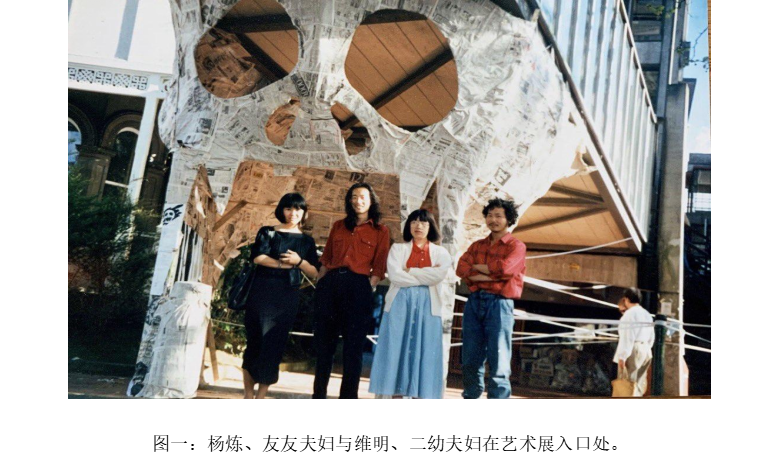
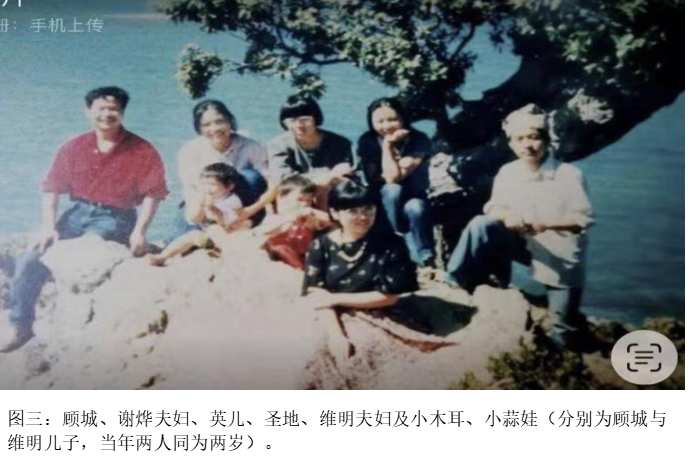
想当年,顾城一家、杨炼一家与我们一家,都定居在新西兰而成为好友。不想今天由超华转来杨炼夫妇在37年前和我们一起在新西兰的合影!这是我们共同举办“面对死亡坚持生命”的行为艺术展上,在奥克兰大学入口处,我用报纸糊了一个大骷髅作为艺术展的入口,合影留念就在此入口处。
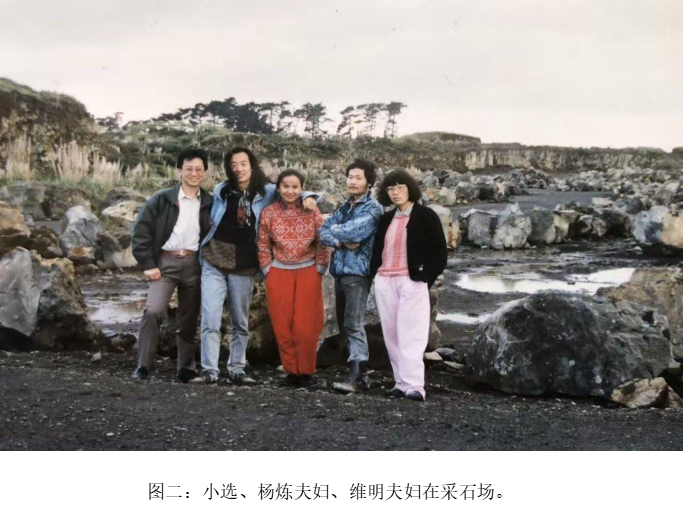
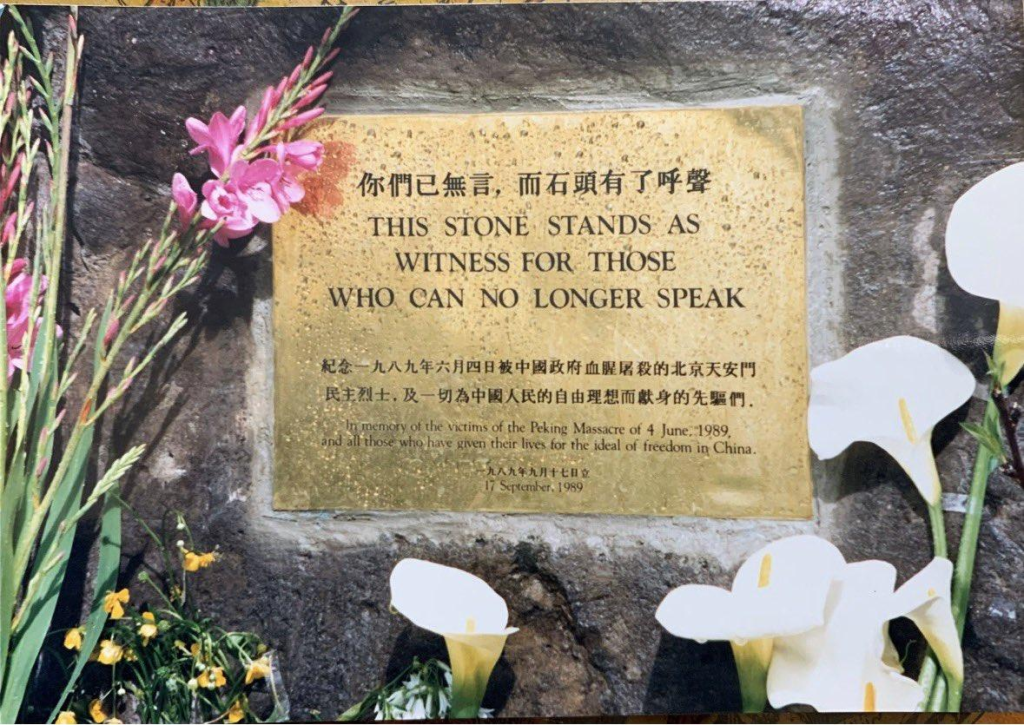
想当年大家风华正茂,我们还一起去采石场,购买了一块深红色中国地图形状的花岗岩石头,做64纪念碑用。当石场老板知道我们用意后,把石头送给了我们。
当时我们选用了杨炼的名句“你们已无言,而石头有了呼声!”,当时顾城也写下了「你们死于春天」,我们认为太诗意不够有力而放弃。我还设计制作了十几座血淋淋的雕塑……
今天,有些人已经「两片叶子同时落下」而离世;也有人当了国会议员,从政成功;也有人成了学者教授;也有人投了共而挣得盆满钵满、飞黄腾达;也有人出卖灵魂,当了中共的线人……而我离开了有“白云之乡”美称的第二故乡新西兰,来到了北美的莫哈维沙漠,并重操雕塑旧业,领着一帮甘愿吃苦的义工,把我的记忆和思绪进行固化……
When Stones Found Their Voice — Recollections from New Zealand Thirty-Seven Years Ago and the Divergent Destinies of a Generation
Author: Chen Weiming Editor: Huang Jizhou Proofreader: Mao Yiwei Translator: Lyu Feng
Abstract:“When stones found their voice” refers to the act of preserving memories and voices that could not be spoken or were suppressed—through commemoration and artistic creation—so that the silenced may continue to speak and history is not forgotten.
A few days ago, Liu Jun—the father of an Olympic figure skating champion—came to Los Angeles to give a lecture. At the pre-lecture dinner, several prominent figures from the student movement who had once been on wanted lists, including Wang Dan and Wang Chaohua, were present. Sister Chaohua now resides in the United Kingdom. While discussing people and events from those years, I asked her to convey my regards to Yang Lian and his wife.
Back then, the family of Gu Cheng, the family of Yang Lian, and my own family all settled in New Zealand, where we became close friends. Unexpectedly, through Chaohua, I recently received a photograph taken thirty-seven years ago of Yang Lian and his wife together with us in New Zealand. It was taken at the entrance of the University of Auckland during a performance art exhibition we jointly organized titled “Facing Death, Upholding Life.” At the entrance, I had constructed a large skull using pasted newspapers as part of the installation, and the photograph was taken there.
In those days, we were all in the prime of youth. We even went together to a quarry, where we purchased a deep-red granite stone shaped like the map of China, intended as a June Fourth memorial monument. When the quarry owner learned of our purpose, he donated the stone to us.
At the time, we chose a famous line by Yang Lian: “You have fallen silent, but the stones have found their voice.” Gu Cheng also wrote, “You died in spring,” but we felt it was too poetic and not forceful enough, and thus did not adopt it. I went on to design and produce more than a dozen blood-streaked sculptures…
Today, some people have already “fallen like two leaves at once” and passed away; some have become members of parliament and found success in politics; some have become scholars and professors; some have aligned themselves with the authorities and amassed great wealth and status; others have sold their souls and become informants for the Chinese Communist Party…
As for me, I left my second homeland, New Zealand—known as the “Land of the Long White Cloud”—and came to the Mojave Desert in North America. There, I resumed my work as a sculptor, leading a group of volunteers willing to endure hardship, solidifying my memories and reflections into enduring forms.
愿你平安,圆满,不必流浪
侯改英-愿你平安-rId5-1179X1720.png?w=768&resize=768,0&ssl=1 "愿你平安,圆满,不必流浪")
——献给我的小学老师蔡荣生
作者:侯改英 编辑:黄吉洲 校对:程筱筱 翻译:吕峰
摘要:笔者生于河北太行山偏远山区,此文记录缅怀在我村义务支教10多年,后被我村聘为临时老师多年,最终年老家庭变故陷入困境,但因为不是中共编制内教师拿不到退休金导致其与孤儿孙女生活艰难陷入赤贫的故事。后我村村民集体联名请愿才使她勉强得到公正。但正义已晚,正式编制待遇仅仅消受不足一年,便撒手人寰,留下孙女被县孤儿院收容。
侯改英-愿你平安-rId5-1179X1720.png "愿你平安,圆满,不必流浪")
蔡荣生是一位女士,在我以黑户身份返乡入村里小时,她就已经在我们村做临时老师好多年了,具体多少年我也不知道,但她在教我三年后又教了我弟弟三年,至少在我上初中时她一直在我们村支教。
她是一位中年女人,教我的时候约30多岁,白净整齐,戴着那个年代鲜有的金丝眼镜,齐耳短发,身材微胖,常年穿庄重或黑或灰套装制服,中性皮鞋,声音偏低沉,看起来感觉起来都像一个男人。
她说话慢,坚定,清晰,眼神犀利,整个人透着那个年代在农村极少见的文化人的睿智儒雅。她一条腿有一点微跛,走路左右摇晃摆幅较大,再搭配她常背着手微微驼背检查学生背诵功课的体态时,看起来跟我爸一样是一个与众不同非常优秀的——男人。
听说她婆家在短短的二里山路外的隔壁村,但她似乎没有家,她常年住在学校,独来独往,除了教学外几乎不跟村民攀谈。
她的工资因为不是正式教师,一直由我们村大队象征性的每月发二十块钱。她也没有地,无法种粮种菜,所以不得已她工资不足以果腹时,她会让学生每人带一点小麦谷子,冬天太冷时,她也会让学生带玉米轴(褪了玉米粒后的那个玉米棒)在教室生火取暖。
她最偏爱我,除了借书给我,有一次还叫我帮忙给她冷风倒灌的卧室窗户糊毛头纸。于是我有幸瞥见了她的卧室:逼仄,昏暗,我看到了火炉,桌子上的碗筷,也看到了挤在一起的单人床和放在其下的尿盆……虽然收拾的很整齐,但看着很憋屈。
我当时的感受是有些不适应,强烈的反差,让我觉得不真实,因为我的老师看起来那么优秀,儒雅,精致而有尊严……
我们村的学校是几所破房子,她的卧室是其中一间约6个平方,囊括了她的整个饮食起居,还有一间则是她不知从哪里带回来的许多童书堆砌成的图书室,是她对偏爱学生的福利。比如我,她常让我进去挑书借书给我看。
这就是我的学校,也是她的城堡和象牙塔。
没错,在我童年的记忆中,她是一位男老师。
蔡荣生——这名字听起来也挺像男人的。
我在村学校只上到三年级,后来我跟我弟长大在外上初中时,也不再跟老师有联络。听村民说蔡老师的二儿子二十七八岁,刚结婚没几年被自家房顶上塌方的黄土砸断了脊柱,变成植物人了……然后老婆跑了,蔡老师只好告别教师生涯回家照顾二儿子。
然后普通人的岁月在残酷的中国社会野萍般地离散沉浮。
一晃多年过去,许多人分开后相别相忘于茫茫人海,从来没想过上次对视竟然是今生的最后一面。
2022年,我开始在破碎的婚姻里挣扎,我从城市回老家给我爸上坟,听我舅说,蔡老师的大儿子车祸死了。我当时心里一紧,我问他,蔡老师怎么样了?我舅说,她命苦啊,小儿子她伺候了这么多年,前年刚去了。现在留下老大家的一个小孙子,这日子怎么过啊?
我当时真的很难受,真的很有冲动想去她的家看她一下,但是想着自己也做不了什么,我当时也挣扎在自杀的边缘,曾一次次的想了结生命,我满脸的颓废和破碎的心……,我自惭形秽,觉得自己没脸去,我曾是她最爱的学生,她的那么那么的骄傲,我们村的人都知道。
所以我没去看她,我觉得等我有时间调整回来,看起来不那么狼狈了,我再去。因为我对自己失望,无法面对她。
然后又过了一年,我陷于四面楚歌,六亲断绝的境地,又因为跟教育局,前夫,村委,派出所等的僵持,压力和恐惧过载罹患了很严重的神经疾病,手抖的几乎无法拿筷子,那时我跟我妈为数不多的电话中,她给我说从我舅那听来的村里的八卦,我以前是从来不听的,但她突然大骂共产党,她说村里正在联名给教育局写信,蔡老师现在生活极度贫困,而教育局因为她不是正式编制老师,不给她发退休金还是说退休金不是正式编制的标准来着,具体记不清了,引起了我们村村民的愤怒,大家都很气愤纷纷联名上书教育局,要求善待蔡老师,具体结果还不知道。然后我妈又骂政府没人性……
我心中泛起一阵酸楚,湿了眼睛,心疼她,也为我自己的无能。
2024年,当我抱要么死去要么重生的决心带着俩娃坐着渐行渐远离开故土的火车出发时,我流了最后一次泪。
擦干泪,我给我姐电话想让她帮我给蔡老师带点钱,替我去看看她。我姐不等我话说完,说,蔡老师去世了,她也是刚知道,听大舅说的。
蔡老师也教过她和我大姐,她也是她们俩的老师。
然后她也一阵感慨,她说好在好像村民联名上书迫使教育局给蔡老师转正了……
然后她又轻轻说,又有什么用呢,这才不到一年……
我压着眼泪匆匆挂断了电话,然后在火车的厕所里压抑的哭了一场。当时的眼泪不知是哭自己还是为她,可能都有吧。
我这一走是永远的跟故土告别,告别那些山水树木,鱼鸟花虫……我爱的山河故土,自然万物……只不过它们也和我一样痛苦,不得解脱,而我无能为力。
我悄悄的离开,没有跟任何人告别。
在渐渐模糊远去的故乡里,我在乎的人都消逝于暴政的桎梏之中,我的父亲,我的老师…我为自己的无能无力感到深深的遗憾。
好在我还能带走我仅有的,珍爱的——我的孩子。
擦干最后一滴泪,我踏上了征途。
侯改英2026年3月9日于纽约
原文发表于作者侯改英的X帐户,原文链接
https://x.com/hgylucky2017/status/2032839224492216331?s=20
May You Be Safe, Fulfilled, and No Longer Wandering— Dedicated to My Primary School Teacher, Cai Rongsheng
Author: Hou GaiyingEditor: Huang JizhouProofreader: Cheng XiaoxiaoTranslator: Lyu Feng
Abstract:The author was born in a remote mountainous region of the Taihang Mountains in Hebei Province. This essay documents and commemorates a teacher who voluntarily provided education in the author’s village for more than a decade, and was later employed there as a temporary teacher for many years.
In her later life, due to family misfortunes, she fell into hardship. Because she was not formally included within the state-sanctioned teaching system, she was ineligible for a pension. As a result, she and her orphaned granddaughter lived in severe poverty.
Only after a collective petition by the villagers was she able to obtain a measure of justice. However, that justice came too late. She was able to receive the benefits of formal employment status for less than one year before passing away. Her granddaughter was subsequently taken in by the county orphanage.
Cai Rongsheng was a woman. By the time I returned to my village as an undocumented child, she had already been working there as a temporary teacher for many years. I do not know exactly how long, but she taught me for three years, and then taught my younger brother for another three. At the very least, she remained teaching in our village until I had gone on to middle school.
She was a middle-aged woman, in her thirties when she taught me. Fair-skinned and neatly dressed, she wore the kind of gold-rimmed glasses that were rare in those days. Her hair was cut short, just to the ears. She had a slightly plump build and dressed year-round in solemn black or gray suits, paired with neutral leather shoes. Her voice was low and deep. In both appearance and bearing, she felt almost like a man.
She spoke slowly, firmly, and clearly. Her gaze was sharp. Her whole being carried the wisdom and refined dignity of an intellectual—something rarely seen in rural areas of that era. One of her legs had a slight limp, and when she walked, her body swayed noticeably from side to side. When she inspected students reciting lessons, she would often clasp her hands behind her back, slightly hunched. In those moments, she looked—much like my father—to be an extraordinary and remarkable man.
I heard that her husband’s family lived in the neighboring village, only about two li (roughly one kilometer) away. But she seemed to have no real home. She lived at the school year-round, keeping to herself, rarely speaking with villagers outside of teaching.
Because she was not an officially appointed teacher, her salary was merely symbolic—twenty yuan a month, paid by the village collective. She had no land to cultivate, no way to grow food. When her income could not sustain her, she would ask each student to bring a little wheat or grain. In the harsh winter, she would also ask students to bring corn cobs—what remained after the kernels were removed—to burn in the classroom for warmth.
She favored me especially. Besides lending me books, she once asked me to help paste paper over her bedroom window to block the cold drafts. That was when I caught a glimpse of her living space: cramped and dim. I saw the stove, the bowls and chopsticks on the table, and the narrow single bed pressed tightly against other belongings, with a chamber pot tucked underneath. Everything was tidy, but the space felt suffocating.
At the time, I felt a sense of discomfort—a stark contrast that seemed almost unreal. My teacher appeared so refined, dignified, and composed… yet her living conditions were so harsh.
Our village school consisted of a few dilapidated buildings. Her bedroom, about six square meters in size, contained her entire daily life. Another room had been turned into a small library, filled with children’s books she had somehow gathered. This was her gift to the students she favored. For example, she often allowed me to enter and borrow books.
This was my school. It was also her castle—her ivory tower.
Yes, in my childhood memory, she was a male teacher.
Even her name—Cai Rongsheng—sounded like a man’s.
I only studied at the village school until third grade. Later, my brother and I left for middle school elsewhere, and we lost contact with her. I later heard from villagers that her second son, in his late twenties and newly married, had been crushed by a collapse of earthen roofing at home, breaking his spine and leaving him in a vegetative state. His wife left. Teacher Cai had no choice but to give up her teaching career to care for him.
And so, like wild duckweed drifting in a harsh current, an ordinary life was scattered and tossed about in the brutal tides of Chinese society.
Years passed in a blur. People parted ways, disappearing into the vast sea of humanity, never realizing that the last glance they shared would be the final one in this lifetime.
In 2022, as I struggled through the wreckage of my marriage, I returned from the city to my hometown to visit my father’s grave. My uncle told me that Teacher Cai’s eldest son had died in a car accident. My heart tightened. I asked him, “How is she now?” He sighed and said, “Her life is bitter. She cared for her younger son for all those years, and he passed away just the year before last. Now only her eldest son’s young child is left. How is she supposed to live like this?”
I felt deeply distressed. I had a strong urge to visit her, but I knew I could do nothing to help. At that time, I myself was hovering on the edge of suicide, repeatedly thinking of ending my life. I was consumed by despair and shame. I felt unworthy of seeing her—I had once been her favorite student, her pride, as everyone in the village knew.
So I did not go. I told myself that I would visit her after I had regained some stability—after I no longer looked so broken. I was too disappointed in myself to face her.
Another year passed. I found myself besieged on all sides, estranged from family, and locked in conflicts with the education bureau, my ex-husband, the village committee, and the police. The pressure and fear overwhelmed me, and I developed a severe neurological condition—my hands trembled so badly I could barely hold chopsticks. During one of my rare phone calls with my mother, she relayed gossip from the village—something I had never cared to hear before.
Suddenly, she began cursing the government. She said the villagers were collectively petitioning the education bureau. Teacher Cai was now living in extreme poverty, and because she had never been formally recognized as a state-appointed teacher, she was denied a proper pension. The injustice had angered the villagers, who jointly signed a petition demanding fair treatment for her. The outcome was still unknown. My mother continued to curse the authorities for their inhumanity.
A wave of sorrow rose within me. My eyes filled with tears—for her suffering, and for my own helplessness.
In 2024, when I left my homeland by train with my two children—determined either to die or to be reborn—I shed my final tears.
After wiping them away, I called my sister, asking her to bring some money to Teacher Cai on my behalf and to visit her for me. Before I could finish speaking, my sister said, “She has passed away. I just found out—from our uncle.”
Teacher Cai had also taught her and my elder sister.
My sister sighed and added, “At least it seems the villagers’ petition finally forced the education bureau to grant her official status…”
Then she said softly, “But what was the use? It lasted less than a year…”
I held back my tears and hurriedly ended the call. Then, in the train’s restroom, I broke down and cried in silence. I do not know whether I was crying for myself or for her—perhaps for both.
This departure marked my final farewell to my homeland—to its mountains and rivers, its trees, fish, birds, and flowers… the land I loved. Yet they, too, seemed trapped in suffering, unable to escape—and I was powerless to change anything.
I left quietly, without saying goodbye to anyone.
As my hometown faded into the distance, the people I cared about had all been consumed under the weight of oppression—my father, my teacher… I was left with a profound sense of regret for my own helplessness.
At least I could take with me the only thing I still cherished—my children.
After wiping away my final tear, I set out on my journey.
Hou GaiyingMarch 9, 2026, New York
Originally published on the author’s X account:https://x.com/hgylucky2017/status/2032839224492216331?s=20
论“爱国主义”的危害
作者:彭小亮
编辑:Geoffrey Jin 校对:王滨 翻译:彭小梅
剥削的本质是权力得不到约束,而不是所谓的地主、私有企业、民营经济。特斯拉、索尼、丰田等世界知名企业都是私营企业,没有权力撑腰的资本家才是真正的资本家,所以这些企业的工资高,福利待遇好。
真正好的法律是保障人权,选举、民主、司法独立、王在法下,保护私有产权,而在毛泽东时代,毛泽东做的事情是践踏私有财产,践踏人权,毛泽东从来没有制度建设,也没有私有化改革,而是一个人说了算,每天在家里自大,高傲,喊口号小麦亩产三万斤,造成中国六十年代初饿死数千万人。
为什么要希望一个强人来把国家治理好,而不是希望有良好的法律来把国家治理好呢!毛泽东只是杀的人多得来的皇帝位,搞闭关锁国和慈禧基本没有区别,现在中国的烂摊子就是毛泽东留下的后遗症。
所谓的社会主义公有制就是皇有制,所谓的资本主义私有制就是民有制。所谓的社会主义,站在心理学的角度就是不肯把公共资源分发给底层的老百姓,社会主义最终的结局就是集体贫穷和灾难!
中国现在想变好,唯一的道路就是产权改革,然后选举,让民众拿回属于自己的利益,然后引进国外石油,电力,通信、矿产等公司,进行市场竞争把资源价格降下来,然后像美国一样高速免费,让民众富裕起来,保护人权才是长治久安之道。
如果世界上只能存在一种歌颂祖国的声音,这个声音一定是奴役人民的声音。
社会主义公有制就是皇有和官僚所有制,资本主义私有制就是民有和百姓所有制度。
东方大国的皇帝吃着改革开放的饭,砸着改革开放的锅。
有人权讲人权的国家都是文明的发达国家,有主权讲特权的地方都是独裁专政封建皇有制国家。
如果一个人把一个凡人或组织捧上神坛,这个人一定会遭到吞噬,更有甚者可能会借用你孩子的器官为伟人续命。这个世界上不管是谁吃爱国主义这碗饭,他一定会被爱国主义反噬。
如果一个人高呼爱国主义,不是证明了他的伟大和英明,恰好证明了他的邪恶和懦弱。
有爱国主义的地方一定灾难深重,爱国主义泯灭人性践踏人权。
爱国主义的本质就是让你闭嘴,让你不要监督公权力,让权贵阶级随意骄奢淫欲,腰缠万贯。
每一个穷苦民众的心中都有一块裹脚布,这块裹脚布就是爱国主义。
人权思想和人权制度才能让社会长治久安,爱国主义独裁思想和制度永远走不出封建王朝更迭的悲惨命运。
贫穷和灾难的根源就是爱国主义,因为爱国主义的存在造成的后果是忽略人最基本的价值为皇权服务,是一种邪恶的法西斯思想。
如果人民是国家的主人,公务员只是仆人,人民不仅养活了自己还养活了仆人,让主人感恩仆人,这种思想行为模式真的需要进行反思。
西方现代民主法治国家,公务员不能从国家获得巨大利益,所以从来没有感恩教育,义务教育的课本也没有要求孩子们感恩国家,教育的内容是要求孩子们监督公权力,保障人权,避免社会进入贪腐的恶性循环里。
民主、自由派人群才是真正爱国人群,他们心胸开阔,他们一心想要吸引外资增加民众的就业岗位,他们希望国家公务员没有贪腐,他们希望国企没有垄断,民众可以平等就业,他们希望食品安全,民众能吃的放心,民众能被善良的对待。
反观那些口号爱国的盲从之人,他们抵制外资,减少民众的就业机会,他们对贪腐和不公视而不见,他们对糟糕的食品安全做闷头鬼,他们对走失的年轻孩子漠不关心,他们对农村弱势群体毫无善意,他们正在实践他们的人生格言沉默是金。
贪腐的根源其实就是产权没有明晰,民众几千年都没有属于自己的私有财产,哪怕是百姓的生命也是皇帝的私有财产。就是因为美国是完全私有制的国家,所以美国总统不能去贪污私人和民营企业的财产,这样就从制度上杜绝了贪腐。
美国有一整套完整的约束权力的法律、制度、思想、文化,从而告诉总统能做什么不能做什么,这样做的后果就是:哪怕是白宫常年失修,也需要总统自己私人掏腰包3亿美元来给政府修缮大楼,因为总统本能的知道这笔费用,有立法权的国会可能不会通过。
中国没有这样的法律制度,从秦皇汉武开始到今天,国家都是用野蛮暴力的方法武力夺取政权,所以都是秦始皇、刘邦、朱元璋、慈禧、毛泽东一个人说了算,说通俗一点,国家的所有公共资源本质上就是皇帝的私有财产,这样就永远停留在人治社会的贪腐中不停的挣扎、徘徊和轮回,不要说一个小民没有安全感,有可能皇帝也没有安全感。
所以人权才是保障社会能长治久安,每个人都能安全幸福活着的唯一方法。
让我们一起来回忆一下名人名言:
“跟着美国人混,有面包也有自由。跟着苏联混,有面包没有自由,跟着他们混,即没有面包也没有自由。”
——原北京大学校长中国驻美大使 胡适先生
“帮魔鬼唱赞歌,终将被魔鬼抛弃,成为魔鬼的祭品。”
——英国原首相 撒切尔夫人
“哪里有自由,哪里才是能生活的国家。”
——德国裔美国籍科学家 爱因斯坦
“财产不能公有,权力不能私有,否则人类将进入灾难之门。”
——英国经济学家 哈耶克
自由最大的敌人是:民族主义,是民粹思想,是法西斯,是特权和独裁,如果真正为了您的孩子着想,请站在自由一边,切勿站在民粹和独裁者一边,切勿站在公有制国家一边。
在爱国和爱民之间只能选择一个,爱国本质意义就是让孩子成为国家的炮灰,让孩子为国家服务;爱民的意义在于:国家只是物业公司,国家是服务民众的工具。
一个藏富于民的国家、保障人权、追求公平公正的国家才是正常国家,如果利益被少部分人瓜分,民众一贫如洗,民众的脑子被洗得一干二净,这样的国家就是法西斯的独裁国家。为人民服务,人民却一贫如洗,为人民服务的人却腰缠万贯,切勿让“为人民服务”成为表面宣传语。
一个13亿人都想做官的国家,官没有做成,最后大家都成了奴隶。民众没有属于自己的土地,他们承包着公有和集体的土地,民众没有自己的房子,居住着国家卖给他们的70年产权的房子。民众们吃着世界上最毒的食品,用着世界上最贵的汽油,交着世界上最贵的社保,缴纳着世界上最贵的房贷利息,死之前要把一生的财富贡献给医院。
中国共产党的权力阶层,个个都是数万亿资产,他们个个都是富可敌国,这些财富难道不是剥削民众所得吗,所以西方哲学家黑格尔说:中国非常适合奴隶制度,因为他们的思想决定了他们的社会制度。民众被自己的皇帝野蛮的剥削和压榨,这个就是大部分人贫穷的根本原因。
所谓的社会主义公有制,其本质上还是奴隶制和封建帝王制度。西方哲学家罗素、洛克、孟德斯鸠、哈耶克(诺贝尔经济学奖获得者)都有同样的思想表述:大部分人的公有制其实就是少部分人的私有制,少部分人霸占着公共资源,比如石油、通信、电力等,从而垄断和剥削民众,公有制是毁灭一切平等、人伦道德、文化良知的源头。所以私有制和私有产权才是人类文明发展的方向,是文明的基石,保护私有财产就是保护人权。
同胞们请行动起来,宣传私有制,宣传私有产权,抵制封闭式教育,宣传民主、自由、法治、人权,让我们的孩子生活在蓝天白云之下,生活在有爱、有尊严、幸福安康的世界里。
On the Harm of “Patriotism”
Author: Peng Xiaoliang
Editor: Geoffrey Jin. Proofreader: Wang Bin. Translator: Peng Xiaomei
Abstract:This article criticizes the tendency to instrumentalize patriotism, pointing out that exploitation stems from the lack of constraints on power rather than ownership itself. It emphasizes the importance of the rule of law, protection of property rights, and checks and balances of power. The article advocates replacing personal authoritarian rule with institutional construction, promoting development through reform and market mechanisms, and warns against the suppression of individual rights and social progress by a monolithic patriotic discourse.
The essence of exploitation is that power is not constrained, rather than so-called landlords, private enterprises, or the private economy. Companies such as Tesla, Sony, and Toyota are all well-known private enterprises. Capitalists without the backing of power are the real capitalists; therefore, these companies offer high wages and good benefits.
Truly good laws are those that protect human rights, elections, democracy, judicial independence, the supremacy of law over rulers, and the protection of private property. In contrast, during the Mao Zedong era, Mao trampled on private property and human rights. Mao never engaged in institutional construction or privatization reform; instead, everything was decided by one person. He stayed at home, arrogant and self-important, shouting slogans such as “30,000 jin of grain per mu,” which led to tens of millions of deaths by starvation in China in the early 1960s.
Why should people hope for a strongman to govern the country well, instead of hoping for good laws to govern the country? Mao Zedong only obtained his “imperial position” by killing large numbers of people. His policies of isolation were essentially no different from those of Empress Dowager Cixi. The current mess in China is the aftermath left behind by Mao Zedong.
The so-called socialist public ownership is imperial ownership, while so-called capitalist private ownership is people’s ownership. From a psychological perspective, socialism essentially means refusing to distribute public resources to ordinary people at the grassroots level. The ultimate outcome of socialism is collective poverty and disaster.
If China wants to improve, the only path is property rights reform, followed by elections, allowing the people to reclaim their own interests. It should introduce foreign companies in sectors such as oil, electricity, telecommunications, and mining, promote market competition to lower resource prices, and implement policies such as free highways like in the United States, so that people can become prosperous. Protecting human rights is the only path to long-term stability.
If there is only one voice in the world that praises the country, that voice must be one that enslaves the people.
Socialist public ownership is essentially imperial and bureaucratic ownership, while capitalist private ownership is ownership by the people.
The emperor of the “Eastern great nation” eats from the bowl of reform and opening up while smashing the very pot of reform and opening.
Countries that speak of human rights are civilized and developed nations; places that emphasize sovereignty and privilege are dictatorial, authoritarian, and feudal imperial systems.
If a person elevates an ordinary individual or organization to a godlike status, that person will inevitably be devoured, and in extreme cases may even have their child’s organs taken to prolong the life of a so-called great figure. Anyone who lives off patriotism will ultimately be devoured by it.
If a person loudly proclaims patriotism, it does not prove their greatness or wisdom; it instead reveals their evil and cowardice.
Wherever there is patriotism, there will be deep disaster. Patriotism destroys humanity and tramples on human rights.
The essence of patriotism is to make you remain silent, to prevent you from supervising public power, and to allow the privileged class to indulge in luxury and accumulate vast wealth.
In the heart of every poor person, there is a piece of foot-binding cloth; that cloth is patriotism.
Only human rights thinking and systems can ensure long-term social stability. Patriotic authoritarian ideology and systems will never escape the tragic cycle of feudal dynastic change.
The root of poverty and disaster is patriotism. Because of patriotism, people ignore their most basic value and serve imperial power. It is an evil fascist ideology.
If the people are the masters of the country and civil servants are merely servants, then the people not only support themselves but also support the servants. Yet making the masters feel grateful to the servants—this kind of thinking and behavior truly needs reflection.
In Western modern democratic and rule-of-law countries, civil servants cannot gain enormous personal benefits from the state. Therefore, there is no “gratitude education,” and textbooks in compulsory education do not require children to be grateful to the state. Instead, education teaches children to supervise public power, protect human rights, and prevent society from falling into a vicious cycle of corruption.
Those who are democratic and liberal are the truly patriotic people. They are broad-minded. They want to attract foreign investment to increase employment opportunities. They hope that government officials are free from corruption, that state-owned enterprises do not monopolize, that people can have equal employment opportunities, that food safety is ensured, and that people can live with peace of mind and be treated with kindness.
In contrast, those who blindly chant patriotic slogans resist foreign investment and reduce employment opportunities. They turn a blind eye to corruption and injustice. They remain silent about poor food safety. They are indifferent to missing young people. They show no kindness toward vulnerable rural groups. They live by the motto: silence is golden.
The root of corruption is actually unclear property rights. For thousands of years, the people have not had their own private property; even their lives have been treated as the private property of the emperor. Because the United States is a country of complete private ownership, the president cannot embezzle private or corporate property. Thus, corruption is eliminated at the institutional level.
The United States has a complete system of laws, institutions, ideas, and culture to restrain power, clearly defining what the president can and cannot do. As a result, even if the White House falls into disrepair, the president must personally pay hundreds of millions of dollars to repair it, because the president knows that such expenses may not be approved by Congress, which holds legislative power.
China does not have such a legal system. From Qin Shi Huang to today, power has been seized through violence. Therefore, whether it is Qin Shi Huang, Liu Bang, Zhu Yuanzhang, Empress Dowager Cixi, or Mao Zedong, one person has always made all decisions. In simple terms, all public resources of the country are essentially the private property of the emperor. This leads to an endless cycle of corruption under rule by man. Not only do ordinary people lack security, even the ruler himself may lack security.
Therefore, human rights are the only way to ensure long-term stability and allow everyone to live safely and happily.
Let us recall some famous quotations:
“Follow the Americans, and you will have both bread and freedom. Follow the Soviets, and you will have bread but no freedom. Follow them, and you will have neither bread nor freedom.”— Hu Shi, former president of Peking University and Chinese ambassador to the United States
“Those who sing praises for the devil will ultimately be abandoned by the devil and become its sacrifice.”— Margaret Thatcher, former Prime Minister of the United Kingdom
“Where there is freedom, that is the country where one can live.”— Albert Einstein
“Property must not be public, and power must not be private; otherwise, humanity will enter the gate of disaster.”— Friedrich Hayek
The greatest enemies of freedom are nationalism, populism, fascism, privilege, and dictatorship. If you truly care about your children, stand on the side of freedom, and do not stand with populism, dictators, or public-ownership states.
Between loving the country and loving the people, only one can be chosen. Loving the country essentially means turning children into tools of the state; loving the people means the state is merely a service provider—a tool to serve the people.
A normal country is one that stores wealth among the people, protects human rights, and pursues fairness and justice. If wealth is monopolized by a small group, the people are impoverished, and their minds are completely indoctrinated, then such a country is a fascist dictatorship. “Serving the people” should not become mere propaganda, where the people remain poor while those who claim to serve them accumulate vast wealth.
In a country of 1.3 billion people where everyone wants to become an official, if they fail, they all become slaves. People do not own land; they merely contract collective land. They do not own homes; they live in houses sold to them with 70-year property rights. They consume the most toxic food, use the most expensive fuel, pay the highest social security costs, and bear the highest mortgage interest. Before death, they must hand over their lifetime savings to hospitals.
The ruling class of the Chinese Communist Party possesses assets worth trillions, each of them extremely wealthy. Are these not obtained through exploitation of the people? Thus, the Western philosopher Hegel said that China is well suited for slavery, because its people’s thinking determines its social system. The people are brutally exploited and oppressed by their rulers—this is the fundamental reason why most people are poor.
The so-called socialist public ownership is essentially still a form of slavery and feudal imperial rule. Western philosophers such as Russell, Locke, Montesquieu, and Hayek (Nobel laureate in economics) all expressed similar ideas: public ownership for the majority is private ownership for a minority. A small group monopolizes public resources such as oil, telecommunications, and electricity, exploiting the people. Public ownership destroys equality, morality, and cultural conscience. Therefore, private ownership and private property rights are the direction of human civilization and its foundation. Protecting private property is protecting human rights.
Compatriots, act. Promote private ownership, promote private property rights, resist closed education, and advocate democracy, freedom, rule of law, and human rights. Let our children live under blue skies and white clouds, in a world of love, dignity, happiness, and well-being.
中国民主党洛杉矶地区举行第782次茉莉花行动
黄吉洲-rId4-2048X1153.jpeg?w=768&resize=768,0&ssl=1 "中国民主党洛杉矶地区举行第782次茉莉花行动")
——抗议《民族团结进步促进法》
作者:黄吉洲
编辑:Geoffrey Jin 校对:王滨
洛杉矶,2026年3月22日 —— 周日下午4时,中国民主党洛杉矶地区党员组织华裔群体在中共驻洛杉矶领事馆前举行第782次茉莉花行动,主题为“抗议《民族团结进步促进法》!抵制中共马列同化灭绝政策!捍卫少数民族与汉语方言、地域文化!”
活动由黄吉洲发起,现场负责人为倪世成、卓皓然,陈信男负责秩序维护。
参加党员包括倪世成、黄吉洲、卓皓然、孔祥庆、吴腾辉、陈信男、卢超。
参与者高举标语,高呼“废除恶法!”、“停止文化灭绝!”、“抢救方言与地域文化!”、“马列不是中华!还我多元传统!”、“中国共产党下台!”,他们强调“中共马列
主义 ≠ 中国文化,强制同化 ≠ 民族团结”,呼吁各少数民族团体、方言保护组织及海外华人社团联合行动,通过现场抗议与网络传播表达反对。
活动背景指出,2026年3月12日通过的《民族团结进步促进法》(7月1日起施行)以马列主义为指导,核心条款包括强制幼儿园起普通话主导教学、推动跨民族通婚、禁止维护母语/信仰/习俗(定性为“破坏团结”)等。批评者认为,该法将新疆再教育营、西藏寄宿学校、内蒙古禁蒙语等政策全面合法化,同时加速汉族内部粤语、上海话、闽南语等方言及地方戏曲、民歌、地域文化的消失,是对中华多元根基的摧毁。
孔祥庆(客家人)在演讲中表示,自己是最后一代能流利讲客家话的人,批评中共通过“大一统”手段润物细无声地强制同化中国人,并指出该法否定了1984年《民族区域自治法》,法律自相矛盾。
黄吉洲演讲称,说自己的语言、用自己的文字是基本人权,该法本质上是针对少数民族的文化种族灭绝,是严重的反人类罪行。他抨击中共政权从未把人当人看待,只把百姓当成“燃料、耗材”,所以漠视基本人权,并呼吁终结暴政,胜利终将属于追求自由的世代。
李亚辉表示没有共产党的中国会更好。我们需要多样化,拒绝同质化。他认为中共政府的法律不是真正的法律,而是统治工具。
活动参与者呼吁拒绝沉默,各族各地区人民团结起来,为母语、信仰和地域根基而战。
黄吉洲-rId4-2048X1153.jpeg "中国民主党洛杉矶地区举行第782次茉莉花行动")
The Chinese Democracy Party Los Angeles Chapter Holds the 782nd Jasmine Action
—— Protest Against the “Law on Promoting Ethnic Unity and Progress”
Author: Huang Jizhou
Editor: Geoffrey Jin Proofreader: Wang Bin Translator: Peng xiaomei
Abstract:On March 22, 2026, members of the Chinese Democracy Party in Los Angeles held a “Jasmine Action” in front of the Chinese Consulate, protesting the “Law on Promoting Ethnic Unity and Progress,” accusing it of promoting forced assimilation and suppressing ethnic minorities and dialect cultures. Participants expressed dissatisfaction with CCP policies through speeches and slogans, emphasizing that language and cultural rights are fundamental human rights, calling for opposition to cultural homogenization and centralized rule, and advocating diversity and freedom.
Los Angeles, March 22, 2026 — At 4:00 p.m. on Sunday afternoon, members of the Chinese Democracy Party Los Angeles chapter organized members of the Chinese community to hold the 782nd Jasmine Action in front of the Chinese Consulate in Los Angeles, with the theme:“Protest the ‘Law on Promoting Ethnic Unity and Progress’! Resist the CCP’s Marxist-Leninist assimilation and extermination policies! Defend ethnic minorities, Chinese dialects, and regional cultures!”
The event was initiated by Huang Jizhou, with Ni Shicheng and Zhuo Haoran serving as on-site coordinators, and Chen Xinnan responsible for maintaining order.
Participating party members included Ni Shicheng, Huang Jizhou, Zhuo Haoran, Kong Xiangqing, Wu Tenghui, Chen Xinnan, and Lu Chao.
Participants held banners high and shouted slogans such as:“Abolish the evil law!”,“Stop cultural extermination!”,“Rescue dialects and regional cultures!”,“Marxism-Leninism is not China! Return our diverse traditions!”,“Chinese Communist Party step down!”
They emphasized that:“CCP Marxism-Leninism ≠ Chinese culture, forced assimilation ≠ ethnic unity,”and called on various ethnic minority groups, dialect preservation organizations, and overseas Chinese communities to take joint action, expressing opposition through on-site protests and online dissemination.
The background of the event points out that the “Law on Promoting Ethnic Unity and Progress,” passed on March 12, 2026 (to take effect on July 1), is guided by Marxism-Leninism. Its core provisions include:mandatory Mandarin-dominant teaching starting from kindergarten,promotion of interethnic marriage,and prohibition of maintaining mother languages, beliefs, and customs (defined as “undermining unity”), among others.
Critics believe that this law fully legalizes policies such as re-education camps in Xinjiang, boarding schools in Tibet, and the banning of Mongolian language in Inner Mongolia. At the same time, it accelerates the disappearance of internal Han dialects such as Cantonese, Shanghainese, and Minnan, as well as local operas, folk songs, and regional cultures, constituting a destruction of the pluralistic foundation of Chinese civilization.
Kong Xiangqing (a Hakka speaker) stated in his speech that he is the last generation able to speak Hakka fluently. He criticized the CCP for using “great unification” methods to impose assimilation on Chinese people in a subtle and pervasive manner and pointed out that the law negates the 1984 “Regional Ethnic Autonomy Law,” making the legal system self-contradictory.
Huang Jizhou stated in his speech that speaking one’s own language and using one’s own writing system are basic human rights. He said that the law is essentially cultural genocide against ethnic minorities and constitutes a serious crime against humanity. He criticized the CCP regime for never treating people as human beings, but only as “fuel and consumables,” thus ignoring basic human rights. He called for an end to tyranny, stating that victory will ultimately belong to generations that pursue freedom.
Li Yahui stated that China would be better without the Communist Party. We need diversity and must reject homogenization. He believes that the laws of the CCP government are not true laws, but instruments of rule.
Participants in the event called for rejecting silence and urged people of all ethnic groups and regions to unite and fight for their mother languages, beliefs, and regional foundations.
洛杉矶 4月5日 《全球觉醒》第六十六期 国际良心日 释放良心犯


《全球覺醒》第六十六期
自由之鐘 時刻敲響 全球覺醒 民主聯盟 消滅獨裁 推翻暴政
活動主題:國際良心日,釋放良心犯
又是清明雨紛紛,今天我們站在領館門前,祭奠的是那些在中共黑暗牢籠中被折磨、被失蹤、甚至被活活虐殺的良心同胞! 4月5日,不僅是清明節,更是聯合國「國際良心日」。在這個呼喚良知、清算罪惡的時刻,我們呼籲中共釋放要為那些被高牆隔絕、被數字抹除的中國良心犯。
王炳章,海外民運先驅,數十年來為中國的民主而戰,現被中共判終身監禁。高智晟,這位“中國的良心”,被失踪至今已近九年,生死不明;黎智英,年近八旬仍被囚禁在香港鐵窗後,寧折不彎。這些民族的脊梁,卻遭遇殘酷的肉體摧殘。從兩會期間因醫療虐待慘死的楊立,到長期被關進精神病院實施「社會性謀殺」的李宜雪,中共正試圖用「數位禁錮」抹去他們的功勳,用黑監獄終結他們的生命。這不僅是對生命的殘殺,更是對文明底線的公然褻瀆!
我們絕不接受被閹割的記憶!在“國際良心日”,我們呼籲全球清算中共的血債。我們大聲疾呼,就是要拆穿中共的虛假繁榮,撕碎數字枷鎖。清明祭奠,祭的是英魂,招的是民氣!辣椒水噴不滅自由的火種,黑監獄關不住正義的呼喚。
我們要讓高智晟回家!我們要讓王炳章、黎智英自由!血債終將清算,所有被禁錮、被消音的靈魂,終將在民主中國獲得真正的安息!
我們的口號:
我們要良知 不要暴政!
中共不倒 冤魂不散!
獨裁不滅 正義難尋!
國際良心日,釋放良心犯
時間:2026年4月5日(星期日)3:30PM (下午)
地點:中共駐洛杉磯總領館
地址:443 Shatto Pl, Los Angeles, CA 90020
活動召集人:廖军/劉廣賢
活動規劃: 孫曄/ 周蘭英
活動主持:易勇
組織者:
胡月明4806536918/穆偉6265670518
楊郭軍6263713274/粱振华626 828 9079
孔德翠6265588877/ 于越 6266498381
活動義工:于海龍 /李錦華/陳健 / 張健/范强/陈文辉/劉紹陽
攝影:Ji Luo /劉樂園
主辦單位:
中國民主黨聯合總部美西黨部
中國民主黨聯合總部美南黨部
自由鐘民主基金會